Jason Ross

PhD Philosophy & Psychoanalysis

Reclining into the emerging

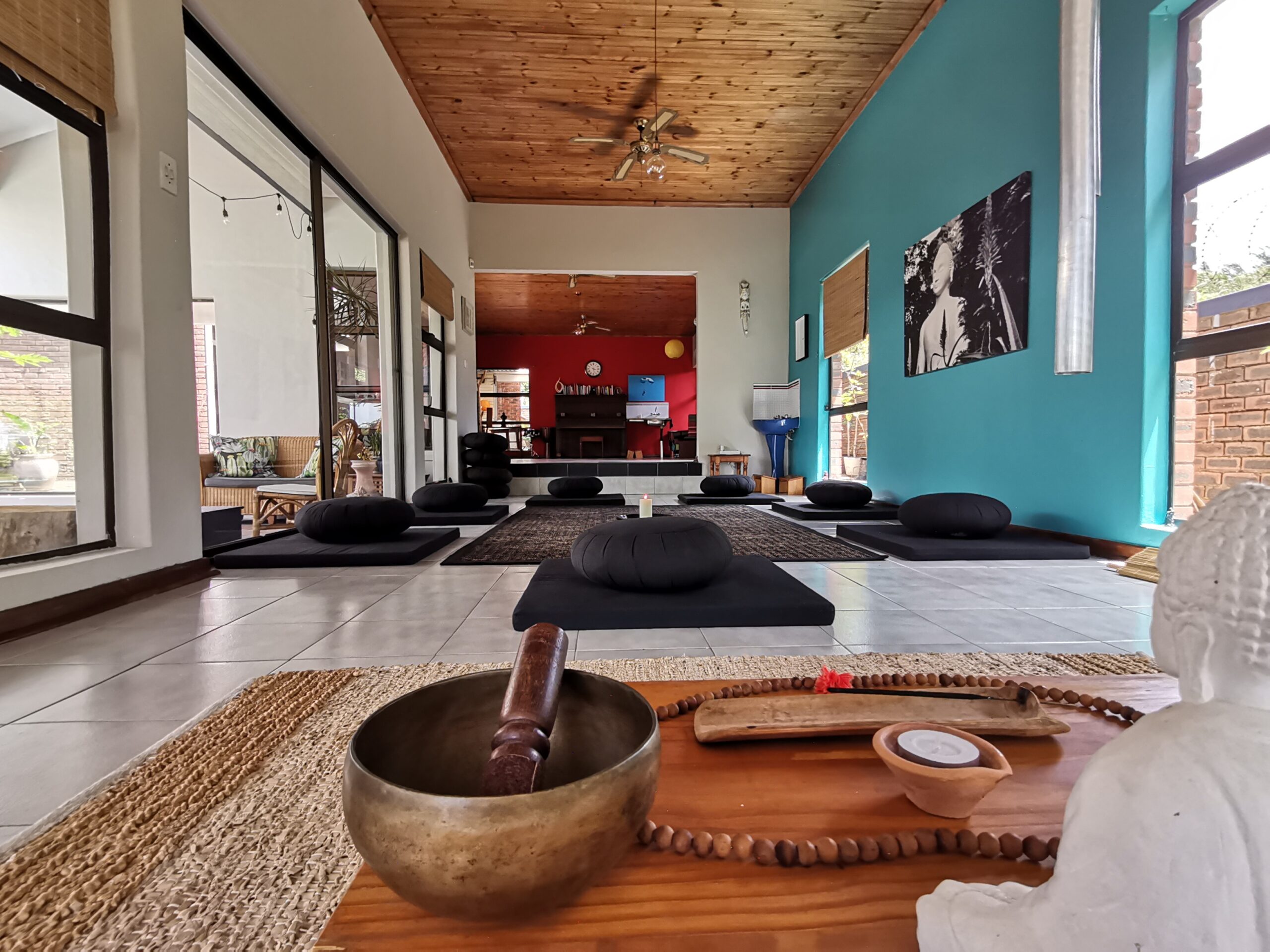
The new home of existential analysis in Cape Town is finally taking shape. Even though I am far from a traditionally trained psychoanalyst, many of my clients have shared the fantasy of being able to just lie down and speak freely – to just be for a moment. This very fantasy of being able to say everything that could be said or needs to be said, is the very fantasy of psychoanalysis. This fantasy is perhaps most accurately represented by the psychoanalytic motif – the “chaise longue” (French for “long chair”) – an object with a fascinating story of its own.

We can imagine as far back as 7th Century B.C., an Assyrian King reclining on a sofa in what is now modern-day Iran, while feasting in celebration of a great victory. Reclining to eat or recount conquests was a marker of one’s elite status: you needed enough servants, enough space, and enough security to lie down like this in public. The Greeks and Romans adopted this reclining habit for their symposion – banquets that focused on drinking wine, conversation, and intellectual debate. Reclining became an increasing symbol of social status and masculinity.

The “Garden Party” relief from Nineveh, depicting the Neo-Assyrian queen Libbali-sharrat (left) dining with her husband, the king Ashurbanipal (right; r. 669–631 BC)

This trend went out of fashion in the Middle Ages but made its comeback in 18th century France. Reclining was, however, no longer a male endeavour but a feature saved for aristocratic women’s private chambers. The luxury and even performance of rest became an ideal that spread across upper class Europe. This is where the actual pieces of furnishing designed for such activity became popularised amongst those who could afford it.

The long chair got its most famous cultural boost in 1800, when the painter Jacques-Louis David depicted a 23-year-old socialite, Madame Récamier, seductively reclining on one, her feet bare. With her feet bare, the painting became a scandal and the gradual sensation of the work (bought by the Louvre) led the chaise longue to become something of an object of desire, femininity, and a certain transgressive sensuality.

Jacques-Louis David, Portrait of Madame Récamier, 1800, Louvre Museum, Paris. Public domain image

The Victorians moved the chaise longue out of the boudoir and into their over-furnished living rooms, where it served a new function – to catch women fainting from the physical restrictions of their corsetry. As a result, the Victorian “long chair” was now the fainting couch, with a particular design: featuring a single back with one high, curved arm – the perfect backdrop for a dainty arm as the lady in question wilted. You can therefore tell a Victorian chaise longue by this particular shape. Its design not only aestheticized collapse but became an object that supported the oppressive social norms imposed on women.

This is where its use in psychoanalysis became interesting. Freud was apparently gifted a chaise longue by his patient Madame Benvenisti. He covered it with a Qashqa’i rug – a carpet originating in southwestern Iran – and some pillows for comfort. The reclining position was first used for hypnosis but following a particularly stubborn patient, a wealthy woman named Fanny Moser, who preferred to talk rather than give into hypnosis, a new method was gradually discovered: Freud found that patients were more relaxed, open, and receptive when they lay down, facing away from him. This physical arrangement – the patient reclined, relaxed enough to be somewhere between sleep and wakefulness, and unable to see the analyst – seemed to allow things usually pushed away to surface. In this way, the chaise longue was no longer just a Victorian piece of furniture but an integral part of methodology and a particular mode of relating.

“There was always a feeling of sacred peace and quiet here. The rooms themselves must have been a surprise to any patient, for they in no way reminded one of a doctor’s office but rather of an archaeologist’s study… Everything here contributed to one’s feeling of leaving the haste of modern life behind, of being sheltered from one’s daily cares.”

Sergei Pankejeff, known as the Wolfman

It potentially remains a significant symbol of the power of clinician over patient. But I like to think that it has other potential: a symbol of how methodology may be moving from oppression and suppression to freedom of expression. After all, it moved from an object to catch women as they fell prey to their oppressive corsetry to one that attempted to gradually free the symptoms of their sexual repressions. We have gladly moved beyond the idea that “hysteria” is a symptom of female failing, but I like to think that there may still be some therapeutic value in succumbing to a therapeutic “recline”, watchful of classism, racism, sexism and capitalism.

My own methodology, which I named in my thesis – contemplative existential analysis – looks at how Buddhist practices, existential philosophy and therapy intersect. What I invite here is something distinct from the classical psychoanalytic instruction to free associate: less a technique to be performed, and more an open, unguarded presence – a willingness to let what is true simply arrive. And so, with the introduction of this piece of Victorian history into the therapy space, I invite you to come and recline, relax, and speak whatever emerges.

Feel free to book an appointment using the menu below, regular sessions are encouraged and charged at a lower rate if booked in packages…

Beyond Consent

Therapy as kink and kink as therapy

I don’t feel that it is necessary to know exactly what I am. The main interest in life and work is to become someone else that you were not in the beginning. If you knew when you began a book what you would say at the end, do you think that you would have the courage to write it? What is true for writing and for a love relationship is true also for life. The game is worthwhile insofar as we don’t know what will be the end.

Foucault (1988, p. 9), “Truth, Power, Self,” interview with Rux Martin, in Martin et al. (Eds.), Technologies of the Self

NOBUYOSHI ARAKI, SEKF PORTRIT, 1994

Introduction

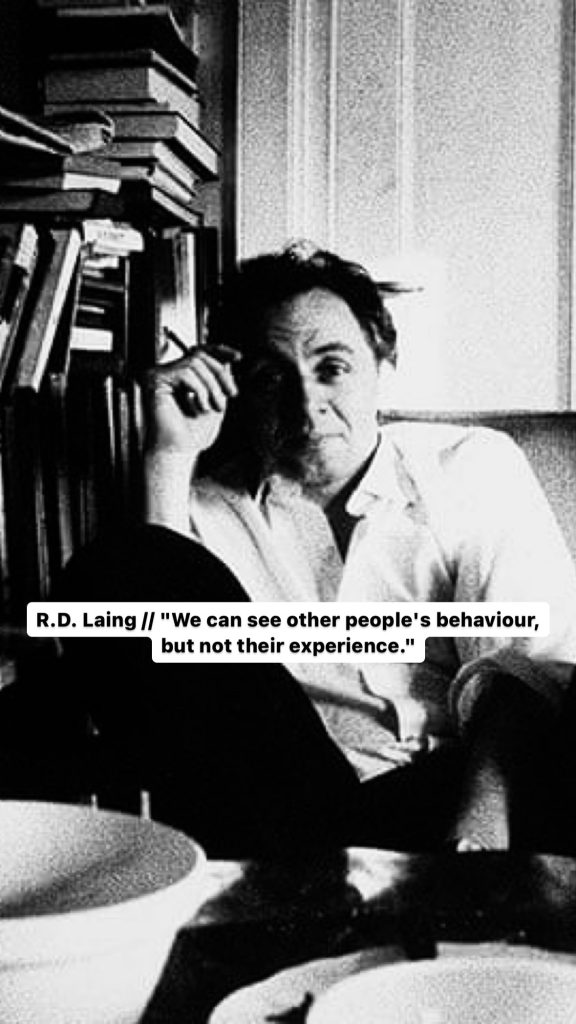
Despite having worked within psychiatric institutions and trained in psychology, Michel Foucault thought it was entirely absurd that one person would pay another person to tell them how to live their lives.  For Foucault (1988), the self was not something to be excavated through confessions (to a priest, analyst or doctor) but to be crafted and exercised in resisting the ways we are made subjects through various forms of power.  Medicine, education, psychology, psychiatry and even psychoanalysis were included in such forms of power.  All play a role in shaping how we define and experience ourselves, especially when it comes to prescriptions for what it means to be supposedly normal.   When it comes to psychiatry, for example, certain experiences are defined as illness conditions such as “bi-polar”.  This is not treated as a metaphor for the patient’s experience, but a claim regarding an inherent truth about them that supposedly defines them as the problem.  A person’s pattern of emotional upheaval is defined as a condition that they suffer from rather than a response to particular life conditions they are struggling against.     He or she does X or Y because they are “bi-polar”.  The critical stance towards the psy-industry that began to emerge out of philosophy lead some practitioners, such as the psychiatrist R.D. Laing, to break away from the conventional ways of treating people in severe forms of distress.  R.D. Laing made the conclusion that we were entitled to the benefit of our own symptoms, leading to much more radical definitions of what was “therapeutic”. 

Although Foucault helped pave the way for a critical stance towards these disciplines, he did not offer much of an alternative methodology for avoiding this play of power.  He did not really foresee us ever escaping power relations.  We can, however, utilise Foucault’s ideas of “self-crafting” in ways that might resist these powers.  Foucault would likely have approved of “kink” practices as a form of constituting and transforming a self in ways that resist the pressure to develop fixed and normative identities.  After all, Foucault was known to frequent bathhouses and leather bars in San Francisco’s Folsom Street district and acquaintances from that period described him as enthusiastic about sadomasochistic practices. James Miller’s biography The Passion of Michel Foucault (1993) deals with this at length, arguing that Foucault saw “limit-experiences”, including intense erotic ones, as philosophically significant.  His idea of “limit-experiences”, drawn partly from Bataille and Blanchot, are experiences that push the self to its edges – allowing it to be potentially dissolved or transformed by these experiences. 

The contemporary psychoanalyst Avgi Saketopoulou (2023) – drawing on Bataille, Sade, and the psychoanalytic theory of Laplanche – develops Foucault’s idea of limit-experience through her concept of “limit consent”: a willingness to enter into an experience that risks the self rather than preserves the self.  Although there are many differences between Saketopoulou’s psychoanalysis and Foucault’s notion of how a self is produced, both thinkers resist the idea that we should preserve the self.  Such preservation is to give into the prohibitive forces of power rather than harness the productive use of power and desire. 

My work with negative psychoanalyst, Julie Reshe (2023), encourages me to further radicalise Saketopoulou’s work.  Where Saketopoulou asks what becomes possible when the ego is overwhelmed, Reshe resists the implicit promise of transformation. There is no cure, only the quality of presence we bring to inevitable suffering. To enter an experience that risks the self is not a path toward a better self but a felt acknowledgement that the self was never as solid in the first place.  For Reshe, the limit experience is “love” – not claiming to know another but a willingness to die into them — relinquishing the boundary between self and other as the only authentic form of accompaniment.

My argument is that there is a necessary “kink” to what we deem as “therapeutic”. But, what exactly does it mean to have a “kink”?  To be bent? To go beyond the norm?  The truly therapeutic event resists the norm.  As R.D. Laing argues in The Politics of Experience and the Bird of Paradise (1967), to be supposedly normal is to be “alienated”, to be asleep, to shy away from consciousness and the nature of one’s own mind.  Kink is not always just some unusual sexual practice but a particular ethic – an openness to how we relate to ourselves, our bodies, our sexualities and each other.  A truly kinky practice is, ideally, an honest and ethical space:  A space for one to more openly explore and perform a self.  It appears that, when it’s permissible to be sexually explicit, other aspects of our personhood are brought into focus.  The practice of kink is ultimately a space where the usually denied aspects of relationships, such as our inherent sadomasochist tendencies, can be more outwardly performed.  In this way, it is the ideal stage for something more honest to happen between two or more people.  Kink invites the courage for more honest discovery of our “true” desires.  It is a practice of ethics because ethics, in the end, is simply the willingness to keep each other in mind and to act accordingly.  Through a preoccupation with consent, however, the new liberal kink community has increasingly come to mistake ethics for an affinity for rules.  In an understandable attempt to create safety, there has been a fixation on how everything about sex can be pre-decided and pre-negotiated.  But rules make perfect hiding places for the lies we tell ourselves about ourselves, alienating us further and further from what we are.    

Rules as hiding places for our true desires

Beverly:  	After I came home last week, he sent me a message to check in if I was okay with him breaking the rules the other evening.  
Therapist: What rules?
Beverly: Given that I probably don’t want children and that his parents will no doubt want him to marry a devout Hindu girl, we decided to put some rules in place that would help make it safe for us to continue with our arrangement.
Therapist: Can you share an example?
Beverly: No communication unless to arrange our hookups. No displays of affection. No shared meals together. No sleeping over. You know…nothing relationship-like.
Therapist: And which rules did he break?
Beverly: All of them?
Therapist: Where does this leave you?
Beverly: I think I was okay…
[long pause]
Beverly: Until he sent the message.
Therapist: What did the message say?
Beverly: That he wanted to know if I was okay after the lines got blurry again. He said he really enjoys his time with me but that he wanted to make sure that he is not hurting me….
[long pause]
Beverly: The night we were together, he said, “I miss you”. We made a meal together. He stayed over.
Therapist: Does that hurt you? Are you hurt by it?
Beverly: No, I don’t think so. I am sad about what could have been, but I don’t want to give up what we have.
[Another pause. She laughs as if I am trying to squeeze something from her through the silence.]
Beverly: It’s not just the sex, it’s the person. I enjoy being around him.
Therapist: So if it wasn’t for the issue of children and marriage, there would be no need for the rules?
Beverly: I don’t think so. Don’t get me wrong, sex in a dungeon is great, but I could really enjoy time with him in the everyday world.
Therapist: Can I be honest with you?
Beverly: Yes, of course.
Therapist: I think it is surprisingly patriarchal of him to propose that his chief concern is for you getting hurt. Surely that is for you to decide? It seems to me, rather than a demonstration of responsibility for breaking the rules, it is a way for him to absolve himself of when you do possibly get hurt. His guilt is not your responsibility, nor is a display of his guilt to be mistaken with taking responsibility.
[Beverly laughs nervously]
Therapist: Forgive me, it is against my training to give such strong personal opinions. But perhaps we have known each other for long enough by now for me to give an opinion?
Beverly: No, no, please go ahead. This is much more fun.
Therapist: Rules are hiding places for the lies we tell ourselves and others.
[Beverly repeats therapist’s sentence slowly back to herself].
Therapist: It is perhaps rather a question of how you hold each
other in mind rather than whether you are sticking to the rules. When he says, “I miss you”, what does he mean by it? Who is the “I” and who is the “you” he is referring to? What did he hope, in that moment, of uttering “I miss you” to convey?

There are many dangers to this kind of conversation with a client.  Psychoanalysis cautions the analyst from offering too much of themselves in the interaction.  The client may, for example, start to feel that they need to please the therapist or, on the other hand, may feel oppressed by the therapist’s views.  The therapist can easily become just another parental figure that the client fears disappointing.  In short, the therapist above risks entering into a theatre of projection and counter-projection.  On the other hand, when the therapist gives nothing of themselves, the relationship becomes overly contrived.  What is most important is that the conversation remains mostly about the client without losing its honesty.   Kink can teach us something about how to say what we mean and mean what we say.  As a place where you intend to take things beyond their usual limit, it is important to be clear about your intentions.  However, when everything is pre-negotiated and pre-decided, it can lose an essential edge.  In Sexuality Beyond Consent, Avgi Saketopoulou (2023) proposes that it is only at this edge, where the ego is overwhelmed, that any true shift can happen in a person. 
 

Beyond Consent

He leans towards her and asks how she is feeling.  A private conversation made deliberately public.  She just nods at first, smiling back at him, genuinely nervous.  The room laughs with her as she grins at the dimly lit audience. Kneeling even closer beside her, he turns to the room and describes how he has an idea in mind, but that he is not quite sure how it will play out.  He explains, demonstrating with hands softly resting on each of her shoulders, how he tries to get a feel for how she is doing and what she is needing.  He looks over at her and she gives that same nervous smile.  There is no usual check in regarding “hard limits” and particular likes or dislikes – they have done this many times before.  As he sets her up in Seiza, she notices that she can see herself in a free-standing mirror across the room.  She leans over and whispers in his ear.  He nods, smiling for the first time.  Rising, he moves the mirror to the back of the room, out of sight.  His movements are slow and deliberate.    
Kneeling behind her, he begins a ceremonious Takate Kote, binding her forearms together behind her back, causing her shoulders to pin backwards, exposing her chest for it to receive sensual attention as the strands of jute rope slowly slide against her skin and weave a munenawa around her already half-exposed breasts. Entrapped in this way, it is easy for him to raise her slender frame to its feet. He forms a tight rope between two Hashiras, a couple of metres apart. The rope runs between her legs, bringing her to her toes as the slight weight of her torso tightens the pressure of the rope against her still hidden crotch. A silk scarf masks her sight, but she can hear the crash of Lego pieces forming a carpet at her feet. She giggles at the familiar sound. The room laughs with her. Her toes twitch nervously, keeping her balanced between the pleasure and the tension. He steps away as a sculptor would, momentarily examining his work.
He tugs at the rope that crosses between her breasts. More of an invitation than a command. Her toes find the edges of the first few pieces. She inches forward, slowly, precariously. Low light reveals smooth muscles twitching and tensing as she makes the painstaking traverse. He has made neat knots along the rope, ostinati that offer a brief note of pleasure against the pain. Her cheeks flushed, she sucks on her breath as if through a straw. His own movements are comparatively subtle; the room hardly notices his heavier feet gliding over the white Lego pieces effortlessly. His face unreadable, his body offering no testimony to discomfort nor desire. He seems entranced in her and her every move. The audience has disappeared for him. She takes increasingly deep breaths; her body does not lie. Each step a small confession, a surrender, an offering, a devotion. The room holds its breath with her. By the time she nears the far pillar, she lets out a gasp. The rope between her legs is now at its tightest.
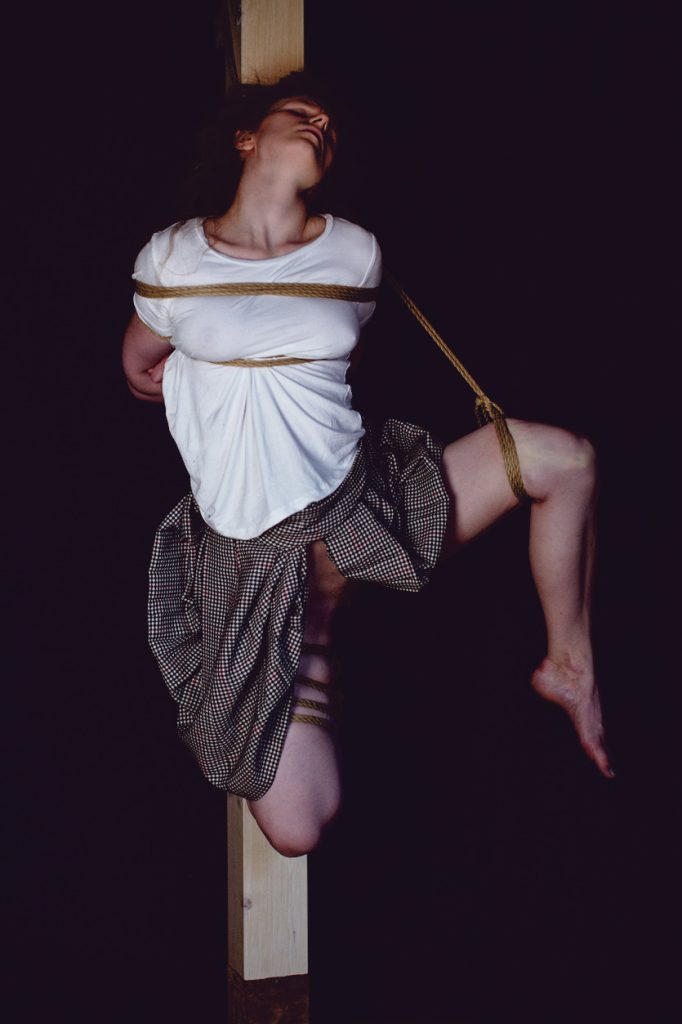
This signals him to finally release her from this tight rope as he lays her on the floor upon the scattered Lego. He begins to tie around a single limb. Any voyeur in the room familiar with Shibari might safely anticipate that he is about to relieve her current discomfort by suspending her into a new predicament. He works the ties slowly, each rope a remapping of her form. Surprisingly, she is not so much going up but going against the pillar, a Hashira tie. Eyes still covered in a silk scarf, the rest of her in a state of increasing undress. Suspended off the floor, back pinned to the pillar, arms behind her back, feet curled behind her flanking the pillar: she has become particularly exposed to his forgotten audience. She seems to be able to relax somewhat into this kind of familiar yet extreme discomfort.
Looking up at the audience for the first time in a while, he smiles as if colluding with the audience, he leaves her there for a moment to return with the mirror. This time, he places it against the opposing pillar, even closer to her than before. For the first time his body gives way to his own anticipation. He moves hastily to remove the silk scarf. She blinks at the sudden unveiling. She smiles, laughs, then frowns at herself - suddenly looks away. He grabs her firmly by the jaw, distorting her cheeks and with slow and deliberate force returns her gaze back to herself in the mirror. She now sees what we see. Her beautiful agony. Breasts contorted by rope. One nipple exposed. Lines of rope pork her lean belly. Her inner thighs spatchcocked to the room. Rope slits her mons pubis. She is breathing heavily. Suspended somewhere between arousal and discomfort. A murmur moves through the room as we all share the same gaze. Then everything goes still. She perhaps gives in to being seen for the first time that evening. She perhaps allows herself to see herself in this state. Eyes dare to look up into the room, watching us, watching her, watching herself. The room has received her as she is.

No one should ever condone the intent to violate.  But what if there are breaches of initial fear and reticence that are not violations?  This is why both a night of kink or a moment of therapy are better off not left as a once-off event, but a gradual process of mutual trust and discovery.  More significantly, what if we only find freedom at our limits – at our unintegration – rather than the ego’s constant need for consolidation and consolation.  Deciding what is going to happen prior to the event, prior to contact with another, limits how something new can potentially emerge out of the encounter.  We do not know if we have an appetite for something until we have tasted it, and we may even find ourselves at initial odds with the things our appetite reveals.  Therapy, by necessity, goes beyond consent – if only it could admit to this.  When a client arrives in therapy and states that they want to speak about their failed relationship but not about their sexual abuse, the therapist may not pressure them to talk about the abuse at first, but it is likely that the therapist intends to go there at some point.  This introduces the question of the relationship between trust and violation.  On the boundary between the two lies a subtle art, a particular form of attention, an appetite for loving discovery.  For R.D. Laing, to love is a willingness to know (as cited in Feldmár, 2023).

The Therapeutic Event

A therapeutic event is one that undermines the ego rather than upholds it.  A therapeutic event is about holding a particular form of attention, one that is interested in what emerges with care but also with curiosity in what lies on the other side of being overwhelmed.  It is about going to pieces without entirely falling apart and then seeing what can be made of the pieces.   This requires that the therapist avoid sitting outside of experience, that the therapist allow themselves to be affected by the encounter.  Overly careful boundaries, rigid theoretical orientations, and detailed process notes are just places for therapists to hide themselves.  For an encounter to have value, we must relinquish ourselves to it.  We must be prepared to die into the encounter – as Julie Reshe might say. The therapist who remains entirely intact at the end of a session has not yet entered the room.  They have not been fully present to the exchange.  There is no cure to offer, only presence to inevitable struggle, and the quality of this presence depends on each party’s willingness to go to a place together. 

However, this is not an “anything goes” methodology but a subtle art of coming alongside another in their experience and nudging one another along.  If for R.D. Laing, to love is to know then my work with negative psychoanalyst, Julie Reshe, has helped me radicalise this into love as the willingness to die into the other.  What I make of this is that “the therapeutic moment” lies in our capacity to come undone.  Love, knowing, accepting and undoing are perhaps, after all, not that dissimilar.  Such undoing is only bearable in company, in communion, and this company is only authentic when it has the courage not to look away from our shared abyss.  From a Negative Psychoanalytic perspective, what is deemed therapeutic is not “cure” (as this is deemed implausible) but communion around our own inevitable sense of emptiness. 

Conclusion

Despite the inevitable pessimism of this approach, there is something to be gained in the freedom from one’s own defences. When we commune around our own inevitable sense of emptiness; when we acknowledge the absurdity of this life and the indifference of the universe; when we open ourselves up to inevitable suffering; and when we loosen our grip on who is me and what is mine — there is a momentary relinquishing to what it means to be alive, and a gap opens for something new to happen. This does not necessarily imply resolve, cure, or even improvement. No longer refusing to be what we are allows us to break with habitual and defensive ways of existing. We become less alienated. Less prey to the fiction of the supposedly normal.

What Foucault, Laing, Saketopoulou and Reshe share is a refusal — to treat the human subject as a problem to be solved, a self to be corrected, a wound to be closed. For Foucault, there is no true self to be excavated through confession, only a self to be crafted in resistance. Laing insisted we are entitled to the benefit of our own symptoms and that the norms of society are themselves complicit in our suffering. Saketopoulou shows us that it is only at our limit — at the edge of what the ego can manage and translate — that genuine shift becomes possible. Reshe refuses even that promise. There is no cure. There is only the quality of presence we bring to inevitable struggle, and the willingness to die into the encounter rather than supervise it from a safe distance.

The kink of therapy, then, is not a technique. It cannot be taught the way a theoretical orientation is taught, certified, and supervised into compliance. It is closer to an ethic — the same ethic that governs the honest kink space — of keeping each other in mind, of saying what we mean and meaning what we say, of not hiding behind the rules we write to protect ourselves from what we actually desire and what we actually fear. There is no difference in vulnerability between the rigger and the rope bottom, or the therapist and the client. Both take the risk of venturing into the unknown. Communion around shared emptiness is not a failure of therapy. It is its most honest form.

She is suspended between the two pillars, taken far enough to eventually encounter herself in the mirror, at her limit. He holds her gaze there, firmly. The room receives her as she is. This is not cure. It is not resolution. It is something rarer and more necessary — the experience of being fully seen, in one’s beautiful agony, without the other looking away.

This is the kink of therapy and the therapy of kink.

References:

Feldmár, A. (2023). Credo: R. D. Laing and radical psychotherapy. Karnac Books.

Foucault, M. (1988). Technologies of the self. In L. H. Martin, H. Gutman, & P. H. Hutton (Eds.), Technologies of the self: A seminar with Michel Foucault (pp. 16–49). University of Massachusetts Press.

Laing, R. D. (1967). The politics of experience and the bird of paradise. Penguin.

Miller, J. (1993). The passion of Michel Foucault. Simon & Schuster.

Reshe, J. (2023). Negative psychoanalysis for the living dead: Philosophical pessimism and the death drive. Palgrave Macmillan.

Saketopoulou, A. (2023). Sexuality beyond consent: Risk, race, traumatophilia. NYU Press.

No Cure For You: If Buddha were your Psychoanalyst?

I was deeply privileged to have the opportunity to present my ideas for Professor Julie Reshe on her Patreon platform.  Her work introduces “negative psychoanalysis” as an alternative to the therapy provided by conventional psychology and psychoanalysis.  Her work is more of a philosophical shift than a specific methodology and, in this presentation,  I attempt to provide an example of a negative psychoanalytic methodology through my project of merging Buddhist practice with existential methods.

Introducing Existential Analysis

Beyond Snake Oil: The anti-cure of Existential Practice

From the onset of my training in psychology, I had reservations about how psychology was being done. My English professors seemed to have a much better grip on an understanding of the human condition than my Psychology lecturers. Classes on Samuel Beckett’s Waiting for Godot seemed to say more about how we relate to our own existence than a lesson on the characteristics and proposed treatment for supposed conditions like bipolar disorder. By the time I was in my final year of master’s training in Psychology, I was asked to leave my internship because I continually challenged the efficacy of psychometric tests as the means for understanding a person, their struggles, and their response to their life circumstances. Fortunately, I had a very supportive supervisor who happened to be head of our master’s program and he helped me find a new placement straight away. I wanted to explore the art of therapeutic conversation, and I had romantic ideas about the “The talking cure”, but I also distrusted psychodynamics and psychoanalysis. I was concerned for how the psychoanalytic approach was overly focused on our early years and gave too much agency to the unconscious. The psychoanalyst seemed too stoic to be of any help and the process seemed intent on breaking the analysand apart. I believed Freud was dead and we should move on. I discovered Narrative Therapy, an approach that had developed under the influence of Michelle Foucault’s ideas, very critical of the psy-industry (psychology, psychiatry and psychoanalysis). As a methodology, Narrative Therapy was against the idea of therapist as gatekeeper to a client’s experience – the therapist job was not to interpret the client’s world for them. In this way, Narrative Therapy attempts to avoid the potential power differential between client and therapist by focusing on how the client languages their own experience. It considers the client as the authority and author in their own lives, respecting the language that the client uses to articulate their own problems. I found it helpful to see our lives in terms of stories and the therapy room became an editing suite for understanding and transforming these stories. To some extent, therapy became a resistance movement to the dominant stories imposed on us by society and even our own families, about who and how we should be.

I took this further, writing a thesis in Discursive Psychology, scrutinising the everyday language we use in constructing our reality. In philosophical terms, this put me on the side of structuralism and post-structuralism, exploring how we structure reality through language. This seemed like the appropriate skill for a psychologist to develop, language being the means of “treatment”. This, however, set me off on somewhat of a lonely path of attempting to carve out a different way of doing Psychology. I applied this approach in many contexts, including sexuality; illness and injury; neurological rehabilitation; addiction; trauma; and relationship therapy. More than a decade and a half later, Covid hit, and I printed the portraits of the thinkers I was finding most helpful at the time. It felt particularly lonely in this daunting time to be a therapist. I stuck the portraits above my desk and as I looked up at them, I realised that most of these figures – including R.D. Laing, Jean Paul Sartre, and Albert Camus – were existentially inclined. There was also the existential Buddhists, Stephen Batchelor, and the postmodern author, Jeanette Winterson, who wrote: “To be ill adjusted to a deranged world is not a breakdown”.

Just before covid hit, Fiona and I had attempted to turn our home into a retreat centre – a live-in therapy centre that moved away from the clinic as a setting for dealing with problems of living and feeling. As part of this project, I had started to merge ideas from Western Philosophy and Buddhism. My interest in Buddhism spanned back to the onset of my 20’s. During Covid I decided to formalise this thinking in the form of a PhD in Philosophy. I had come across a contemporary philosopher and psychoanalyst whose work I appreciated, Julie Reshe. A lecture of hers on Sado Masochism led me to the Global Centre for Advanced Studies (GCAS).

As I began my studies with GCAS, I came to realise that the thinkers I had been exploring shared similar origins, Phenomenology (the study of experience from within experience), and some had translated this into a practice that could be called Existential Psychoanalysis. GCAS teaches Philosophy and Psychoanalysis, and I had the privilege of being exposed to contemporary thinkers and psychoanalysts like Jamieson Webster. I was very quickly seduced by Jamieson’s reading of Freud. It wasn’t so much Freud’s ideas but Jamieson’s intensity, the return to a deeply embodied practice of client and therapist being with each other in the almost inarticulatable struggles that we face. There was something deeply meditative about the approach. Jamieson and many others at GCAS favoured Lacan, a complicated language-based reading of Freud. Given my interest in how reality is constructed through language, I had often flirted with studying Lacan, but never had the courage to engage with his riddles. This gave me the chance to dabble in Lacan, even though I was drawn mostly to phenomenology and existentialism, and I even saw Lacan as a closet phenomenologist. For me, the important questions for us to start with was “how do we exist” and, from there, “how do we go on”.

I was appointed a super smart supervisor who held three doctorates, Prof Kevin Boileau. He knew so much and had many incredible ideas bursting out of him, more than he could write down in one lifetime and he had already written a lot. But I needed to develop my own ideas, my own way. I knew what I wanted to say, I just needed the time and the space to agonise with the words. Prof Boileau introduced me to a path that straddled the study of embodied experience (phenomenology) with an appreciation of how we function within a language (structuralism). In the end, I completed my PhD with a nudge and some inspiration from Julie Reshe herself. I wrote an exploration of a therapy that was against diagnosis and treatment. Using some ideas from Buddhist practice, I attempted to describe how to help people by being with them in their struggles, rather than acting upon them with a particular treatment methodology. It became somewhat of a study of consciousness and an account of how there is no “true self” behind consciousness, looking out at the world. It followed Sartre’s notion that “Existence precedes essence” – how we are in the world defines what we are. In this way, the “psych” fell away from “psychoanalysis”.

This has led me along a path of developing a practice more inclined towards Existential Analysis. Our struggles are not seen as individual pathos but as inherent aspect of how we exist in the world. It views our struggles, that we are in the habit of naming depression, anxiety, bi-polar, or addiction, as inherent to consciousness. These struggles are seen as responses to our lives, rather than conditions in the brain. It is not a practice that proclaims to tell people how they should live or what they should do with their lives, but brings a presence to your own experience and supports a courage with being with things as they manifest. Change is not something that we force but that we try and open up to, through giving contemplation to our responses, rather than giving in to our habitual reactions. Existential Analysis also involves an ethical stance towards our struggles: an appreciation of truth, responsibility and freedom.  In order to address our struggles with this kind of openness, resisting the impulse to try and “fix” and “get over” things, requires a certain courage, commitment and sufficient containment. The objective is not “cure” but finding ways of “being” in the world, in ways that feel most true to our own intentions. However, something needs to “hold” us as we allow ourselves to undo and redo ourselves in this way. Therapy becomes a constant process of relinquishing any grasp on a fixed idea of “who I am” or how things should be. For this reason, I have come to increasingly value commitment from both therapist and client to a weekly ceremony of connecting, the same day and time, for as long as we feel we need to, or for as long as the relationship lasts. In this way, we can really give our lives, the relationships it is made up of, and our experience of things sufficient care and attention. The therapy process becomes a lived-out experience of staying alert to things as they arise in our consciousness.

Self-Retreat Therapy

This past weekend, Fiona and I found ourselves entranced by a Leonard Cohen tribute show.  I wouldn’t usually be inspired by the idea of anyone attempting to emulate the grand master of melancholy, but a dear friend’s sister was performing, so I thought I would take a Sunday afternoon break from writing my thesis and venture off into the depths of Umbilo.  Coincidentally, I had been reading and writing about Cohen.

Dave Starke and Lizzie Gasford

In his later years, Cohen spent some time in a Zen monastery.  He served as assistant (or carer) to the aging Roshi.  Although he didn’t consider himself a monk, he shaved his head and adorned robes in order to get access to Roshi and his teachings.  This is where he wrote most of the poems from the “Book of Longing”.  Cohen had indulged in all the sex, drugs, money and fame one could have dreamed of and, yet, still seemed to be filled with longing.  It seems that he entered into the monastic life as a means of coming to terms with his own insatiable longings.  It seems possible that we all share this underlying feeling of lack or incompletion, not matter how much we try fill it with ideas of who we are and what we have achieved or think we should still achieve.  In a poem called “Titles”, he speaks about having had the title Poet and being “kindly accorded” the title singer “even though I could barely carry a tune”.  He renders the monastery as a place where these become irrelevant, in a challenging yet freeing way.

He still kept a bottle of Johnny Walker in his quarters and after 5 or 6 years returned to civilian life.  But I get the impression that his time there brought him more clarity.  In an ode to Leonard Cohen, the writer and Zen monk Shozan Jack Haubner, writes “But in Leonard’s world, the opposite of despair was not hope — it was clarity. From this clarity came the vision of a prophet.”  In his clarity lies a brutal honesty about life that he even poses a challenge to Zen beliefs.  Cohen writes:  “I know your burden’s heavy as you wheel it through the night. The guru says it’s empty. But that doesn’t mean it’s light.”

Modern Psychology has become the new priesthood, selling us a false promise of everlasting happiness – if you just follow these 10 steps, just work hard enough at your success, and take your medication regularly enough – you’ll get there.  I am yet to meet someone who is “there” and those that appear to be there, seem to be pretending. In our struggles to carry our “empty” burdens, I enjoy Cohen’s preference for clarity over hope and I have found that periods of retreat style living – that allow us to simply be with our struggles rather than escape them – are an ideal means of allowing such stark clarity.

From the 1st to 18th of March we will be opening up our retreat centre in La Mercy for self-retreat therapy.  You can book in for any length of days where we will follow retreat style living involving: 3 healthy meals a day, noble silence in the evenings, meditation and yoga in the mornings, somatic movement therapy and philosophical reflection.  If you are not already a client in therapy with me, you would need to have a preliminary session with me in order to make the most of your retreat.

To book a space or find out more, please email fiona@centreforpurposefulliving.co.za

If you happen to be close enough to the Magaliesburg, please join our retreat on “On Being-No-Thing-ness” from the 20th – 24th March at Emoyeni Retreat Centre.

Myself with Buddhist master and brilliant poet, Mervyn Croft, at Emoyeni.

Whether you decide to join us on retreat or not, please don’t miss this upcoming show with Dave Starke and Lizzie Gasford, it’s a melodic lesson on love, relationships and living, on the 6th of April at Northlands Bowling Club.

On the Marginalising practices of Psychology

[vc_row][vc_column][vc_column_text]Interviewer:    Do you think that if you had paid for the train your life would have been entirely different?”

JG:                      Listen, do you believe in God?

Interviewer:    Sometimes.

JG:                      Well, ask him.  Ask him if my life would have changed – I don’t know.


The psychological consultation can easily take the form of this kind of journalistic interview.  The question-answer sequence, in which the client’s life becomes an object of knowledge and scrutiny, can start to feel and sound like an interrogation process.  The therapist, as interviewer or interrogator, asks questions of the client with specific ideas and answers in mind.  We have preconceived ideas about how the world works and how a person is psychologically formed by their choices and experiences.  These ideas shape the questions we ask.  There is often the absence of a genuine question mark at the end of our questions.  They are more often statements than questions.  In some cases, they can even be surreptitious accusations of having made wrong choices, had wrong feelings, or come to failed conclusions.  In a BBC interview with the writer, playwright and “Saint” of French Existentialism, Jean Genet, in 1985 (soon before his death) – Genet is able to “break the order of things” (as the interviewer puts it) in this question answer process.  Genet was first incarceration in Mettray, one of the most severe reformatories in France, at the age of 15 (until the age of 20).  This was the first of many imprisonments.   Even though he was already in a habit of thieving, the offense at the time was not having a train ticket.  At the onset of the interview, he is asked about the “feelings” of his childhood – of not having parents.  A particularly psychologised line of questioning.  Genet refuses to take up any lines in this psychological script for how we assess our lives:

JG:                      You are asking me to tell you my feelings as a child. To speak of them in a satisfactory way. I would have to begin a kind of archaeology of my life, which is absolutely impossible.  All that I can tell you is that the memory that I have of it is of a difficult period, certainly. But, in escaping the family I also escaped from family feeling- the feelings I might have had for a family, or the feelings they might have had for me. And so, I am entirely detached, and I was as a child, from any family sentiments.  And, it is one of the virtues of the French Public Assistance, which certainly brings up children fairly well and stops them from attaching themselves to a family.  Which is, in my opinion (the family that is) probably the first criminal cell.


I am not sure if I would describe Genet as having been brought up “fairly well” but do we even know what that means?  He questions here whether the very institution of a family is a good place to be brought up.  You could perhaps say that his entire life, his creative works, are a challenge of normative ideas.  Genet may represent the possibility of something outside the “incarcerating” ways that we conceive of things as supposedly “normal”.  Or, perhaps, he is a genuinely traumatised man lost in his own defences?  Genet goes on to describe the relationship between the incarcerated: some inmates were appointed as authorities (elder brothers) over others, a relationship of dominance and submission, that was overseen by the warders.

JG:                      If you like, the warders were the first audience and we were the first actors, and they enjoyed the pleasure of looking on.

Ironically, the interview process mimics a scene of dominance and submission, being enjoyed by an audience.  Dominance of interviewer (on behalf of society) over interviewee (who refused to play by the same rules) and enjoyed by myself (the audience) who now becomes the warder.  I become complicit in the act of objectifying Genet as a thing to be known and judged for the life he has led, looking for psychological explanations for who and why he is how he is.  A mirror of a scene from Abert Camus’s The Outsider.


This is a position of onlooker is made readily available to us these days through the psychological and psychiatric ideas that have made there way into our everyday thinking and language.  We have become the onlookers of war, poverty and and the marginalised.  The supposedly well-meaning idea of “mental health” (and therefore, illness) is simply another form of marginalisation.  Psychological ideas and explanations of who, how and why “they” are serve as distancing practices that keep you over there and me, safely, over here.  Genet manages to address this in in the interview in a language that suggests we are all disempowered by this dynamic: both interviewer and interviewed, jailers and jailed.  He questions who has the “right to speak”, and when?  What are they allowed to say?  On the second day of his interview, he addresses the 7 people hidden from camera:

JG:                      I had a dream last night.  I dreamed that the technicians of this little film revolted.  While they’re taking the shots of this film, they never have the right to speak; how does that come about?  And I thought they might have enough guts to push me out and take my place.  But, nevertheless, they are not moving.  Could you ask them how they explain that?

Interviewer:    Yes.  How they…

JG:                      How they explain this..,why they don’t come and push me out, and you too…and say ‘It’s so stupid what you’re saying and that I don’t want to carry on with this work’.  Ask them.

Interviewer:    Yes certainly.  Because they don’t speak French.


The interviewer goes on to translate Genet’s utterances from French to English (in a much-abbreviated fashion).  The crew fumbles with answers as the camera haphazardly moves off Genet.  Part of the interrogation was about Genet’s choice to distance himself from society.  At this moment, Genet turns the interrogation onto the film crew and, in doing so, illustrates how it is these kinds of conventions, of treating people as objects to be known and questioned, that are actually the distancing and marginalising practices.

Interviewer:    But does it interest you to break the order of things, since you were dreaming about it, do you want to break the order in this room?

JG:                      To break the order?

Interviewer:    Yes.

JG:                      Of course.  It seems so rigid – I am all on my own here and in front of me are 1, 2, 3, 4, 5, 6, people.  Of course I want to break the order.  That’s why yesterday I asked you to come sit here [points to the chair he is sitting in].

Interviewer:    Is it like a police interrogation?

JG:                      There is that about it, yes.  I told you.  Is the camera rolling? [Looks at camera man] Good.  I told you yesterday that you were behaving like a policeman and you’re carrying on like that now, this morning.  I’ve told you that yesterday, and you’ve already forgotten.  Because you’re continuing to interrogate me, exactly like the thief I was thirty years ago was interrogated by the police.  [Gestures towards the rest of the room] By a squad of police.  And, I am alone on this little chair, being questioned by lots of people.  There is the norm on one side, where you are: 1, 2, 3, 4, 5, 6, 7 [pointing at people behind the camera] and elsewhere, the editors of the film and the BBC, and then there is the margin where I am [pointing to his chair] where I am marginalised.  If I am afraid to join the norm, then so be it.


So often, the psychologist or psychiatrist sits on the side of the supposed “norm” and the client or patient sits on the other side – the margin – awaiting judgment.  Let us rather talk in equal turns, side by side.  Neither of us marginalised by an imaginary audience with criteria for who and how we should be.  What would such a therapy look like?  Free from interrogation.  You shouldn’t need a ticket for the destination that is your own life.


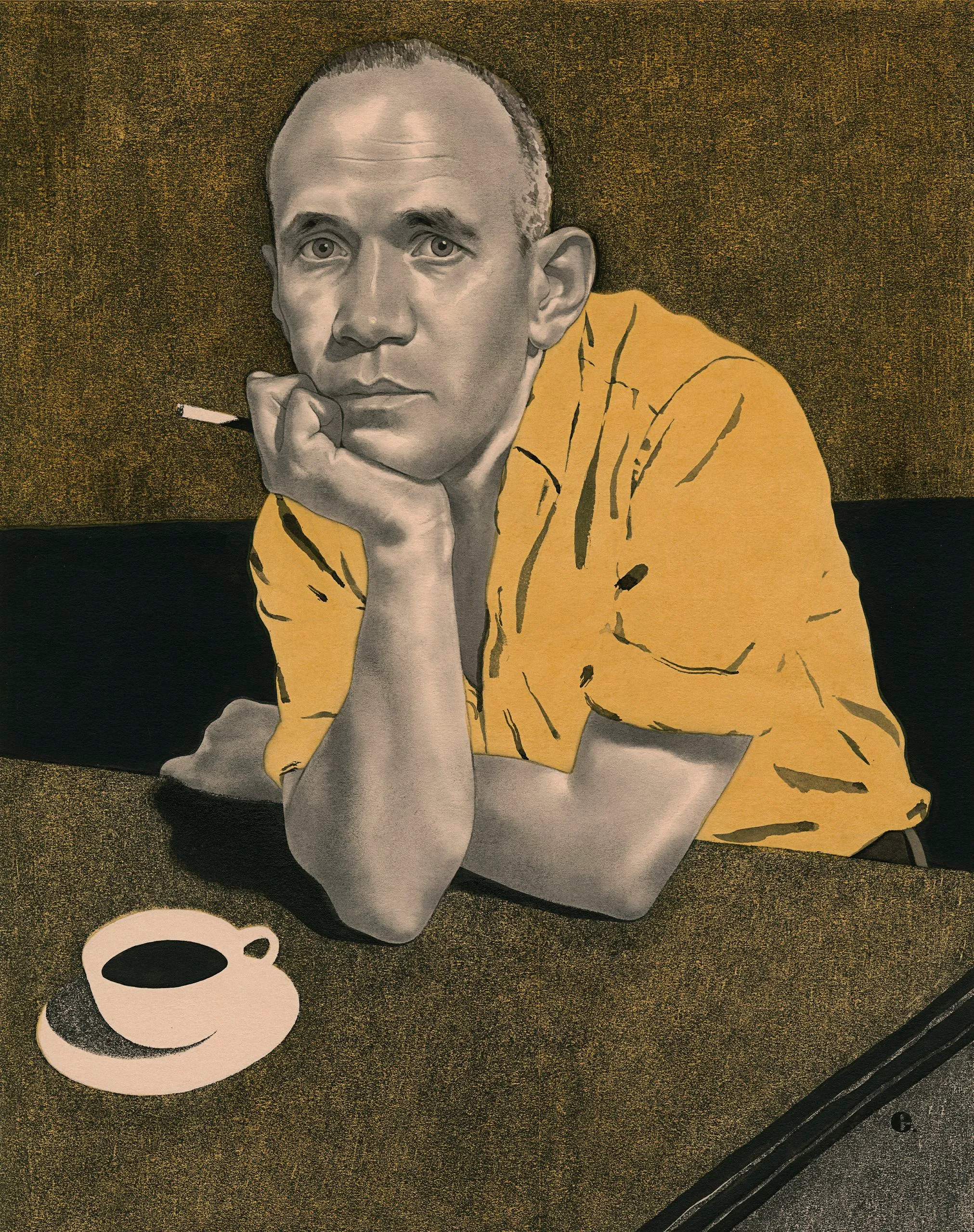
[Image used above is an illustration of Jean Genet, by Edward Kinsella, from an article in the the New Yorker][/vc_column_text][vc_video link=”https://www.youtube.com/watch?v=Cn7LWdmdyTU”][/vc_column][/vc_row][vc_row][vc_column][/vc_column][/vc_row]

Renewal 2024

[vc_row][vc_column][vc_column_text]Dear Clients [current & future],


As we enter into a “new year”, a renewal, I would like to revisit what it is that therapy is, perhaps, about.  The word “renewal” does not only imply to “make new”, or to “begin again”, but also to simply resume: to go on.  Much of therapy is about finding ways to simply carry on.  As I enter into the final months of my PhD in Philosophy and Psychoanalysis, supervised by some of the leading thinkers in the field (through GCAS), I am more and more opposed to ideas of diagnosis and cure when considering how to address the struggles that we face.  As Jean Paul Sartre wrote “Everything has been figured out, except how to live.”  In developing my approach to therapy – Contemplative Existential Analysis – I am increasingly concerned with questions of how to live, rather than how to be “cured” or even how to be supposedly “normal”.  “For if there is a sin against life, it consists perhaps not so much in despairing of life as in hoping for another life and in eluding the implacable grandeur of this life.”  (Albert Camus).   Psychology seems to have become our new priesthood and, in its sermon, provides the false promise of eternal happiness – if you just follow its prescribed self-affirming steps.  The therapy I invite you to join moves away from happiness as the goal, focusing on awareness: on what it means to be conscious creatures.  Our struggles that have traditionally been divided up into diagnostic categories are reconsidered as hints of what it means to be human.


Whether we are dealing with relationship struggles, addiction, grief, trauma, depression or anxiety – I invite us to, first and foremost, be human, together.  In being human together, the focus is not on the individual person as the “problem” but on our struggles with what it means to exist within the context of our own lives.  This requires bringing awareness to the relationships that shape our lives:  the relationships of the past, the relationships in your present, the relationship you have with your own self and the relationship you have with the idea of a future.  Even though our conversations welcome an awareness of these relationships into the room, the actual people in your current life are always welcome to join you in person.  This also means that we must appreciate that you and I are entering into a particular relationship.  Although this relationship is somewhat contrived, as you are paying me to be available to you, I have learned to deeply value the nature and intensity of this relationship.  I am learning to pay more attention to this relationship, reflecting on it with you as we go along.  There are also certain practical considerations in the maintenance of this relationship.  These considerations are more relevant than ever given that we are moving into an increasingly virtual world.  I would, therefore, like to request that we uphold the following:

  • To start our sessions timeously (a note to self).
  • To stick to the prescribed time frame of the sessions. After much consideration, sessions will revert to the classical “therapeutic hour”, which is 50min.  I have found that this structure gives the conversation enough impetus for us to get to a meaningful place in each conversation.
  • If we are meeting online: to try and always meet in a space that is comfortable and private enough, free from distractions (closing all other browsers, windows, or messaging apps); with a clear view of each other (to allow for body language) and a good enough connection (keeping in mind that this is not always possible in South Africa). It is preferrable that you are not eating a chicken pie over the dashboard of your car in your lunchbreak.
  • In the past, clients have been able to book ad hoc sessions with me. However, I find that it is much more constructive for us to approach your concerns in a more deliberate way – to commit to either weekly (ideally at first) or fortnightly sessions on a particular set day or time.


Outside of this structure I would, however, encourage us to try other formats of therapy.  I have found, for example, that walking and talking are very good practices.  It has been very helpful to take walks with clients, even when we are in different cities or landscapes (again, it helps to share a visual of this experience).  I also encourage written reflection on our meetings and you are welcome to send me some of your written thoughts, accounts of your dreams, letters to people in your life, or questions you are busy with.  I am unlikely to have enough time to send detailed replies, but I will make sure I take a look at these so that we can go through them in our sessions.  I am also busy with my own writing, and you may make an anonymous appearance.  I will, however, always share anything I write about our sessions with you.


Lastly, I would encourage you to join us on retreat to make the most of a Contemplative Existential Analysis.  You are invited to come and self-retreat at any stage at our suburban retreat centre The Centre for Purposeful Living.  Couples and families are also welcome to book in for a live-in therapy experience.  We will be hosting more structured therapeutic retreats later in the year.  Please let us know if you are interested.  In addition to our own retreats, I offer two annual (post)Buddhist retreats in the incredible settings of renowned Buddhist Centres.  The first will be from the 20th-24th March 2024 at Emoyeni, on the northern slopes of the Magaliesberg mountains; and the second will be from the 6th-11th September 2024 at the Buddhist Retreat Centre in Ixopo, at the foothills of the Drakensberg.  These retreats involve a merging of Secular Buddhist practice with Existential Philosophy.


I look forward to our encounters this year.


“The end is in the beginning and yet you go on.” – Samuel Beckett.


Sincerely,

Jason

[/vc_column_text][/vc_column][/vc_row]

The Myth of Addiction

A practical application of Existential Phenomenology to human cravings in developing a Contemplative Existential Therapy.

September 2023, by Jason Ross (MA Counselling Psychology, PhD student GCAS).

What if, what we are in the habit of calling “addiction” is not a break down in personal ethics, not so much an issue of being “out of control”, but a state of “denial”: a pushing away of that which we struggle to face. A phenomenological reading of Freud might conclude that this is the ego’s struggle: it does not want to be with things as they are; it is forever in waiting for a better time, a different place, an impossible destination – the false promise of complete fulfillment. The ego wants to be unmediated by the facticity’s of life. The perplexingly stubborn nature of this state of denial has us in the habit of thinking of it as some sort of illness or affliction. It is stubborn because it is denial in infinite regress: We are usually not only in denial of the actual addiction itself, proclaiming to ourself and others “it’s not that bad”, but in denial of how this compulsion serves to obscure something else, the “something” we don’t want to face. This something else is, more often than not, a source of pain. But, in a twist of terrible irony: in our ongoing attempts at escaping this pain, the compulsion becomes a pain in itself. Freud’s chief contribution may have been in recognising that there is always the return of the repressed through the “symptom”. Psychology is inclined to focus on treating these symptoms, but this is like the constant pruning of the branches of a tree. You can cut these branches back as much as you like but you are nowhere near the root. R.D. Laing proposed that every person was entitled to the benefit of their own symptoms, our symptoms tell us something about the things we are struggling with. Rather than something to be treated, symptoms are something we should be curious about, they tell us something about what it means to be human. Existentially speaking, we all share one fundamental, incurable, struggle – we all sit with a fundamental sense of lack or emptiness. Rather than something to be cured it is something to be endured. Addiction is the chief symptom of our fundamental sense of emptiness and the ego’s need to become something fixed and solid. According to Buddhism “The basic problem is not that we crave this or that thing, but that is seems to be our nature to crave.” (Loy, 2018, p.128)

Addiction is, therefore, the ego’s means of standing steadfast against the return of the thing we don’t want to face. This might be my own personal fears of not being good enough, of failure, of rejection or abandonment. All depending on my own personal history. But ultimately, existentially speaking, we all share an underlying fear that we do not even exist in the first place. This manifests in the ego’s need to make something solid of itself in the world. An existentialist perspective names this the “Oedipal Project” (rather than oedipal complex): To become the sustainer and creator of one’s own life, or as Nagarjuna (Buddhist philosopher) put it, to become “self-existing” (Loy, 2018). This is, however, an impossible project and such is the self-digging trench of “addiction”. In some ways addiction, especially in its extremer forms, is the eventual surrender to this fact: to give up on making something solid of myself and dive into my own emptiness through obliterating myself. Any process of recovery is, therefore, not a process of abstinence, per say, but a process of recovering a basic sense of self within a sea of potential emptiness, meaninglessness and insubstantiality.

Addiction could be reframed as a collection of potential compulsive behaviours in response to an underlying anxiety with regards to inherent feelings of “lack” to conscious experience. According to phenomenology, consciousness can only ever be consciousness of some “thing”, consciousness is not a “thing” in itself. This underlying sense that we have that there is something lacking to consciousness, as it is not a solid thing, leaves us with a feeling of emptiness, a question of “what if I am not real” or “what if this is all just a farce”. Buddhists call this “Dukkha” – perpetual unsatisfactoriness. When a person suffers severe enough trauma in their lives, rather than having a distorted view of reality, it is possible that a veil of illusion, a false sense of security in the world, is lifted. It is possible that trauma reveals existential truths about the world, truths we find too hard to face. What we call addiction becomes a flight from these felt realisations. Find a pub and you will find a war veteran drowning himself in the corner with the remains of his pension. It is because these habitual cravings are so difficult to resolve that we are attracted to conceiving of them as some fixed obstacle somewhere inside us – a condition of desire gone wrong in our heads. However, the answer may not lie in putting a lid on desire (abstinence) but rather in going into what it is that we truly desire and facing the things we are struggling to face. What we have come to call “recovery” is at risk of becoming a whole new process of denial through a constant stance of suspicion towards one’s own desires: a perpetual self-surveillance. Self- control alone is not recovery. To “recover” is to move from a “fleeing from” to a “going into” our true desires. It is to ask: What is the thing I am searching for at the bottom of a whiskey barrel? The aging veteran drowning himself in Guiness at the lonely end of a bar is, most likely, even if privately, asking himself some unbearable questions. What has this all been for? Recovery is the courage to sit with these questions, even if there are no clear answers.

What we have come to call “addiction” is, therefore, a state of denial of denial itself. Addictive behaviours serve to obscure us from the thing we are struggling to face, the existential questions we are asking ourselves: what are we all doing here and is it worth carrying on? Conventional recovery can surreptitiously serve as a form of further denial: by shutting the door on all and any longings – stopping at the doorway of our cravings and looking no further. What if a therapeutic endeavour was to fully enter into our own longing and discover what we find there; getting a sense of the thing we are most struggling to be, think or feel. For addiction to do its job, hide things from us, it must remain somewhat obscured from full view. In this way addiction is a form of alienation from our actual experience of things. Recovery can be an equal (even if opposite) form of alienation through renunciation of our longings. As Slavoj Zizek often warns, the renunciation of pleasure can easily turn into the pleasure of renunciation itself. Far too often, what we call “recovery” is simply a more risk averse form of denial: If addiction is a form of non-living through our own automated, compulsive and destructive behaviours, then recovery can be a state of non-living through putting all our longings on hold. An existential approach to “recovery” encourages us to embrace life in all its banality.

The human propensity for addiction is perhaps evidence of life’s absurdity. Addictive behaviours often fail all logic. From the supposed “outside” they may seem completely ridiculous. Often a person might ask “but, why are you doing this to yourself, it makes no sense.” In truth, so much of what we do makes no sense. However, ridicule is no cure. Far too often what is deemed “rehabilitation” takes on the form of the language of ridicule: pointing to the lack of logic in our behaviour. This seems to achieve very little other than yet another infinite regress: the ridiculousness of ridiculing the ridiculous. The objectifying practices of rehabilitation, through naming and shaming conditions, don’t seem to help much in facilitating agency and change in a person attempting to regain a sense of self-regulation. On the contrary, shame usually keeps us stuck.

My therapist once said to me “Stop doing the thing you have always done and do the thing you don’t know how to do”. This is, perhaps, the very definition of “recovery”. In fact, most of therapy is probably about breaking habitual ways of being in the world. But, how do we learn to do the things we don’t know how to do? The Russian psychologist, Vygotsky (2012), called this “the zone of proximal development”: the developmental leap that the child makes, often through his/her interaction with a caregiver, in learning to do something new, in becoming something she was not before. According to this perspective, development does not precede learning. We are not, therefore, predisposed to addiction but learn addictive ways of being with the world. Addiction is something that is learned through my encounter with the world. I can, therefore, learn a different way of being in the world. Learning to speak a language is perhaps the best example of this theory. The chid is exposed to something they do not know how to do, over and over, until one day they make a leap into something they did not know before. If I can learn addiction, I can surely learn alternative ways of being with my struggles? What I am, however, unlikely to “learn” is the absence of desire. To some extent, this is about learning a language about who and what we are. Is there a language for self-preservation that does not give in to the toxic positivity and self-policing perpetuated by the current self-help movement?

People in “recovery” are learning a new language: a new way of thinking and speaking about themselves. The significance of this reflective act, of consciousness, of languaging ourselves back to ourselves, is ignored in a purely scientific approach to human behaviour. There is a particular language of concern, typical of rehab-speak, that is inclined towards shaming: it proposes an “inside” and an “outside”; that there is a specific “addict” kind of person and a non-addict kind of person. People like us, addicts, supposedly have a certain developmental inclination that can’t be trusted. Giving compulsively into our own desires is supposedly inevitable. We might have let ourselves down enough times, tragically, to begin to feel we cannot trust ourselves, but should this distrust be treated as truth? Is this true only for the supposed addict? My argument here is that we are all inclined towards compulsive craving in as a means of dealing with our struggles. However, it is assumed that people on the “outside” of addiction can’t understand our struggles and that people on the “inside” require a different set of conditions, a different way of living, a particular kind of intervention into their compulsive cravings. I challenge this view: proposing that what we call addiction is an aspect of the human condition – the craving process is an integral part of the very fabric of our being. Compulsive cravings (for chocolate, sex, drugs, money and even exercise) are born out of an attempt to escape a particular kind of pain or struggle, to try and get ourselves out of the way, and are even part of an innate “spiritual longing” (to use a reluctant term):

There is a yearning that is as spiritual as it is sensual. Even when it degenerates into addiction, there is something salvageable from the original impulse that can only be described as sacred. Something in the person (dare we call it a soul?) wants to be free, and it seeks its freedom any way it can. … There is a drive for transcendence that is implicit in even the most sensual of desires.” – (Epstein, 2005, p. 8)

The Vedanta (the earliest account of consciousness) talks about “ahamkara” or “self-making”: As we encounter the world on a sensorial level, we experience perpetual cravings and aversions. It’s through these cravings and aversions that we establish a sense of self, “I am [this]”, “I am not [that]” (Thomson, 2015). A much scarier thought than all the shaming of rehab-talk is that this illusive self is the sum of my cravings. We are desire. As Samuel Beckett put it “You’re on earth. There’s no cure for that.” To live is to crave. The solution is not to avoid craving but to go into our own craving and understand it better. As Rumi says, “you must ask for what you really want”. Recovery from addiction is a coming to terms with our own craving. The craving for alcohol, drugs or sex is often a substitute for what we are truly craving – soothing. We want to go beyond our self. In the end, we crave the sensation of freedom itself. Freedom from what? According to existential Buddhist philosophy – we are all attempting to flee a gnawing underlying sense of lack or emptiness inherent to consciousness.

Perhaps even worse than the damnation of “My name is Jason and I am an addict” is “I am a recovering addict”: To be damned to a life of cravings but banished from acting on any of them. Not only does this pathologize a pre-given aspect of the human condition (our perpetual craving), but I have found that many people who considering themselves “recovered” are living at half-mast. It is as if they are holding their breath all the time in a state of distrust in whom they are. It is worth debating how much free will we have but therapy would be impossible if it couldn’t rescue some degree of agency. Personally, I dream of places where we can navigate between compulsive (and harmful) cravings and the freedom to express, to be, to indulge. What we call addiction is simply a flight from what we feel, who we are, and an aversion of the things we are finding hard to face. Compulsive craving offers us an escape route. As Albert Camus wrote “Man is the only creature who refuses to be what he is” (Camus, 1951, p. 11). To supposedly overcome “addiction” is to face being what we are but there is no real cure for what we are. The very word “recovery” implies the regaining of something. What is it that we are trying to salvage through recovery? What if the addiction itself is an attempt at salvaging something? The original feeling of unity with mother that we had as a child; an unmediated sense of the world before we had a sense of being an individual self; a getting beyond our existential dread (the confrontation with our own feeling of emptiness).

I am not proposing that we can’t get ourselves into deeply destructive patterns of compulsive craving. I am also not against the proposal that abstinence from a particular behaviour or substance might be the most caring thing we could do for ourselves. What I am proposing is that the notion that there is such a thing as an “addict” and that these people are the damned few, is a problematic and outdated remnant of a therapy system that was thought up by a stockbroker and a rectal surgeon in the 1930’s. (https://aahouston.org/about-aa/aas-beginnings/). Shame, confessionals, behavioural control and illness models are the remnants of a poor hybrid between religion and medicine. Care is the real solution. Care enough for yourself and care enough for those who are hurt by the outcome of the compulsions (no matter how sporadic). It is, however, critical that we tell the difference between “care” and “control”. Whether a parent, a practitioner, or a lover – far too often control disguises itself as care. If you want to know the difference, ask yourself if it feels like shame – then it is control. According to psychoanalyst Adam Phillips (2022), shame can be an attempt to recover our core morality. In other words, shame can be a (failed) attempt to remember the best version of ourselves. There is the illusion that when we feel shame, we will remember who we are meant to be. But this definition of who we are meant to be is a societal story – a function of social regulation. He sites homosexuality as an example of this – as something that people used to believe that they should feel ashamed about.

Coincidentally, homosexuality was once a feature of the Diagnostic and Statistical Manuel, a supposed disease of the mind that you could be diagnosed with. Diagnostic thinking, including the idea of addiction, is mixed up with the social construction of morality, of societal ideas of wrong-doing and right-doing. Psychotherapy is not a religious practice, it has no place reifying societal moral norms. Although “recovery”, of any kind, does seem to have to move through the feeling of shame, at least the feeling of exposing things that might have been hidden (even from yourself), shame itself is not the cure. We all tend to be able to reveal certain ideas about ourselves and hide other versions of ourselves. What we call addiction almost always involves some hiding. Recovery, therefore, should include some sort of exposure or revealing, but this should not be treated as a confessional (as psychotherapy is always at risk of immolating). Psychotherapy should move away from its risk of become a modern priesthood. Psychotherapy is better suited as an effort for discovering the truth of things, without judgement. As Michael Guy Thompson (1994) points out, Freud’s life endeavour was to uncover the truth. It is unfortunate that he attempted to do this in scientific terms, but psychotherapy, nevertheless is a relationship with the truth (of experience not of logic). The value of the average rehab model is that it is aimed at telling the truth; at a sense of community (or solidarity); it is concerned with belonging; it provides some structure and routine (or ritual), and it is a surrender to the fact that we do things we don’t quite understand. But most of all, “recovery” should be an attempt to salvage some sort of agency: the idea that there is something to be done beyond how we are determined by our own impulses, habits, and histories. The methodology for this, however, is problematic as it is founded typically on shame. There is no escaping shame. There is also no value in feeding it. Rather we should simply attend to its natural arising with equanimity. The treatment model being proposed here therefore begins with simply attending to who we are and how we are with equanimity.

According to Adam Phillips (2022), shame can expose how you have been subjected to the tyranny of your own internal ideals. Shame can also reveal to you what it is that you truly value. There is a beautiful line in Jeanette Winterson’s Written on the Body (2013, p. 56): “What you risk reveals what you value”. It’s a wonderful ethic and a good indicator that we are in trouble with addiction – we end up betraying our own intentions and risking the things that we most value. Any behavioural pattern can do this and so simply not drinking too much, for example, doesn’t solve the problem. We need to reflect on how we betray our own intentions (even if unconsciously so). What is this preferred self that we want to be? Can I make room for it? Am I holding on too tightly to it? Is alcohol an attempt to just let myself “be”? We seem to be forever at risk of holding on too tightly to ideas of who we are. Even though psychoanalysis is based on a rather deterministic model, it is equally, surely, founded on the intention to somehow intervene in our lives? What if we are all just looking for some relief from the ongoing struggle to exist? Human experience may come standard with degrees of shame, but that does not mean that we should settle for dwelling in that shame. Perhaps the best kind of “intervention”, therefore, is a “being with” or attending to (as Laing encouraged) rather than an acting upon (getting people to change).

I risk being accused of “promoting the occasional drink” to persons with identified problematic relationships with alcohol. This is not necessarily the case. The question for anyone who is in trouble with alcohol is: Can I drink safely or not? The answer to this question, I believe, lies in resolving the struggle they have been trying to resolve (or at least escape from) through alcohol. As Tom Waits put it: “I’d rather have a bottle in front of me than a frontal lobotomy”. We need to ask what is it that we are attempting to lobotomise. Why spend that kind of money on a psychiatrist when you can go to the pub, right? But, as far as an abstinence-as-cure-model goes, it is surely curious how complete abstinence is the proposed solution to alcoholism but not necessarily for sex addiction or obesity? For someone like myself, active in working with people’s struggles with addiction, this raises questions about some of our taken for granted ideas about what “addiction” actually is and what constitutes a “recovery”. My proposal is that what we term addiction refers to the relationship between a state of mind (linked to our struggles) and a compulsive behavioural pattern (that serves as a form of denial). This behavioural pattern does not necessarily have to involve substance use, but often does. For example: I am addicted to my own disappointment. I was about 10 years old when I first discovered my father in the act of attempting suicide. He survived (then) but it has taken my lifetime and his final self-ending (much later in my life) for me to come to understanding that my experience of that moment was one of “disappointment”. Disappointment now comes easy to me as a kind of state of mind. It’s a place I can habitually go to. Freud’s “repetition compulsion”, if you like. Alcohol doesn’t help with this but I don’t need alcohol to go there.

The word recovery does not only imply a return to health or cure, but the regaining of something lost or taken away. The question then lies in what has been lost and how can it be salvaged? Often it is our own integrity that we are attempting to retrieve, a particular sense of our self, a coming back from a state of alienation, a feeling of disconnection (even if from our own feeling states, good or bad). But “recovery” might be the wrong approach. In my case, the idea of recovery keeps me attached to my disappointment, my need for things to be different to what they are. I want to recover feelings of hope rather than the disenchantment my father left me feeling. However, it is more likely that the solution lies in going into my feelings of disappointment, to be with things as they are: acceptance rather than denial.

The particular concern I have with the notion of an “addict” is that these kinds of diagnostic statements become identity conclusions: this is what I am and therefore it describes what I am doing. This not only offers no insight into actual experience but also keeps us stuck: When it comes to the human experience, diagnostics are an aetiological cul-de-sac, preventing any further understanding of the phenomenology of things like addiction. Put simply, we end up concluding that I behave like an addict because I suffer from addiction. Let’s take a different example: a client says to me “I struggle to get out of bed in the morning”. I ask, “why do you think that is”. She replies, “I think it is because I am depressed”. There is no meaningful exchange in our conversation, so far. Not getting out of bed and depression are two ways of describing the same symptom. She is essentially describing herself as depressed because she is depressed. Depression is a word to describe a response (albeit lasting) to experience, not a fixed condition or self-description.

Addiction (much like depression) is therefore a word to describe our struggle with something. Even if it is through destructive cravings, or compulsive thoughts and behaviours, the struggle is real and we should be supported in this struggle, not shamed. Furthermore, to say I am behaving a certain way (addictively) because I am an addict is a tautology. The more a biomedical model takes precedence in attempting to explain the phenomenology of our struggles, the more experiences like addiction are compared to, for example, epilepsy or diabetes. But this kind of thinking was debunked some time ago already. Psychiatrist, Thomas Szasz (2011, p. 179) was one of the first to raise alarm bells in this regard:

“The claim that “mental illnesses are diagnosable disorders of the brain” is not based on scientific research; it is a lie, an error, or a naive revival of the somatic premise of the long-discredited humoral theory of disease. My claim that mental illnesses are fictitious illnesses is also not based on scientific research; it rests on the materialist-scientific definition of illness as a pathological alteration of cells, tissues, and organs. If we accept this scientific definition of disease, then it follows that mental illness is a metaphor, and that asserting that view is asserting an analytic truth, not subject to empirical falsification.”

Szasz asserted that the idea of “chemical imbalance” as the cause of our suffering was a falsification based on the outdated humoral theory of disease (the 19th century idea that the human body was made up of four humors or fluids: black bile (also known as melancholy), yellow or red bile, blood, and phlegm. Health was defined as the proper humoral balance.) Since Thomas Szasz there has, however, been considerable neuroscience with regards to addiction. For example, evidence of how differences in functioning of parts of the prefrontal cortex influence addiction. But, as far as science goes, it is also well established that a scientific approach alone is not helpful. There is an entire body of knowledge around this, known as phenomenology, that cautions reducing man to a natural object that can be studied like other natural objects – through measurement and by breaking the human as object down to its component parts. The reservation here is that a purely scientific approach to a person can never reveal the full richness of our lived experience. It is for this reason that I increasingly turn to philosophy rather than psychology: The field of psychology was arguably born out of philosophy, but it may have, in error, adopted a scientific approach and the fantasy of an objective external observer. This has placed limitations on its understanding of human consciousness and individual experience. The phenomenological argument is that we need to go directly into experience in order to understand it, there is no Archimedean point from which we can observe ourselves. Psychology, as it is predominantly practiced, has increasingly attempted to reduce us to a set of interesting facts.

Foucault, who was against both psychoanalysis and psychiatry (coincidentally a trained psychoanalyst) wrote extensively on how these “illness” concepts become forms of defining, classifying, controlling, and regulating people according to ideas of supposedly normal (and abnormal) behaviour. Even though I don’t refute the pain of “addiction” or that people feel helped by traditional treatment models, the tautology of I am (or was) doing this [insert addiction] because I have an “illness” is, ironically, part of the denial process. The illness model lacks accountability, and any “recovery” process begins with accountability in order to have the courage to face that which I am struggling to face. But the process should not be one of confession but care. Recovery takes care, accountability, responsibility, insight (into what am I have medicating) and courage to face the things that are hard to face. This does not exclude looking at biological predispositions and other causal factors but an existential analysis encourages a sitting together, therapist and client, in the “perpetual unsatisfactoriness of existence” and attempting to embrace what it means to be alive in this moment in time.

The bottom line is that the idea of addiction as an illness is not the only way of understanding and addressing these struggles. In the end, my father gassed himself in his own car. Perhaps it was his final attempt at liberation from his struggles, or a resignation to defeat from the ruins that alcohol had made of his life? These are not struggles to be taken lightly, they can literally be a matter of life and death. But all of us, everyday, in everything that we do, are in a struggle between life and death. “There is only one really serious philosophical problem,” Camus (1995) said, “and that is suicide. Deciding whether or not life is worth living is to answer the fundamental question in philosophy. All other questions follow from that”. In everything we do we choose to live or die.

I don’t call myself an “addiction therapist”, much like I wouldn’t call myself a “sex therapist”, because these experiences lie at the heart of what it means to be human. They are not specialised concerns. I sit, every day, with people who are perplexed by the hold that “addiction” has over them. I believe that it is from this perplexity that we are inclined to frame it as an “illness”. It is tempting because illness processes happen outside of our own volition. What a relief it is if my addiction is just something that I am attempting to survive, not something that I have done to myself. However, what if we are capable of having intentions even at a pre-reflective or unconscious level? It is easy to respond to the bewilderment of addiction by professing that the only explanation could be that this in fact a disease. For some people there is relief in having a diagnosis, it seemingly removes that shame. The problem is that the shame will come anyway. Illness models aim at “cure” and there is no curing for the human condition. The illness model, therefore, has me in a state of being constantly at odds with myself. If what we call addiction is an illness, what exactly is this an illness of? An illness of brain chemistry? An illness of reasoning? An illness of choice making? An illness of character? An illness of perception? The illness model does not fit into the realm of understanding our response to the experience of our very existence (which inevitably involves a trauma of some kind or other). It seems possible that the real concern should not be whether I am an addict or not but whether I am in a state of denial or not. Denial is something that we all suffer from to a greater or lesser degree, addict or non-addict. I believe that denial (partly through its estrangement from accountability) is always symptomatic of any so called “addiction”. However, there is no way of going through life successfully without some form of denial. Life would be too brutal otherwise.

The current trend is to separate behavioural addictions (like sex) from biological addictions (like substances). But, categorising sex addiction as purely behavioural and alcohol addiction as purely biological is a clinical misapprehension. One of the particular challenges with sex addiction is that the “drug” lies somewhat in your own biology and it is, therefore, much more complicated than avoiding booze and bottle stores. Furthermore, when it comes to substance addiction, it is not the substance you put into your body alone that is at play, but the interaction between those substances and your own neurochemistry that creates the powerful hook. Cocaine’s high, for example, is what it is because of its workings on a brain rich with dopamine receptors. But, this doesn’t even begin to incorporate what it does for you behaviourally as your “cocaine tongue” (as Guns&Roses put it) gets wagging. Furthermore, show me a substance addict where sex isn’t playing a role. I am yet to come across a single person suffering with substance addiction that does not share similar struggles with other kinds of addictions. To live is to crave.

My central point here is that addiction (of any kind, including and especially a substance addiction) are never entirely just behavioural or just biological, and abstinence does not equate to recovery from the overall phenomenology of addiction itself. Hence the psychoanalytic notion of “the return of the repressed”, or the “dry drunk”: those who are successfully sober but perpetually angry. To be conscious is to be in a state of craving. An illness model for “addiction” (and other human struggles that get listed in the Diagnostic and Statistical Manual) assumes it is an “epiphenomenon”: a secondary mental phenomenon that is caused by and accompanies a physical phenomenon but has no causal influence itself. This one-way causal link ignores the symphony of simultaneously existing phenomenon. It is like reducing the ineffable melody made by a string quartet to bows moving along strings. There is so much more than these purely material phenomenon that create the experience. As far as the neuroscience goes, we do know that addiction can involve deficits in inhibitory control, along with functional and structural changes in, for example, the dopamine circuits of the brain. These biological deficits are more likely a self-perpetuating consequence of ongoing addiction than the initial cause of the addiction itself. This doesn’t even begin to consider the results of trauma on addiction – on the brain and, more significantly, on our motivation to seek refuge in the false promise of soothing through whatever addiction (behavioural or otherwise) we might fall prey to.

So I ask, if addiction is an illness, then what is it an illness of? Biology, perception, attachment, relation, thought, feeling, or behaviour? My practice as a psychotherapist suggests, strongly, that it involves all of these everyday human phenomenon, and it is a mistake to reduce it to something strictly biological. Blind worship of physicalism, which the field of psychiatry has increasingly built an alter to, is frankly ignorant to the complexity of the phenomenon of addiction (or any other mental struggle). Some would suggest that medicine has come a long way since, for example, Foucault but, never mind Foucault, David Hume was writing extensively on the dangers of applying pure scientific reason to human phenomenon as far back as the 1700’s. Medicine’s gaze has only entrenched its physicalist position in a project of objectification that is even more concerning than arguably any other ethical concern that we might have at this stage in human history.

A common argument is that “normal” cravings and desires are very different from a clinical diagnosis of “addiction”. This seems to be a fallacy. No one starts off an addict. It is a development, usually in response to trauma. Imagine Bob: Bob the biker falls off his motorbike, he breaks his femur. It’s a painful event. They administer morphine for the first few days he is in ICU. Morphine is a highly addictive substance. Bob feels pain relief, maybe even momentary euphoria, but he is not so keen on the side effects. It mostly leaves him feeling pretty disorientated and nauseas. A week later he finds himself at home, still recovering, struggling somewhat. He goes through grueling rehab. He has pain, but he is still not so keen on morphine. However, Bob has a friend Bill. Bill is in a similar accident a few months later. A similar injury. By the time they get him to hospital, he welcomes the morphine. Bill also lost his son in a drowning 2 years ago. Suddenly, not only the pain in his leg but the unbearable pain of the immeasurable loss of his son momentarily dissipates. Month’s later, Bill can’t get enough of this morphine stuff, despite the side effects, despite losing his job. With increased use, maybe his anterior cingulate gyrus starts to atrophy – further reducing his ability for impulse control? Who knows, we didn’t get to measure regions of his brain before his son’s tragic death. We can only take guesses. Scientific ones, but they are still guesses. Bill just can’t get a grip of his life, he needs to abstain from morphine and similar drugs, but how? Being conscious is just too painful. Abstinence won’t solve his pain.

Given the increasing medicalisation of human struggles, it is not uncommon to compare addiction to, for example, epilepsy. But, even though it has been suggested that Freud’s hysteric patients were actually epileptic, I struggle with this increasing tendency to reduce experience to biology. Are we comparing “addiction” to epilepsy because they are both considered diagnosable? How do we account for the fact that homosexuality was once diagnosable? According to Szasz (1974) mental diagnosis are a matter of politics and economics, it is not medicine. Diagnosis is a culturally influenced phenomenon and the diagnostic criteria for a physical condition are entirely different to those of mental phenomenon. It’s a bit like looking for proof of love through an astronomy telescope. Freud did, reportedly, share the fantasy that we would eventually find proof of mental pathology in science, but we are not there yet, and I don’t think we ever will be – for reasons alluded to above. This is known as the “hard problem of consciousness”. As helpful as science is, there are aspects of human experience that remain ineffable. A good psychotherapy provides a means of dwelling within this ineffability. The biological basis of epilepsy can be detected through evidence such as scans or an irregular EEG. Even then, this process is not 100% scientific. We don’t always know the relationship between objective biological anomalies and experience, even when this comes to detectable biological phenomena. I injured myself pole dancing. Three different doctors gave me 3 different diagnoses. My scans indicate damage that was probably there all along and that does not necessarily coincide with my symptoms. Almost all treatment and diagnosis is a process of “try this and see if it works”. Medicine is all too often less scientific than we are comfortable to acknowledge. It’s a bit like an educated game of “bobbing for apples”, you just have to keep trying until you get your teeth sunk into something that makes sense. But, just because something makes sense doesn’t mean it is true.

Reducing addiction to a purely biological condition is part and parcel of the denial process, it’s how we turn our back on the perplexing ways in which we do things that make no sense in destruction of our own lives: Freud’s death drive. When people make a special place for “alcoholism” as opposed to “sex addiction”, this is part of the denial process. I once worked with Joe. A charismatic, successful, articulate man. He had been sober for 20 years. He was a poster boy for the AA, sponsored many people, knew the struggle, talked at conferences, seemed to know everything there was to know about addiction. His wife catches him sleeping with a friend and insists he come for therapy. Turns out, Joe has been secretly bedding anyone he can for the past 20 years. Although Joe’s life isn’t nearly as close to destruction as it was when he was looking for a solution to his anxiety at the bottom of a whisky bottle, there are aspects of his own life that he still hides from himself behind his sexual cravings, and he was still, secretly, potentially throwing it all away (through the risk of the things he hides from those he loves). It turns out that there are things Joe finds hard to face, a restlessness he cannot shake, a validation he seeks, a constant stimulation he craves, a high he can hardly resist, a sadness he fails to acknowledge, a false self he still portrays to the world, a fulfillment he still longs for. There seems to be better and worse ways for him to pursue his true desires, but there is no cure. There is also not much difference between his struggles and the struggles of any other client I work with. Such is the nature of the human condition – no satisfaction is permanent – just ask the Rolling Stones. It seems there are many supposed “addictions” that Joe could be said to be in denial of. He loves danger, for example. However, there is an addiction that I privately worry about: his obsession with the “steps” (AA), the meetings, his belief in a creator – something he soothes himself with over and over again. My conversations with him leave me with the unshakable sense that there is no such thing as “addiction”, only denial of the human condition, whether this be through religion, alcohol or opium. If there is something to “recover” it is the ability to embrace what we are. Maybe Joe should leave his wife and live out the sexual freedom he craves so privately? Maybe what we call “addiction” is simply the secret longing to discover the sensation of freedom, no matter how. For the existentialist there is no escaping, the only freedom to be found is to fully embrace the totality of our lived experienced. “For if there is a sin against life, it consists perhaps not so much in despairing of life as in hoping for another life and in eluding the implacable grandeur of this life.” (Camus, 1968, p. 91). For Camus, we defeat death, or the inherent emptiness in life, through living sensuously.


Reference:

Camus, A. (1951). The Rebel. An Essay on Man in Revolt. Vintage: New York.

Camus, A. (1995). The Myth of Sisyphus and Other Essays. Vintage: New York.

Camus, A. (1968). Lyrical and Critical Essays. Vintage: New York.

Epstein, M. (2005). Open to desire: Embracing a Lust for Life – Insights from Buddhism and Psychotherapy. Gotham Books: New York.

Loy, R. L. (2018). Lack and Transcendence: The Problem of Death and Life in Psychotherapy, Existentialism and Buddhism. Wisdom Publications: Summerville USA.

Phillips, A. (2022). Attention Seeking. Picador: USA.

Szasz, T. (1974). The Myth of Mental Illness. HarperCollins e-book.

Szasz, T. (2011). The myth of mental illness: 50 years later. The Psychiatrist , Volume 35 , Issue 5, pp. 179 – 182. DOI: https://doi.org/10.1192/pb.bp.110.031310

Thompson, E. (2015). Waking, Dreaming, Being: Self and Consciousness in Neuroscience, Meditation, and Philosophy . Columbia University Press. Kindle Edition.

Thompson, M.G. (1994). The Truth About Freud’s Technique: The Encounter With the Real (Psychoanalytic Crossroads, 5). NYU Press. Kindle Edition.

Vygotsky, L.S. (2012). Thought and Language, revised and expanded edition. MIT Press. Kindle Edition.

Winterson, J. (2013). Written on the Body. Vintage Books: London.
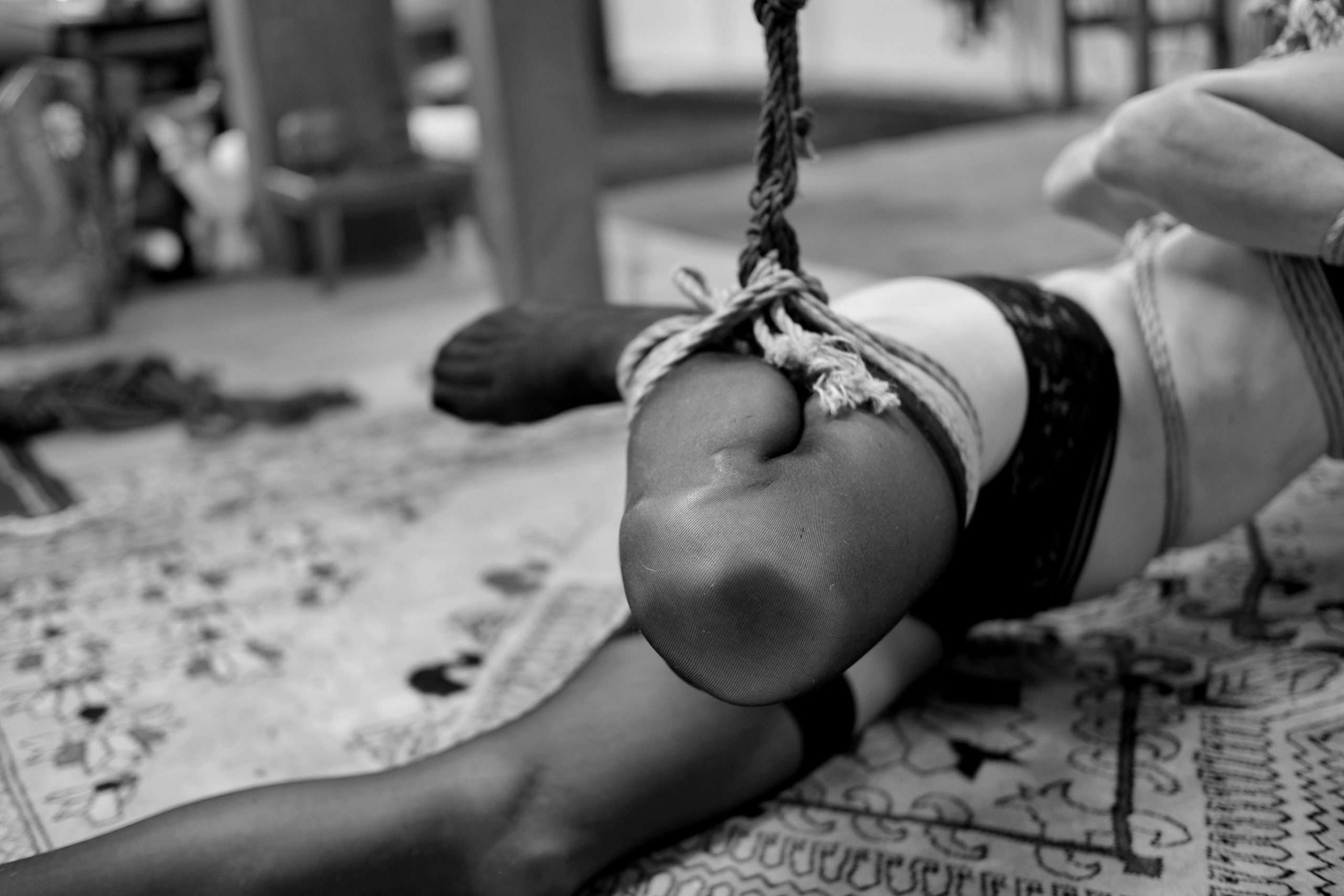
On Being “no-thing-ness” (Day4/5)

Mind as Relational

It unlikely that we emerge from the womb with a distinct sense of self. Rather, we are born crying-feeding-defecating blobs, with no sense of what is me and what is not me. A psychoanalytic premise is that it is through the process of soothing and frustrating of our basic needs that we begin to get a sense of self. An oversimplified model would be: I experience a discomfort that I don’t yet register as “hunger” (as I have no language for it) but it has me instinctively crying; a breast arrives in response to this cry and momentarily soothes this discomfort; the breast disappears (or doesn’t arrive back in time) and my need for soothing is frustrated. As the story goes, this process of soothing and frustrating my needs has me realising that I and the breast are distinct entities. Ideally, as I grow up, I realise that this breast is in fact attached to another person. This human, my caregiver, is not only essential to my survival but shapes how I experience myself: it is through my significant caregivers’ eyes that I begin to imagine myself, not only does my physical and emotional development rely on the extent to which they meet my needs, but I begin to imagine what they need from me. As my circle of significant others in my life increases, they become internalised “voices” that inform how I relate to an idea of my “self”. The self is, therefore, not just a first-person experience but a process of imagining ourselves from the outside in, through the eyes of others. What this translates into is that I know that I exist through the “other”. A baby girl cries, and she is given a bottle, legitimating her hunger. Later in her life, her father throws her a ball and he jumps up and down gleefully when she manages to catch it, demonstrating that she has succeeded in the task. We do not exist in isolation. Our minds develop mostly through interaction. And yet, we are always somewhat alone in our experience.

This developmental process is of particular importance to Psychoanalysis. For Lacan, for instance, the child is born premature, “at sea” in its own helplessness. At first, the child cannot even control its own movements and there is a dis-unity to its entire sensory experience. She can only experience the world and herself in fragments – in “part objects” (Kemp, 2006). It is proposed that from about six months the child enters a “mirror stage” – the stage in which she attempts to create an image of herself. The only thing that child has to go by is to try and resolve her “dis-unity” in identifying for an “other” (the primary caregiver). In Psychoanalytic terms, this sense of self that is lacking unity is known as the “primordial ego” – a feeling of emptiness, lack or alienation that the development of an ego (or attempt at a unified sense of self) never fully resolves. This unresolved lack is what gives rise to desire (or, in Buddhist terms, craving). For Lacan “mankind is doomed to a state that is forever split, alienated, castrated, narcissistic and destined to seek completion in the other, through desire.”  What this means is that a pervasive sense of unease exists for even the most well-functioning persons.  The recognition of this unease is central to Buddhist philosophy.

The chief tension between Buddhism and Psychoanalysis is that Buddhism (at least certain interpretations of it) proposes a relinquishing, whereas Psychoanalysis (for Lacan, at least) our desire can never be fulfilled, unity is never achieved, we are doomed to an endless seeking. Another interpretation of Buddhism, however, is not to relinquish desire, but to fully enter into it – not only the desire but the “pregnant emptiness” (to use Mark Epstein’s term) from which desire is born.

At first glance, it is a pretty bleak and contradictory picture that is being painted. Although my desire has me forever seeking unity with an “other”, I am ultimately alone (in that my experience is unknowable and not entirely articulatable to you) and simultaneously with others (I can never experience myself entirely in isolation, I can only know myself through you). “The fundamental delusion of humanity”, Master Yasutani Roshi points out “is to suppose that I am here and you are out there”. In Buddhism, the illusion of separateness lies at the heart of human’s struggle. Therefore, when I sit on a cushion I inevitably confront the interactive nature of my own being – the constant dialogue of all the voices that have been internalised during my life and, simultaneously, my own sense of alienation and isolation (even from any direct sense of a coherent and consistent self).

What is proposed here is that the only reliable aspect of our being (the focus of the therapeutic approach I wish to develop) is not so much a consistent sense of self, a fixed thing that can be discovered, but the capacity for awareness. When we start to pay some attention to our capacity for awareness, we notice that it is the one relatively pervasive quality to being human, even in Dreamless sleep (the closest we perhaps come to not interfering with or distorting our own existence) there is a form of subtle awareness that exists (see Evan Thompson). Despite this contradictory existence (aloneness with others) Buddhism proposes that we need to be weary of the ways in which we reify illusions of separateness. In our psychologised culture, we can easily fall into language traps of “othering” experience. For instance, when we talk about people as “addicts” we feed the assumption that they are “those people” defined by “that condition”. Even though Sartre might argue that there is no true essence to us as humans, for Buddhism, there remains something common to human experience: we all seem prone to similar tendencies – cravings, aversions, and clinging; and there is a particularly quality to consciousness that is luminous and insightful, accessible to all of us. However, the way consciousness is structured, especially through its mediation by language, I could perhaps never truly know your experience or fully understand why you do what you do and, at the same time, I cannot ignore our interconnectedness. Not only is your consciousness completely other to me, but even my own consciousness will never achieve a full grasp of my experience and what (or who) I am. What Buddhism calls Dukkha is, therefore, mostly likely linked to an infinite feeling of “otherness”. Yet, I am because you are.


R.D. Laing was of the opinion that we are afraid of truly experiencing our own minds (and each other).  We are petrified of our capacity for awareness and, therefore, we live mostly in a state of alienation from or denial of what we truly are.  We are only interested in finding out just enough to get by, to go through the motions of our ordinary, automated, lives.  Rather than labeling other people’s experiences, he was more inclined to enter as deeply as possible into understanding the conditions of another person’s experience.  Following this phenomenological attitude, Existential Psychoanalysis assumes that what we refer to as “mind” is not a self-governed thing that I possess and try to gain some kind of control over, but an ongoing relational event: between consciousness and world, and between consciousness and another consciousnesses.  From this perspective, it is proposed that the consciousness of the “other” poses both a problem and a solution:  Sartre elucidated how the consciousness of an “other”, as experiencing subject, is problematic for my own consciousness.  In encountering another consciousness, I am no longer the organising centre of my own universe – I encounter another consciousness which I can never quite reduce to an object in the world but that, at the same time, uses the same objects as me to organise its own world.  I am, therefore, forever at risk of being reduced to an object in the other’s consciousness.  However, as the contemporary philosopher Wilfried Ver Ecke illustrates, the gaze of the other is not entirely problematic – although the “look” of the other might leave me vulnerable to objectification (and therefore degrees of shame) at the same time (especially in our childhood development and, perhaps, other relationships such as therapy) we depend on this organising other to help us mediate our own subjectivity (for example, to develop a sense of justifiability for existing in the world).  The gaze of the other is usually objectifying but it can be affirming and it can facilitate agency and change.  In terms of what constitutes a therapeutic encounter, I am interested in how we might avoid an objectifying gaze and cultivate a more facilitative gaze (when we refer to the gaze here, we are obviously not just talking about the conventional understanding of visual gaze but the gaze in all the senses involved in encountering another, including how I hold the other in my imagination).  As I can never truly know the consciousness (or experience) of another, as a therapist I must constantly imagine what your experience is.  This is a great responsibility, and I must approach it with caution.  I have found that diagnostic (or any dogmatic kind of thinking) is not a very helpful form of imagination.  The challenge, therefore, is how to hold a person in regard without objectifying them.  This is something that we will explore further (see Levinas).

My Nurse and I, by Frida Kahlo

The role of therapy and psychoanalysis

The word “analysis” has its origins in “breaking apart” of something into its constituent parts. I don’t think that it is entirely uncommon for clients of conventional psychoanalysis to feel somewhat broken down or taken apart by the analytic process. I certainly felt this way, even during my training, being broken into constituent pieces. I can recall leaving my psychoanalytic lectures feeling particularly scrutinised rather than encouraged. Even my own clients tell me that I can sometimes be “brutal”. I think that it is important for a therapist to be as honest as possible. As Nietzsche declared in Beyond Good and Evil, ““The strength of a person’s spirit would then be measured by how much ‘truth’ he could tolerate, or more precisely, to what extent he needs to have it diluted, disguised, sweetened, muted, falsified.” But this dismantling of our barriers of denial is a delicate process that should be done in a spirit of care and in solidarity with the client’s own will. Unfortunately, it is not uncommon for Psychological and Psychoanalytic literature to speak of the psych or the person with the assumption that they can be broken down into working parts. There is, however, an Existentialist move through works as Sartre and Heidegger (and those that followed, such as Boss and Binswanger) towards a contemplation (rather than analysis) of our “being in the world”. What then can we call this? It can perhaps no longer even be called “analysis” and it is perhaps no longer an analysis of the psyche but a consideration of our being-in-relation-to-becoming. This will be the focus of our work here. From this perspective, the mind is an ongoing relational event rather than a thing and we should perhaps move our analytic focus away from the idea of an individual psyche to an appreciation of how we are in a constant relationship with our own thoughts, experiences, each other and the world.


Other than feeling like you are being broken down into separate parts, it is concerning that the therapeutic gaze tends to make objects of us; reifying the notion of a fixed self, especially through categories of this or that kind of person, interpreting the meaning of our lives through the notion of symptoms. Taking inspiration form Laing, the Hungarian therapist, Andrew Feldmar, describes how the original meaning of the word “therapy” was to “attend to” or to “let be”. The therapist’s job could, therefore, be understood as a return to this original meaning – to let be, to meet the person where they are at. What if therapy should rather be an invitation to be what we are? What if experiences such as anxiety, melancholia, emptiness, isolation, obsession, addictive cravings, and our aversions are common-place responses to the ontological insecurity that comes standard with our own existence (exacerbated by life trauma and love gone wrong), rather than illness processes in minds that have supposedly gone wrong?


The conditions of experience

The Buddhist claim that separateness is an illusions is supported by their appreciation of “conditional arising” – nothing can be separated from the conditions from which it arose. According to Stephen Batchelor, it is accepted in all schools of Buddhism that “whatever is born has arisen from a cause” and that “something that is whole has been made up of parts” which implies that “all things depend on each other”. There are also specific and unavoidable causal factors that are emphasised in Buddhism: the fact that we are born and that we will inevitably die, are key conditions to be considered. Hence the underlying Existential flavour to Buddhism. At the very least, we are born into a world where our senses make contact with a reality that immediately gives rise to an experience. This experience then gives rise to craving, aversion or clinging – known as “tahna”. The extent to which we might inherently avoid, seek out, or cling to an experience contributes further to the already inevitable “unsatisfactoriness” of our experience (the disunity described earlier). Buddhism proposes that bringing conscious awareness to this process – of how we hanker on to some experience and evade other experiences – helps mitigate the perpetuation of ignorance and suffering. When we sit on a cushion, we are inevitably confronting the inevitable arising of this “tahna”.

It is important to note here that the notion of conditional arising should not be understood in simple behavioural psychology terms. It is not a mere cause-and-effect relationships or stimulus-response psychology. Albeit that the “effects” are entirely dependent on the “causes”; the “causes” are also dependant on the “effects”. There is no “cause” without its “effect”. It is perhaps better, then, to call it “interdependent arsing” – a simultaneous event, rather than a linear event. There is a common causal moto in psychology: “No behaviour is repeated unless it serves a function”. Curiously, that function doesn’t have to necessarily be positive or make logical sense. We perpetuate our own suffering in more ways than we would like to admit. “Don’t fall in love with your suffering” warns Slavoj Zizek, “Never assume that your suffering is proof of your authenticity. Renunciation of pleasure can easily turn into the pleasure of renunciation itself.” We often take great comfort in the discomfort of our own “symptoms”. Even the Buddhist path can easily become “the pleasure of renunciation itself” (yet another craving) when what it should arguably be is the preparedness for accountability for how we respond to an increasing awareness of the facticity of our own existence. South African musical genius, Chris Letcher, sings “The world has done things to you, but you have done more to yourself.” Vipassana (insight-based meditation) can be a means through which we find the meeting place between what the world has done to us and what we do to ourselves. It is, ultimately, a treatment model for ignorance and a readiness to address how we react to our own ontological insecurity.


Samsara

I may find that, regardless of how much I do or do not achieve in my life, I am plagued by a vague, free-floating, feeling of perpetual inadequacy. Perhaps this was first caused by how my father used to speak to me when the expectations that he had of me were not met. He needed me to be a certain kind of boy, which I was not. He was harsher than he was encouraging. Out of fear of this harshness I would shrink away from experiences rather than try and explore them in my own way. This gave rise to a deeply engrained pattern of withdrawal that manifested in a shyness about being in the world. This very quickly settled into a dreamy, disengaged, inertia (I can still slip into that inert state at even the whiff of disapproval or disappointment in myself). In this way, a cycle is created that starts with: 1) a vague feeling of inadequacy; 2) giving rise over time to a pattern of inertia; 3) leaving me feeling like I am not living up to my own expectations; 4) which compels me to further feelings of inertia; and therefore 5) posing the risk that self-expression continues to become less and less likely. The outcome is what psychology calls a “lack of self-efficacy”. It makes it difficult to have courage to be spontaneously and authentically in the world and more likely to take refuge in “bad faiths” (a concept introduced by Sartre that we will elaborate on) or familiar patterns of behaviour.

What if these thinking-feeling patterns are the true Samsara, the real cycles of suffering? When we are caught up in cycles like this for long enough, we feel stuck, we lose hope, it starts to feel like we don’t have a solution. What is depression other than a loss of hope? And, how do we break these stubborn cycles of suffering? As my therapist once said to me, “Jason, stop doing what you have always done and do the thing you don’t know how to do”. But, it is often in these moments, when we are caught up in these hopeless cycles, that our “tahna” escalates as our cravings are an attempt at escaping painful cycles. The cravings that manifest are not sins to be condemned but, more likely, an attempt (no matter how poor) at providing a necessary escape. At its worst, the need for escape will have us fantasising about our own ending. Suicide is not only in a final act. We are often complicit in a slow exit from our own lives, but most attempts at escaping (whether through substances, beliefs or behaviours) usually end up perpetuating the cycle of suffering, as Laing pointed out, of the “the pain that comes from trying to avoid pain.”

We all have moments where we seem to sabotage our own lives in attempts to resolve our perpetual suffering. Over time we can become deeply at odds with who we think we are or where we are at in our lives. It is important to catch ourselves out; to notice the ways in which we abandon ourselves. Novelist, Daniel Stern wrote:
Everywhere there were people living out their lives using aspects of suicide against themselves. They did not even have the authenticity of the final act to speak for them. Suicide is, in short, the one continuous, every-day, ever-present problem of living. It is a question of degree. I’d seen them in all varying stages of development and despair. The failed lawyer, the cynical doctor, the depressed housewife, the angry teen-ager…all of mankind engaged in the massive conspiracy against their own lives that is their daily activity.

In an attempt to end our own personal samsara, to escape the agony of our own perpetually unsatisfied longings, we all have a propensity to commit to a slow unofficial suicide through being at odds with ourselves, and our longings, just going through the motions of everyday activity. We do not live the lives we could be living. We gradually shrink away from what we might truly desire. “There is only one really serious philosophical problem,” Camus says, “and that is suicide. Deciding whether or not life is worth living is to answer the fundamental question in philosophy. All other questions follow from that”.

Through meditation we are committing to bringing consciousness to these perpetual cycles. We are committing to the courage to enter into our own longings more deeply and discover the conditions from which they arise. Entering into longings that are inevitably never fully met can leave us feeling more alone and empty than ever. However, as Mark Epstein puts it, this empty feeling is a “pregnant emptiness”. He encourages that, “Longing, fully felt, carries us to belonging. The more times we traverse this path — feeling the loneliness or craving, and inhabiting its immensity — the more the longing for love becomes a gateway into love itself.” What if it is not about relinquishing our desires but about fully entering into them?

Laing meditating

Navigating our way through Samsara (as habitual cycle):

It might help us to navigate our way through these habitual cycles by looking at a Buddhist psychology (story) of how these cycles of thought might typically manifest:

  • Habitual thought stirs at a subtle, preconscious level.
  • There is an underlying reaction to this stirring, prior to it being fully conscious.
  • In the moment of becoming aware of these thoughts (that are now embedded in further reactions or thoughts) I am most likely to identify with these thoughts.
  • This leads to several consequences, fuelled by tahna: acting on them; dwelling on them; embellishing them; opposing them; attempting to resolve them…
  • I act on this and my habitual tendencies are strengthened.


The past arrives in the present

The analytic traditions of Western psychology may be at risk of overemphasising how our lives are shaped by our childhoods but, from a meditator’s perspective: the past is relevant as far as it manifests in the present. It is as if there are these rabbit holes in our minds that open us up to feelings and mind states from our pasts. The solution does not necessarily lie in trying to go back into the past, but in recognising the past when it arrives in the present. How the past stays relevant in our present is through the ongoing momentum of these cycles. My father is long dead, but he stays alive in me, in good and bad ways, but especially through the habitual cycle of feeling inadequate. As Don Maclennan’s poem, Grieving highlights:

Why do we persist inhabiting old rooms
in houses where we grew to size,
enacting dramas in the attic or the music room
with its dusty bookcases and faulty piano?
You’d think our greatest gift was consciousness,
something to hold us cleanly in the here and now.
But you have grown to size inside me –
that’s why losing you hurts so much.

The houses where we grew to size have grown to size within us. My pattern of withdrawal was born out of a relationship in my past and it will reaffirm itself in the relationships in my present. My father is long gone, but his impact on my life can sometimes manifest in how I perceive a moment. The only remedy is to be present to and embracing of this.


Before the world told you who you are

I was not born feeling inadequate, experiences I had in relationship with others invited feelings of inadequacy into my life. Sartre argued that there was no true essence to (wo)man, we invent this essence through our actions, defining what it means to exist. Buddhism pays attention to how we react to our own “facticity” (the fact that we exist in the first place). It is an attempt to return to the “pregnant emptiness” of our existence. “Can you remember who you were,” Charles Bukowski asks, “before the world told you who you should be?”

There is a plethora of possible mind states between our propensity for suffering and joy. From the moment we come into the world, there are many conditions that we might experience that eventually give rise to relatively fixed states that we see as “just who we are”. Laing seemed to believe that every mind state we entered into was a kind performance of who we are. He encouraged a curiosity in these various states of mind, rather than a fear for them. He believed in proving to ourselves that we had some freedom in moving between these states. It is through meditative practice that we hope to open ourselves up to being curious about the possibilities of human consciousness.

If we look at this idea of cycles of thought and behaviour discussed earlier, then “Depression” is the effect, not the cause. To say I can’t get out of bed in the mornings because I am depressed is a description of the “effect” and not the “cause”. To have true insight, we need to be able to bear witness to the interdependent arising of depression. Whether the terms Bipolar, Depression or Borderline are helpful terms to summarise what I am experiencing or not, they should not be mistaken for a full understanding. True understanding lies in understanding the conditions through which my “symptoms” arose, through noticing the arising of these conditions in the moment. We cannot get away from the fact that these conditions, that we are in the habit of speaking about as if they exist in some concrete form within us, are actually “relational” in origin: their origins are between people, rather than within the person. Our capacity for thinking and experiencing has developed through relationships, and so, my depression does not manifest “in” me, it manifests “between” me and the world: as a result of my experience of it. Depression is often, for example, the result of the experience of oppression that keeps us feeling stuck and hopeless. You can’t imagine how many people feel oppressed by the subtle dynamics in the average family system.

For Laing, the job of the therapist was not to do things to the patient, but to “let be”. This is perhaps true for all relationships: we struggle to “let be” and rather want to shape each other according to our own desires. The work of an Existential therapist is to hold off on interpretation, avoid telling you how to live your life, and find delight in who you are (including everything you could be). We bring this attitude to meditation, through an attitude of “equanimity”, allowing as to be with things as they are. The great philosopher, Ludwig Wittgenstein, declared in Philosophical Investigations (the work that he hoped would put an end to philosophy): “Don’t think, but look!”; “Only describe, don’t explain.” The moment we describe something, even to ourselves, we change it. Mark Epstein talks about his first, disappointing, encounter with psychotherapy as arriving with the hope of an “experience” and coming away with only an “explanation”. What we are doing when we are meditating is giving way to direct experience, rather than settling for explanations that alienate us from the vitality of the moment. When we practice Vipassana, we open ourselves to experiencing what is, rather than living through ideas of who and how we should be. We explore the freedom of choosing what to do with what our existence, so far, has done to us. We put away the answers and allow ourselves to become questions to ourselves.

On being “no-thing-ness” (Day 3/5)

The Psychology of meditation

Ultimately, through a meditative approach to analysis, we are hoping for a different kind of insight. We are hoping for something more felt and instantaneous in consciousness, something that words can only try and make room for but that cannot be found in words themselves, but in the pauses between them. This is a shift away from the tendency to name, explain and pathologize our struggles as conditions of a self-like-structure. It is an invitation into an appreciation of the self as an unfolding process in relationship to a world it is embedded in.

For an Existential Phenomenologist, the task of the philosopher is to skeptically enter her own stream of consciousness and describe what she finds there. This fits neatly with the ambitions of insight-based meditation or Vipassana and the intention of “being with what is, no matter what it is”. Even though Irvin Yalom (esteemed Existential Psychotherapist) is not a meditator he prescribes solitude, silence, time, and freedom from distractions, as the ultimate therapeutic method. However, as Montaigne might have proposed, solitude without method can be at best fruitless and at worst dangerous. Traditional Buddhist methods of solitude can also be rather mentally destabilising for the average Westerner. Solitude does not even have to mean being completely cut off from other people or our everyday lives. Solitude (as an attitude) can simply be a method of making it possible to attend to what is really going on, right here and now. This could be awareness of a particular anxiety; a strong craving; or ways in which we may be feeling relatively stuck or depressed. Vipassana offers us a specific way of being aware of these states of mind, in their moment to moment unfolding, saving us from being overly swept away by them. Although it can be seen as a kind of training exercise, this way of being in the moment does not only apply to when we are formerly sitting on a meditation cushion. Ultimately, it is a means of practicing coming to terms with what is really going on and what it means to be alive.

In a recent interview with Trevor Noah, Jim Carey summarises existence as “None of this is real and all of it is true.” When it comes to thought and emotions, how do we distinguish what feels real from what is true? Vipassana offers a method for this; a systematic means of attempting to see things as they arise, or as the phenomenologist would say – as they are given to us in consciousness.

The origins of Mindfulness

Vipassana emerged out of Southeast Asian countries, such as Burma. Due to increasing contact with the West there was a need to preserve aspects of their own culture, therefore returning to some of their own original teachings. Simultaneously, there was a growing interest from some Westerners (partly brought on by the influence of psychedelics) in exploring what human consciousness was all about. Western curiosity and distilled Buddhist teachings found a meeting place in these countries. Vipassana is now widely considered by many Buddhist teachers as foundational to meditation and is particularly secular in its focus. Vipassana is sometimes knows as “insight-based meditation” but in the western world it has become popularised as “mindfulness”.

The Basic Method

The basic method is to start with finding calm. This is followed by the main task – sustained attention to the “present moment”. From this perspective, access to the “present moment” lies in our sensorial experience. Most typically we rest our attention on either our breath or sound. These are known as meditation “supports” or “anchors”. The anchor you choose can have a slightly different impact on your experience, each with its own challenges and benefits. Following your breath tends to help you achieve calm, it puts you in touch with our own facticity (the fact that you are in a living breathing body) and it is a sign of life that is unfolding in the moment. However, even though breathing happens automatically, we have the ability to manipulate our breath which can get in the way of an attitude of being with things as they are. Allowing your attention to rest on the sounds around you can sometimes be a bit more difficult to access, but sound is truly a phenomenon of this moment. Sounds tend to arise and fall much like thoughts do and attention to this coming and going can help one ease into a meditative attitude. Our tendency, however, is to name and embellish the sounds, make more of them then what is actually there.

The objective is to have no objective, to try and inhabit a sense that there is nothing to be done and nothing to be achieved. We spend most of our day in a doing, thinking, achieving mindset. It is often taught that one should imagine you had two minds, one for thinking and one for observing and it is the observing mind that you want to enter into. My phenomenological critique is that it is unlikely that there is an observer behind consciousness from which we experience the world. It is, nevertheless, fascinating that there is a faculty of consciousness that takes on this experiencing role – the reflective awareness that an experience is being had. We won’t go into this now but there are likely to be many cognitive faculties involved here, including working memory. However, what seems to make room for this ability to observe rather than become swept away in participation is an attitude of “impartiality”. Part of this artistry lies in resting our attention on our sensory experience “effortlessly”. The most common challenge is that we try too hard.


The inevitable arising

What you will experience is the inevitable arising of thoughts. Thoughts simply stir up of their own accord. This is not thinking. Thinking then occurs in how we engage in these original stirrings in the mind. It is remarkable to notice just how attached we are to our own thoughts and thinking. The task from here is perplexingly simple – when you realise that you have been swept away by your own thinking, you notice this, where you mind has taken you, and you gently bring yourself back to the sensory support. This helps us achieve a stance of impartiality we are hoping to develop. It is important to note here that the task is not to achieve a state of no thought: thoughts and thinking are inevitable, but the Buddhist attitude is that “thoughts in themselves have no power”.

As we continually bring ourselves back to the anchor, we start to make room for a clearer view of things as they are, that is less clouded by our own reactivity. As we become more rooted in a stance of being able to observe ourselves with impartiality, we get an increasing sense of “things as they are”. Over time, this gives rise to a more spontaneous kind of insight. In other words, this is not a cerebral kind of insight but a simple seeing and accepting things for what they are. Over time, regular practice allows for a clarity of mind that, ironically, cannot be the achieved through striving to achieve it. Although the initial practice is to continually bring yourself back to the meditation support, training sustained attention, practitioners like Stephen Batchelor promote a progression to attending to all that is given to us in consciousness, thoughts included. It is, therefore, important not to enter into a wrestling match with your own thoughts but to reach a point where you can attend to their naturally arising as if they were a passing sensation. The outcome is necessarily about achieving a state of bliss or calm, but rather practicing being with things as they are without becoming overly reactive, making room for a quality of attention to experience that helps brings insight. This is not easily achieved at first and so what follows are a few basic suggestions drawn mostly from Stephen Batchelor.


Basic steps to Vipassana

Attending
Simply bring your awareness to your own breath. Actively using your breath to achieve a sense of calm in your body. Taking deep, deliberate breaths at first. Begin to follow the breath all the way in and all the way out. Perhaps taking special note of the pause between breaths. Allow the sensation of your breath to bring attention to the fact that you are sitting here in a living breathing body, pinned to the world by gravity. When you are ready, allow your breath to return to its natural rhythm. Try not to interfere with the breath any longer. Simply notice how your body breaths, on its own accord. This is where we can begin to practice approaching experience as an impartial witness, entering into the capacity to experience yourself experiencing. Let your attention come to rest on your breath. See if you can allow your attention to ride your breath all the way in and all the way out.


Arising

Even though you are attending to your breath. It is simply your anchor. You can still cultivate an openness to whatever is going on in this very moment: bodily sensations; the natural and inevitable arsing of thoughts; underlying feelings or attitudes (even towards yourself); the sounds of life around you. It is remarkable how thoughts inevitably arise as brought in from some deeper current stirring in the mind. It is difficult to sense their moment of origination and by the time we know they have arrived, we are usually already caught up in them: usually taking the form of fantasies about the future or rehearsals of the past. This is also where our Ahamkara (“self-making”) becomes most obvious through our preferences of like – don’t like; want – don’t want; me – not me: an ongoing tendency of grasping and aversion. But, when you find yourself lost in thoughts and thinking, you simply notice that where you have ended up, what you are doing there, perhaps even how you get there and remind yourself that you can anchor back into the sensory support. In this way the sensory experience (usually your own breath or the sounds around you) serves as a reference point for the what is going on here and now. This is not so much about clearing your mind of all thoughts but in gaining perspective on your own experience and, especially, on how thoughts and thinking colour that experience. The problem is not the thoughts in themselves but how we involve a self in these thoughts. A good term for this is reactivity.


Reactivity

Thoughts arise seemingly out of nowhere. They don’t seem to require much conscious involvement from us in their initial arising. But as they arise, we become more and more involved in them. There are many habitual ways in which we become involved in them. Some unique to ourselves but, overall, we seem to have many shared tendencies (especially within any given culture). For example, we make constant comparisons – “is this good or bad” and react accordingly through either clinging on to that which we like and showing aversion for that which we don’t. This seems obvious and harmless but it is the foundation of the “I” position we discussed in Day 2. Not only do we establish an “I” but when we judge these thoughts as good or bad we judge ourselves for thinking them. The intention is to participate as little as possible in the arising of thoughts as we take note of the shape and shaping of these thoughts. Over time, this gradually introduces us to the reactive nature of our minds. The hope is to move away from habitual reactions to more conscious responsiveness. Much like the relation between dreaming and lucid dreaming – there is a quality of awareness that we would like to introduce that enables us to participate more effectively in our own lives. The basic premise is that unnecessary suffering is caused by attempts at escaping things as they are. From this perspective, the therapeutic outcome is a facilitation of “embracing the totality of experience” to use a phrase by Stephen Batchelor. Perhaps following from his interest in Buddhism, R.D. Laing suggested that:

“There is a great deal of pain in life and perhaps the only pain that can be avoided is the pain that comes from trying to avoid pain. ”


Sati Sampajanna

What we call “mindfulness” in the West refers to the Sanskrit term Sati Sampajanna which can be translated to “remember the present”. In order to “remember the present”, we continually bring ourselves back to the meditative support: something to hold us in the here and now. It is our senses that give us the most reliable access to the present, but they can also serve a place of refuge from how incessantly restless and reactive our minds are. If we break this term down – to remember the present – it may not just be about being in the moment (as is commonly understood) but in re-collecting ourselves around this moment. It would be almost impossible to function only in this moment and only from moment to moment. Much of life requires an anticipation of the future. It may even be possible to hide from life in the present moment. The objective here is, therefore, much more therapeutically minded – to use the reminder of the sensuous immediacy of what is happening here and now to help prevent us getting overly consumed by neurotic and delusional preoccupations with past and future. The preservation of a “self”, the “I” position that arises in relation to thoughts and experience seems instrumental in perpetuating our neuroses and delusions.


Spaciousness

Over time, what we intend to cultivate is a certain openness or spaciousness where the habitual patterns of the mind tend to lose their momentum. This may allow for a bit more freedom from our own reactivity to what we believe is going on in the here and now (often clouded by past ideas and experiences). This is where ideas about our “self” become less fixed and where we might find it a bit easier to “be with what is”. This also requires the practice of letting go of attachment to our thoughts, feelings, aversions, and cravings. The present moment, therefore, serves to hold us as we let go of the fixed grasp we have on an ”I” position (this is me, this is mine) in relation to experience. Experienced meditators often describe this as a feeling of spaciousness.

Coming to terms with our habitual tendencies:

1) What are particularly habitual thoughts you may be having at the moment?
2) What kind of reaction do you have to these thoughts?
3) What “I” position is involved in these thoughts?
For example: 1) “Did I leave the stove on?” 2) “The house is going to burn down” 3) “I am such an idiot, I always ruin things”.

Can you see how, when the self takes up a certain position towards a thought or experience, there is usually some sort of identity attached to this position – “I am such an idiot”. There is usually also a theme or story in your life that form part of this identity formation – “I always ruin things”. This identity and these themes tend to inform what we anticipate about the future. But, what if we made room for something new?

« Older posts

© 2026 Jason Ross

Theme by Anders NorenUp ↑