Jason Ross

PhD Philosophy & Psychoanalysis

Page 2 of 6

On being “no-thing-ness” (Day2/5)

An existential Buddhist analysis of the self as the “struggle to exist”

Day 1: The Phenomenology of Consciousness as Sunyata

For Sartre, consciousness is a lack. To understand consciousness is to understand lack. It is a “lack” because consciousness is only ever consciousness of some “thing”. Consciousness, in itself, is empty. It is from an appreciation of this “lack” that all other existential givens (emptiness, impermanence, angst) potentially flow. The idea of consciousness as a “lack” also offers an alternative explanation to what traditional psychology interprets as “pathology”: both psychosis and neurosis are born out of a particular relation to this lack. But it is not only modern psychology that might have misrepresented what flows from this lack. For example, religious Buddhists are in the habit of problematising desire. For the existentialist, especially a Sartrean, desire is inescapable because of how it flows from this fundamental “lack”. When we talk of desire, here, we are not only talking about sexual desire but all and any desire can be seen as a longing that springs forth from our lack. Ultimately, our longing is to be something solid. As my PhD supervisor, Prof Kevin Boileau succinctly illustrates in Essays on Phenomenology and the self (2012):

Consciousness is lack and, as such, creates its own fundamental project that varies among individuals. But for all of us this desire is a desire for a future fullness, which is the desire to be a substantial self and yet to remain a free consciousness. It is a desire to be an object among objects while remaining free, which is an impossible project according to Sartre.

This is where Buddhism, read as a radical existentialism, makes sense: It is not so much that desire is bad (as religious connotations would have it) but that desire (or tanha in Buddhism) is an “impossible project” as we never really fulfill our desire for “future fullness”. This also links to the Buddhist idea of “anatman” – denial of the self. As already mentioned, there is no self to be found as the originator of consciousness. In the more radically existentialist branches of Buddhism (proponents of Early Buddhism or aspects of Zen Buddhism) there isn’t even a likening to Sartre’s idea of a “pure consciousness” (the appreciation of conscious experience free of ideas about the world), only a “sense consciousness” (the censorial, non-dual immediacy of consciousness in world). See for example, this verse supposedly uttered by the Buddha (source unknown):

In what is seen there should be just the seen
In what is heard there should be just the heard
In what is sensed (smell, taste or touch) there
should be just the sensing; in what is thought
there should be the thought.

In Buddhism, everything, including the self is “sunya” – lacking essence. Everything arises and falls according to conditions; nothing is self -determining and we live out a constant attempt to fill this lack. As David Loy points out, in Lack & Transcendence (2018), even our sense of time may originate from our attempts to deal with this lack. Without our concepts of time, we risk falling into an abyss. However, with a sense of self comes an underlying fear of lack as there is nothing solid to this sense (of self) – it is as fleeting as any other sensation. The “sense of self” is exactly that – a “sensation” (or a collection of sensations). Anxiety is, therefore, not something we have, or suffer from, but something that we are. Anxiety is the knotted belly of the sense of self because what underlies our sense of self is a dread that we, actually, do not exist. This usually manifests as fear of death. In order to shrink back from this anxiety, we tend to shrink away from life itself. It is not just our own death we fear, it is as if we fear being rubbed out by experience and so we cling to ideas of who we are. In this way, as David Loy puts it, fear of death doubles up as a fear of life. From this perspective, Buddhist methods can be viewed as a means of embracing the totality of life rather than a nihilism (as it is often interpreted as). But, to embrace life, we must embrace death or at least “lack” – Sunyata.

It is well-established practice to consider death in existential analysis. However, death tricks us: death is most present in its absence, when we are alive, but when we are finally dead we are not present to our own death. Our death is ever present, through our anxiety about it, and yet never fully realised. The radical existential view is that there is nothing to fear but our own “no-thing-ness”. However, according to both Buddha and Sartre, being “no-thing” is the actual answer. David Loy speaks about how meditation can be a practicing of death without dying. For Loy, it is not so much that we fear death (as many other Existentialists might report) but that we suspect that we don’t really exist in the first place. Therefore, much of our behaviour (and our neurosis) is perhaps fed by this fear of our “nothingness”. Perhaps we all, ultimately, yearn to have some sort of special value or meaning in the world? And, it is perhaps only through the “other” (through the way is which others hold us in regard) that we hope to feel “real” enough (this facilitative role of the gaze of the “other” will be explored in further in Day 4.

The experience of “things”

It is not all lack, we still have an experience and it is important to understand experience in order to deal with it. It was Husserl, the pioneer of phenomenology, who pointed out that conscious experience is always in regard to some “thing” and the experience of these things is clouded by the concepts that we have about them (I would add here – clouded by the concepts we have about ourselves and others). Husserl’s phenomenological ambition was an attempt to “get back to things themselves” and to achieve this, he suggested that we “bracket” our ideas about the world in doubt. Consciousness is also not a continuous or solid event, but is made up of individual “mind moments” (to use a Buddhist phrase). These “mind moments” occur within the context of a state (or as Heidegger might call, a “mood”). Consciousness is more of a constant flux between these states than a continuous experience. Sartre adds to Husserl’s work by indicating that we construct an “I” (and a “you” for that matter) that we treat as a “thing” to be held in regard in consciousness. Furthermore, the “self”, this supposed “thing”, is something we try and anchor into within the flux of consciousness. Yet, as with all “things”, the self remains empty of any “self-being” or “self-origination” (again, these are common Buddhist phrases that I am applying to phenomenology). It becomes particularly troublesome when we encounter another consciousness in consciousness as our tendency is to reduce that other experiencing subject into a thing (just like any other thing, such as a table or chair). We will explore this a bit further in Days 4 and 5.

We are essentially meaning making creatures, yet, at the same time, we also have the capacity to “dis-identify” with the meanings we have attached to things. Phenomenology is an attempt at bracketing our ideas about the world in order to reveal how they potentially obfuscate experience. This is, perhaps, to some extent what meditation is – a practice of dis-identification (or unlearning) of the concepts we attach to things and how we experience them. But, the meaning we give to things are not stand alone “things” in our heads, they are manifestations of overall, shifting, states of mind. Put another way: our thoughts are very much caught up in our states of mind, like driftwood in a current. In psychology this is called “mood congruent thought”, but it seems even more encompassing than this – my state of mind colours the world I experience and, therefore, how I tend to react and act in response to it. Furthermore, my actions and reactions seem to have a way of perpetuating the states from which they arose.

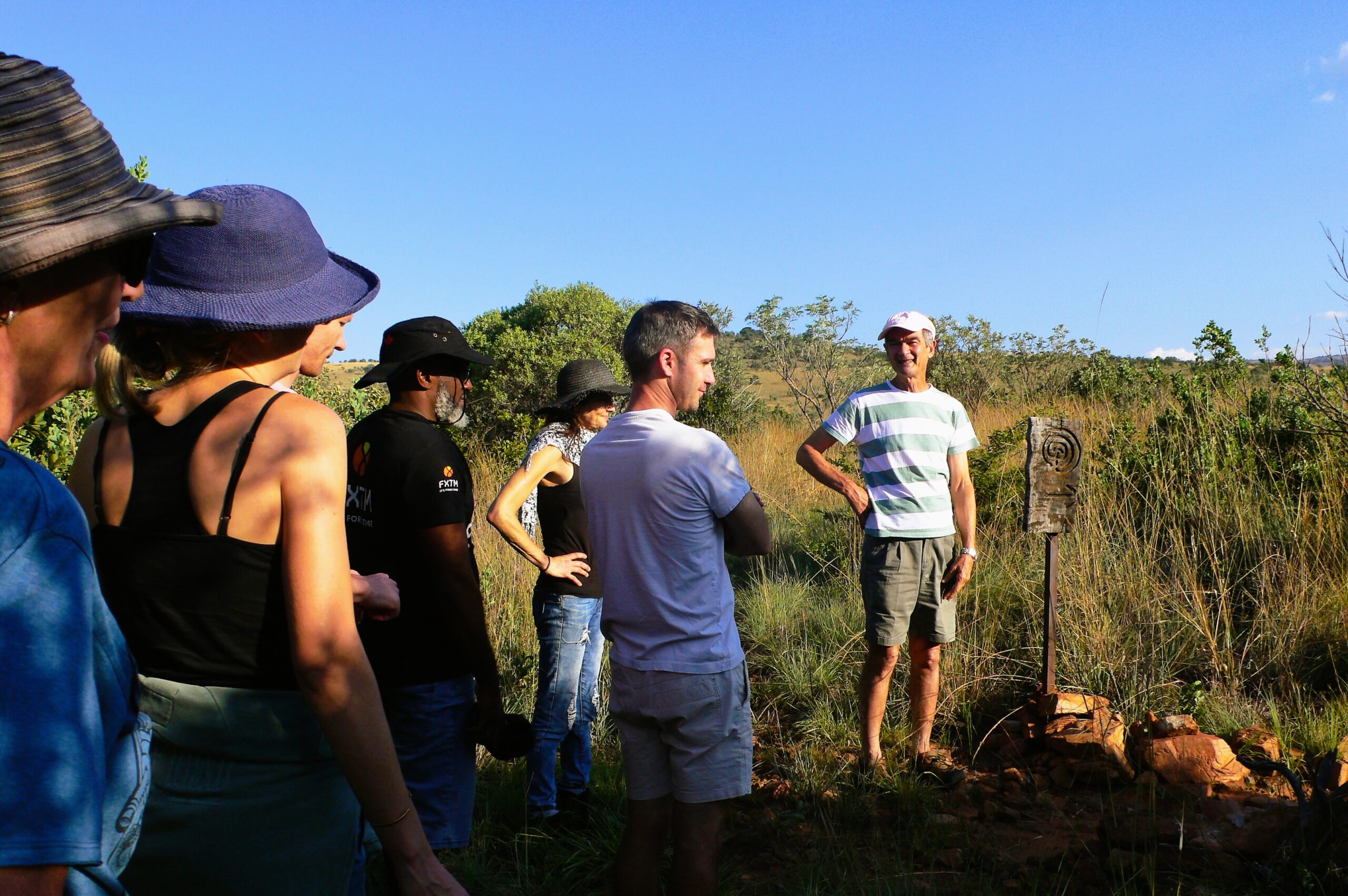
Mervyn Croft guiding us to the Labyrinth

Consciousness and “I”

Can Husserl’s ideal of “pure consciousness” ever be experienced? Is this the fantasy of enlightenment that Buddhists have entertained all along? Can we ever truly see things “as they are”? Is experience not always adrift in a murky sea of language? Is consciousness ever a state-free experience? Perhaps the best we can hope for is that a meditative attitude towards experience puts some insight generating distance between our experience and the meaning that we give to our experiences? In the end, the problem may not be that we are thinking animals, or the thoughts in themselves (the meanings we give), but the fact that we cling to these “things” (thoughts, meanings, assumptions, conclusions) so tightly. It seems possible that even the states we don’t seem to enjoy are sometimes clung to out of fear of unbecoming what we think we are.

Yet, for Sartre, consciousness in its purest state is spontaneous and autonomous; “nothing except consciousness can be the source of consciousness”. Likewise, a commonly purported verse from the Buddha being “there is no thinker only the thinking”. Sartre did, nevertheless, concede that in “I think” there is indeed an “I” that thinks. But, he proposes that it is an error to misinterpret this “I” for a “self that has been there all along”. It is only upon reflection in consciousness that an “I” is constituted. Therefore, we don’t discover a self through reflection, we create a self by reflecting on experience. If we take any guidance from Sartre, the notion of “introspection” is an unreliable process as reflection always “affirms more than it knows”. Therefore, his conclusion is that we should attempt to return to the reliability of “instantaneous consciousness”, or in Buddhist terms “sense-consciousness”.


We can therefore conclude that the unreliable process of “thinking” takes up an “I” position. We can also entertain that in meditative practice, it is not the self that relinquishes thoughts (as it is often instructed in meditation guidance material) but the thinking that momentarily suspends its “I” position. A therapeutic event could, therefore, be the process of finding the ongoing freedom to relinquishing the “I” position in consciousness. It is unlikely that this becomes a permanent state but rather that this makes room to giving rise to renewed self-constituting moments? A therapy based on these ideas appreciates how we reconstitute a self in every given moment, encouraging a more nimble mental process.

“Do you think I count the days? There is only one day left, always starting over: it is given to us at dawn and taken away from us at dusk” – Jean Paul Sartre

Not making objects of ourselves

Following on from phenomenology, Existential Psychoanalysis attempts to understand consciousness as an experience, from the inside out, rather than explain it as a thing from the outside in. Our “sense of self” is considered to be a part of this experience rather than an objective thing to be accurately known and from which we reliably experience the world. A primary aim of Existential Psychoanalysis is, therefore, not to treat people as mere things. Taken even further, time, space and consciousness are not the containers of who we are. Rather, we are manifestations of time, space, and consciousness. We are time, form and consciousness busy happening. Existential Psychoanalysis’s interest is not limited to intrapsychic processes (the things that go on in our heads) and does not take for granted that the models we have for how consciousness is structured tangibly exist because consciousness cannot be understood from some objective external viewpoint. Not only does an existential approach treat these models (for example, of consciousness and unconsciousness, or ego and superego) with caution, its interest extends beyond the notion of a mind to an interest in how the world is given to us in consciousness, and an understanding of the encounter between our being and the world from which it manifests. What happens, in a continuous flow of fragmented moments, when the surface of our being makes contact with a world? Taken a step further, from an Existential perspective, the beauty of consciousness is that it allows us some intervention in our own existence: we are not just amoebas floating in an indifferent universe and we are not purely at the mercy of our own drives and supposedly unconscious processes. It is with this in mind that we turn to Secular Buddhist methods of meditation as a means of discovering how the world is given to us in consciousness (explored further in Day 3).


Letting go of what?

When it comes to mediation, there seems to be a misconception that it is a means of “clearing your mind of all thoughts”. It seems possible that the attitude of an “I” that lets go of a thought will simply serve to solidify this “I” by keeping it vigilant to the threat of new “distracting” thoughts. This is a potential language trap that much of modern Buddhist teachings fall into. But if we return to some of the original teachings, as already mentioned there is no thought without a thinker and no thinker without thoughts. Both thinker and thought are simultaneously arising events. It is more likely that the meditation is about relinquishing the “I” position taken up in response to an event/experience/thought than relinquishing the thought itself. In Buddhist terms this requires an attitude of “equanimity” towards all of experience.

This brings us back to Husserl’s basic premise: that consciousness is always a consciousness of something, what became known as “intentionality”, highlighting that experience is always directed towards things in the world. Building on this, he pointed out how we develop a “natural attitude” towards experience whereby we readily accept the “givenness” of the world around us as we encounter it. We have a tendency to include our “self” and the selves of others as these actual objects (an idea elaborated on by Sartre and his notion of the “Gaze”).

The main concern here is that in order to deal with the inherent emptiness of consciousness we make objects of ourselves. We do this through clinging to our own thoughts and ideas. This tends to lead to an increasingly rigid, anxious and inflexible response to experience. The therapeutics of meditation is in relinquishing a fixed I position towards experience. Put simply, when I say “this is who I am” I take up a rigid position and become the sum of my responses to experience.


An exercise in not making an object of the “self”:

Think of an experience you are having or have recently had. Think of the response or reaction you have had to that experience. Now think of the “I” position (your beliefs about yourself, your wishes for yourself, the things you are avoiding for yourself) in relation to this response to the experience. Try and suspend any beliefs you have about yourself, relinquish the wishes you have for yourself or try and embrace the things you are avoiding in relation to this experience – how does this leave you feeling? Do any other options become available to you?

Can you think of when you most vividly experienced yourself as the object of someone else’s consciousness? When they decided for you who or how you should be? Perhaps a parent, a spouse or a friend deciding for you what is best. Can you think of the effect it had on you? Can you think of the categories you are in the habit of identifying with mother/father/lover/professional/son/daughter…this or that… kind of person? Can you think of the script these identities come with of who and how you should be? When are these categories experienced as helpful? When are these categories experienced as limiting?

Can you think of a time when you might have treated someone as an object within consciousness? In other words, when you lost sight of the fact that they are having an experience of their own. Perhaps you decided for them what they should or should not be thinking or doing? How often do we start a well-intended sentence with “don’t you think you should…” or “why don’t you….”? Or, when you simply presumed that you know best for them or better than them? Can you imagine how this might rob them of a sense of agency? Taken even further, can you think of a time when you might have treated someone as if they where there for nothing but your own utility? Think of how we so often tend to treat shop attendants. How often do we fully appreciate that there is another consciousness looking out at as (in all sentient beings) having an experience?


On being “no-thing-ness” (Day 1/5)

An existential Buddhist analysis of the self as the “struggle to exist”

Day 1: A view on Self

(Day 1 of a retreat hosted at Emoyeni Retreat Centre, Mooi Nooi, South Africa)


This retreat considers an intersection between Existential Philosophy, Buddhism and Psychotherapy. It is based on the assumption that we all bring our own personal struggles with the “self” to a retreat setting in the hope that Buddhist practices may bring some transformation. The traditional Buddhist solution is that the self is an illusion. But, what does this mean for practical functioning in the everyday world. What I propose is that it is better to treat the self as a construction (an interdependent arising – to use Buddhist language) rather than a complete illusion. Ultimately, the “self” that we bring on retreat can be viewed as a “struggle to exist” that arises out of sensory contact with the world, giving rise to conscious experience that is then reflected upon (made sense of in consciousness). Conscious experience is opaque or transient and, therefore, uncertain, lacking or unsatisfactory. In response to this we either 1) enter into a struggle to make something solid and lasting out of experience (such as entering into a project of “having”), or 2) flee from the sensation of what it means to exist, taking refuge in alienating habits. The self can, therefore, be said to be a “struggle to exist”.

View from our comfortable stay at Emoyeni

What does it mean to have a “sense of self”? Is this a feeling? Is it an actual sensation? We all seem to have a felt sense of what it is like to exist. My sensation of self seems to be only accessible to me: I can never have direct access to yours, or you to mine. In the field of phenomenology this is probably best described as “hedonic tone”: a felt sense of what it means to exist on a sensory level that gives rise to the sensation of pleasure or pain. But, beyond this basic sensorial experience, what are we referring to when we talk about a “sense of self”? In a public address to the Spanish people, Leonard Cohen tells the story of how he found his voice:

It was only when he discovered the Spanish Poet, Lorca (even in translation) that he had a sense of permission to have a voice of his own: “It is not that I copied his voice, I would not dare, but he gave me permission to find a voice, to locate a voice. That is, to locate a self, a self that is not fixed, a self that struggles for its own existence”. This provides a succinct rendition of self: something that is “not fixed”, not a thing at all but a “voice” that “struggles for its own existence”. Similarly, for the Existential Psychoanalyst, the self is not a fixed thing brought into therapy to be successfully treated. The self is found at the place where consciousness and the world meet, in the struggle to comprehend what it means to exist. If psychotherapy is, therefore, an attempt to understand what it means to be human and the struggles that we face in response to our own existence, surely it should begin with an understanding of consciousness – our primary relation to the world? Therapy, much like poetry, serves as an attempt to give language to this juncture where consciousness meets a world. In this way, therapy finds a “self” that is not a fixed structure but a “voice” from which experience is articulated. The self is not a thing but an action, a relation and an articulation.

If Buddhism teaches a doctrine of “anatta”, or non-self, how is it even possible to function without a self? What are the therapeutic implications for having and not having a self? What role does the self play in functioning in the world? And, how would one function in the world without a self?

When we ask these kinds of questions, paying closer attention to the sense of self, we realise that it can be experienced in multiple ways. We have surely all had the sense of experiencing ourselves from the outside (in the third person) in a dream as if watching a scene of ourselves in a movie. Similarly, certain kinds of recall memory seem to involve this same third person perspective. Neurophenomenologist, Evan Thompson uses the phenomenon of dreaming as an illustration of how the sense of self takes on various forms in consciousness. In a conversation with Robert Wright in 2016, he equates mindfulness in waking with the lucidity of lucid dreaming while sleeping (and shows how neurologically these appear to be closer in brain states). Lucid dreaming being the kind of dreaming when you are aware that you are actually dreaming and, therefore, able to make conscious choices within the dream. When it comes to meditative practice, there is a certain quality to awareness that we are looking to cultivate that goes beyond just focused attention, a certain kind of quality of awareness of experience and relation to the self – much like the meta-awareness in lucid dreaming, it is the sense of experiencing yourself experiencing.


However, this poses some philosophical challenges, such as: when it comes to this kind of awareness, what is doing this observing? It is often conceived that this “observer”, or what cognitive science calls “meta-awareness”, is a separate self behind consciousness. In Western Philosophy this would be, for example, Husserl’s notion of the transcendent ego (a self that is behind consciousness) or in Upanishads (Hindu philosophy) the “true self” that can be discovered in pure consciousness. But, to what extent is this “meta-awareness” a construction (for example through memory) through which we piece together fragmented aspects of consciousness rather than a direct or immediate experience of consciousness itself? Or, is there a subtle and consistent level of awareness that is present in all states of consciousness (even deep dreamless sleep) and that maybe even survives death (as some Buddhist teachings would have us believe)? However, even though we cannot reduce the phenomenon of consciousness to firing of neurons (what has become known as the “hard problem” of consciousness) there is, as of yet, no scientific evidence that consciousness can exist independent of its neurological basis.


“For things to reveal themselves to us, we need to be ready to abandon our views about them.”
― Thich Nhat Hanh, Being Peace

My concern here is from a therapeutic perspective and is phenomenological. In other words, how can we to try and bracket our ideas about the world in order to go more directly into experience and discover what we find there. Therapy, much like Buddhism, is concerned with dealing with the illusions we are trapped within and freedom from the potential suffering they cause. From a phenomenological perspective, consciousness is all that we have. There is no Archimedean point from which we can stand outside of experience and witness the supposed Truth. Everything we know is given to us in consciousness, even our scientific conclusions are a creative outcome of conscious activity. Taken further, some might argue a panpsychist view – that the functioning and development of all living organisms within the cosmos involve some level of consciousness (awareness and response to existence). Nevertheless, consciousness, like the cosmos, is not easy to explore. Consciousness, like the cosmos, is a continuous and spontaneous eruption that appears to be self-organising and it does not appear that what we conceive of as a self is the actual origin of consciousness but rather the outcome of consciousness. As Sartre argued, the self is something that is constructed in consciousness within the act of reflecting upon experience. However, Evan Thompson argues that it is misleading to say that the self is a “illusion” (which is how it is commonly languaged in Buddhist teachings) but rather that it is a “construction”. It can also be argued that the construction of self within consciousness is essential to our functioning. In order to be effective in the world, to intervene in the events of our unfolding lives, we surely need to take up a position towards experience. This position towards experience, what we could call a “preference” (in its basic form as pleasure or pain, liking or disliking) are the grounds for such self-positioning (or perspective). It is, therefore, not so much this “I” position that we take towards experience that is the problem but the implications and ethics of this position. In other words, this “I” position (with ideas about what is “me” or “not me” and what is rightfully “mine”) takes on a certain understanding of the world, develops particular motivations based on this understanding of the world (and our place in it) and tends to cling on to this position. It is, therefore, not the tendency to take up this position that perhaps should be of central concern but the nature of the position that we take up and the ways in which we cling to it.

My courageous, yet small in stature, teenage son is playing club hockey against fully grown adults. He receives the ball and has at least two beastly men coming at him with sticks. His coach shouts “Back yourself, Sam!” It’s an interesting construction of self – that the self is something that can be self-backing. I probably spend a lot of time doing the same with clients in therapy – encouraging them to stand by their own needs and desires. This seems to be in direct contradiction with Buddhist teachings that encourage a relinquishment of desires. However, clients who have experienced deep enough shame in their lives can end up feeling apologetic for their own existence and live under a constant cloud of guilt-ridden anxiety, leaving them overly compelled to meet the needs of others in denial of their own. Such a tendency can leave them trapped in circumstances that perpetuate their trauma, tolerating circumstances that are harmful to them in the same ways that their original trauma was. Therapy is often, therefore, a process of constituting a solid enough sense of self (rather than dispelling it as an illusion) in order to gain a sense of agency that can lead to important changes. Severe trauma can also leave a person with an overly fragmented sense of self, making it difficult for them to function effectively in the world. Therapy in these circumstances is self-affirming rather than self-denying. I, therefore, ask the question of how therapy can provide some sense integration without supporting an overly rigid (and therefore fragile and defensive) sense of self? In terms of this the Buddhist psychiatrist, Mark Epstein, talks of an “unintegration” rather than a “disintegration”:

One of the most important tasks of adulthood is to discover, or rediscover, the ability to lose oneself. To do this we must understand the difference between unintegration and disintegration. The Chinese expression for orgasm, “having a high tide,” describes this difference quite effectively. In a high tide everything is floating, the self is submerged or dissolved, but it is not chaos. When we are afraid to relax the mind’s vigilance, however, we tend to equate this floating with drowning and we start to flounder. In this fear, we destroy our capacity to discover ourselves in a new way. We doom ourselves to a perpetual hardening of character, which we imagine is sanity but which comes to imprison us.

However, this does not account for the inevitable requirement for something to unify experiences within consciousness (otherwise all we would be left with are the fragments of “mind moments”). How, then, are we able to knit one moment to the next in a meaningful way? An example of the loss of this capacity being dementia. The real problem is not the unifying capacity of a sense of self but its egoic tendencies: the inclination to seek unity withing consciousness by seeking permanence, to have, and be in control. I believe that there is also value in being sympathetic to our self struggles without entering into a morbid romance with this self and its struggles. This is where Buddhism may have something to offer in terms of its concept of “metta” (compassion) and finds semblance with existentialists like Kierkegaard who saw “care” as the unifying factor in consciousness. To add to this, Heidegger claimed that “care” was the stamp of being human. Therefore, it is likely that a unifying aspect of consciousness can be shifted from “having” to “caring”. Such a shift, of care or compassion rather than having, moves us away from attempts to make something solid out of the self to a relationship with the self as an ongoing process of becoming.

“The self is a mystery. In our efforts to pin it down or make it safe, we dissociate ourselves from our complete experience of whatever it is or is not.”
― Mark Epstein, The Trauma of Everyday Life

My proposal is that it is not the self, in itself, that is the problem but how this self is conceived (the beliefs we develop around it, such as the world owes me something, or how Social Darwinism promotes “survival of the fittest”) and the relationship we have with this self, that is the trouble. In Buddhist language, it is the cravings and aversions that manifest out of our relationship with self (an egoic relationship) that are problematic. It’s the clinging to the self and not the self, in it’s self, that is the problem. The therapeutic model I am proposing is an entertainment of the possibility of continually relinquishing and re-establishing a self-position in relationship to experience as a malleable and unfolding process of continual becoming.

In summary, thus far, I am proposing a meditative approach to the self that takes on a Satrean flavour, viewing the self is a forever incomplete project of achieving some unity, something solid out of the fleeting, inherently empty, moments of consciousness. As the existential psychotherapist Spinelli conceives of what we are as “that process-like flow of being-always-becoming”, rather than a fixed objective self that supposedly can and needs to be accurately known.

The self is ultimately a perspective on experience and it can therefore take on many forms: We can talk of an autobiographical self; a sensory self (even a bodily sense of self is a construction – we put together fragmented sensory experiences that can be grossly distorted); an observer self; a habitual self; and an imagined self, to name a few. However, what seems fundamental to the sense of self is that it is a “sense”. Everyone has a felt sense of what it is like to exist. This is a feeling that we have on a sensory level. After all, it is only through my senses that I experience the fact that I exist. As Merleau-Ponty put it in Phenomenology of Perception, “The body is our general medium for having a world”. I’ve been thinking more and more about this hedonic tone and the role that it plays in our struggles. I have also been thinking about how there is something deeply habitual even to this more immediate sense: how the sensation of the past has a way of lingering in the present. Do we ever get a sense of what is occurring in the instantaneous moment? Is experience only ever somewhat retrospective, as we catch the tail end of a sense of something lingering? Are we ever fully in the present? Even the coolness of the wind on my skin as I type out these words has a way of lingering after the moment. It is through that lingering that I seem to trace the moment backwards. If this is true about the wind on my skin, how might this be particularly true for our “sense of self”? The sense of self is surely, in part, a lingering sense of what it is that we are and a potentially always outdated one. This is why trauma is so damaging, it leaves a particularly lasting unpleasant sensation of, for example shame, fearfulness, or discontent that not only impacts the present but what we anticipate for the future. Whatever vague sense one is left with from the past, it makes it ever more difficult to experience our “self” afresh in the present or imagine ourselves different in the future. The past seems to have a way of lingering in the present, much like the coolness of the wind on skin that lingers beyond the moment. It is this lingering sense that a person arrives in therapy with and that they usually would like to shake off. When this lingering sense is unpleasant enough, forever hindering the potential sense of something new, it tends to morph into a desperate despondence, often leaving one with fantasies of our own ending as the only way out.

This doesn’t have to be a passive process: We are not just sensory receptive organisms at the mercy of experience. We make choices and these choices are self-constituting. From a Satrean perspective, to neglect to choose is an unwelcome version of non-self. To exist we must choose. We, therefore, carry great responsibility in everything that we do. As Sartre is famous for saying, “Man is condemned to be free; because once thrown into the world, he is responsible for everything he does.” This is not dissimilar from certain Buddhist views, in Understanding Our Mind: 50 Verses on Buddhist Psychology , Thich Nhat Hanh proclaims that “My actions are my only true belongings.”

I am not studying Philosophy, it is studying me.

My thesis begins with the hope of no ending. In other words it follows Buddhist scholar, Stephen Batchelor’s encouragement “that we allow ourselves to be a mystery for ourselves rather than a set of more or less interesting facts.” (Batchelor & Batchelor, 2019, p.23) My intention is therefore antithetical in that I wish to fully explore this mystery while, at the same time, hoping that I never fall into the trap of believing that I have solved it. It is perhaps appropriate then that my point of departure is with Zizek and his critique of contemporary Buddhism – that it serves as the new opium of the masses.

There is something almost fetishistic about watching Zizek talk that is akin to “rubber necking” as one passes the scene of a gory road accident. I find myself particularly drawn to the vulgarity with which he finds dialectical opposition in everything, even his own utterances, interrupting himself as he builds his argument from multiple directions. At the same time, I am surprised by his generosity, as he goes about finding agreement in the most surprising places. I was particularly amused by his patience with Jordan Peterson in their public debate, politely suggesting that Peterson should perhaps read a bit more. I now realise that this remarkable ability to appreciate the contradiction in everything is a Hegelian stance.


Slavoj Zizek photographed at his home by David Levene in Lubljana, Slovenia. http:///www.eyevine.com

When I came across Slavoj Zizek’s critique of Buddhism, my initial reaction was that he too needed to read a bit more (about Buddhism). However, I have come to realise the gravity of his critique, not only due to its reservations about the development of a Western Buddhism, but for how it speaks to the manner in which we respond to our own existence in general, as we hurtle our way towards the inevitable end of the Holocene. As David Attenborough states in what he calls his recent witness statement, A Life On Our Planet (Netflix): “The true tragedy of our time is still unfolding”. How conscious are we of this? As Husserl insisted – consciousness is always a consciousness of something. What then should we be most conscious of at this time in our human history? It would surely be a tragic irony if Buddhist practices became the opiate through which we sedate ourselves from the consequences of ourselves. Going beyond Husserl, Zizek might argue, with reference to “parallax”, that my very consciousness of things changes the things themselves. This adds a whole new dimension to the concept of what it means to be “mindful”. Although mindfulness is originally a term used to refer to the practice of being present to the moment by moment unfolding of things, it has become a term that can be said to represent a burgeoning, somewhat contradictory, ideology in the west – a preoccupation with “self-awareness” as a necessary tool for surviving our attempts to stay afloat in the rising tides of neoliberal capitalism. Such an ideology narrows my phenomenological gaze to an awareness of self; a self-interested focus on what is going on within me, rather than a reflection on how I am being in the world.

Sir David Attenborough as seen on Netflix

According to Stephen Batchelor (2015) mindfulness is a term that has been loaned from Theology with no equivalent in Sanskrit or Pali.  The Pali phrase that more accurately represents the practice of mindfulness is “sati sampajanna”.  Batchelor roughly translates this as “remembering to be present” or “remembering the present”.  But what does it mean to “remember the present”?  Is there perhaps an accidental truth to the phrase: “remembering the present”?  Can the present be experienced in any other way than through it being remembered?  As Hegel might have argued “”the act of representing reality lags behind the process—it’s what remains residual” (Davis, 2017, p.385).  By my very act of engaging with “the present moment” it is already changed, not only by the passing of time but by the nature of my engagement with it.

Similarly, is being present a form of re-membering the fragments of reality as they are experienced? As Laing (1967, p.19) proposed: “Our task is both to experience and to conceive the concrete, that is to say, reality in its fullness and wholeness. But this is quite impossible, immediately. Experientially and conceptually, we have fragments.” Mindfulness should therefore aim to be much more than a technique for “finding calm within” in coping with modern reality; it can be seen as a consideration of our very relationship with reality.

In my attempt to go beyond the attitude of being a mere set of interesting facts to myself; I wish to capture the spirit of Philosophy as a practice. This spirit is summarised in a conversation that Davis (2017, p.386) recalls having with Zizek:

I remember driving from Chicago to Ann Arbor when Žižek and I got into a conversation about philosophy, about the very nature of thinking. And we thought about this employing his famous Hegelian procedure of the “dialectical 180” and we concluded that it is not so much that you study philosophy so much as the very opposite, that it studies you.

Reference:

Batchelor, S. (2015). After Buddhism: Rethinking the Dharma for a secular age. London, UK:

Yale.

Batchelor, M. & Batchelor, S. (2019).  What is this?  Ancient Questions for Modern Minds.  Wellington, New Zealand: Tuwhri.

Davis, C. (2017).  Today’s Psychotic Academy: Risking the Pedagogy of “Žižek’s 180”.  Philosophy Today, 61(2), 379–387. DOI: 10.5840/philtoday201769164

Laing, R.D. (1967). The Politics of Experience and The Bird of Paradise. Middlesex, England: Penguin.

Evening meditation at The Buddhist Retreat Centre, Ixopo, South Africa. May 2021

Buddhist Practice as Existential Therapy

Buddhism as an existential Practice

What if Buddhism could be seen as, essentially, an existential practice?  In other words, it asks questions like: “what is this thing that I am?”, “what is it that I am doing here?”, or, as Heidegger might have put it, “why am I even here at all?”.  From an existentialist perspective, the most interesting aspect of being human is the nature of consciousness: We experience the world in a way that we are able to be aware of the very fact that we are experiencing it.  This leads to complicated questions, such as: “What does it mean to be human?”; “Who or what in the end is doing the actual experiencing?”; and “What informs how we interpret the experiences we have?”  Our “way of being” in the world is particularly defined by our times.  As Heidegger suggests, we are thrown into a world not of our own making (especially the culture, language and traditions we are born into) but the world itself is not of our own design.  It is not easy to escape these, but it is certainly worth reflecting on how we have been shaped by the ideas about reality that we have grown up in.  Rather than let these ideas about reality be taken for granted and unexamined, the various Buddhist traditions serve as very deliberate methodologies for understanding how we exist in the world.  One of the most effective methodologies for this is Vipassana – the origin of what is now known as the Mindfulness Movement.

Imagination, Memory & Self

It is, perhaps, important for me to clarify here that I approach Buddhism as a secular practitioner and practicing psychologist.  This leads me to some cautionary notes about how Buddhism is often interpreted:  We often misinterpret the aim of meditation as a modality for freeing us from thought.  Psychologically speaking, this is both unwise and unlikely.  Thought is based on our inherent capacity for symbolic representation.  It is based on our ability to imagine.  We cannot live without imagination.  Without imagination, we have no means of conjuring up memories of the past or propelling versions of ourselves into the future.  Dementia is arguably not just a failure in memory, but underlying the loss of memory is a failure in the capacity for imagination.  Without imagination we cannot put together a version of ourselves that we present to the world as a means of getting on with the task of living.  It could be said that what we call a “self” is a felt sense of who we are, where we are and what it is that we are doing here – at any given moment in time.  It is this felt sense of self that is the needle with which we thread ourselves through time.  If the self is the needle, then our memory and imagination serve to thread this self through time.  Without these basic faculties – imagination, memory, and self – conscious experience loses coherence.  Individual moments only have meaning to us when we are able to thread them together.  However, over time the self becomes more than a feeling – it becomes an idea (or even a story) about who we are.   Our sense of self finds consistency along the patterns it weaves (habitual ways of being) as we thread our experiences into a story about our lives.  It is through this process that we start to have a sense of coherence about ourselves in relation to the world (and people) around us.  But it is also through this process that we inevitably build a fiction about this thing that we are.  We hold on to the idea of this thing that we are – an “I”, and a “me”, and all that is “mine” – as we anxiously try to preserve or defend it.  Without the faculties of imagination, memory and a feeling of self – we fear the loss of all sense of time and place.  We risk feeling fragmented. We become potentially incoherent to ourselves.

Buddhism heeds against holding on to the story we have for who we are, the “self”, too tightly.  From a Buddhist perspective, through becoming anxiously bound to the idea of who we are we become potentially ignorant to certain “truths”, chief of which being our own impermanence.

Self as Fiction

We are forever at risk of taking ourselves too seriously, of pulling the thread too tight around ideas of who we are and what we believe is really going on in our lives and, therefore, of restricting ourselves from the myriad of possibilities that life has to offer. We become entrenched in habitual emotional reactions through habitual ways of being in the world. We decide that “this is just who I am” when “who I am” is arguably a collection of patterned thoughts and behaviours that are loosely founded on an original temperament and largely shaped by the world that has been thrust upon us.

This thread (the storyline we develop in order to achieve a sense of coherence) of who we are and what we are doing here, can be easily disrupted by events in our lives, both good and bad. We could fall in love, we could lose a lover, or we could be diagnosed with cancer.  Such events can cut through this thread causing our lives to feel abruptly redefined. Covid19 has been no different to this.  For anyone paying attention, it has brought into question our environmental, social, political and economic ways of being in the world.

Buddhism teaches us that this “self”, that I achieve things with in the world, is a fiction. What I would like to emphasise is that it is somewhat of a necessary fiction. The artistry of Vipassana lies in taking this sense of self just seriously enough (through observation of it) and yet appreciating it as a fiction at the same time, through the ongoing process of “letting go”.  As Mark Epstein suggests, the problem is not that we think we are real but that we think we are “really real”.

If the self is a fiction, then what can we rely on? Buddhist practice encourages a reliance on “pregnant emptiness” of the present moment. It is here that refuge is to be found from our own inevitable neurosis. What makes it difficult for us to find refuge in the present is that our capacity for imagination means that we are forever losing ourselves to ruminations of the past or projections into the future. But I am not convinced that we are meant to do away with these faculties altogether – to give up on our imagination or to completely discard the self. To do so would mean to go deliberately mad. I believe that our task is to try and bring an ‘alertness’ to the process of how our imagination incessantly moves between past, present and future – reifying a sense of self.  Rob Nairn encourages an “impartiality” to this inevitable process as we bring awareness to it.  In this way, the practice of Vipassana helps bring us alive to the role that imagination plays in the formation of our reality. Over time, through the regular practice of Vipassana we are able to observe how thoughts and feelings shape our reality.

This is where the true therapy lies: Through ongoing practice, we come to realise just how much we are constantly rehashing the past or rehearsing the future. We seem to incessantly project a version of self into an imagined future. It is, arguably, a misinterpretation to treat these activities as a taboo or as getting it all wrong. The objective is compassionate awareness rather that critique and striving to “get better” at it. Thoughts, worries, memories, planning, rehearsing…are all tendencies essential to our cognitive functioning. It is more helpful to approach these tendencies with gentle caution rather than self-degradation:  To become an object to ourselves that we can observe with relative “equanimity” (a word Stephen Batchelor seems to prefer to Rob Nairn’s “impartiality”).

Losing ourselves to habitual thinking

This tendency, to lose ourselves in thoughts, is particularly problematic when it is the means through which we find escape from Dukkha – “the perpetual unsatisfactoriness of existence”.  When we talk about “the present moment”, we are not just talking about the sound of crickets, the wind in the trees, or the increasing ache in my back as I attempt to stay upright while meditating.  We are talking about thoughts and feelings that are presently flavouring my experience of reality.  In Buddhist psychology, thought itself is a sensory experience and it is out of our own reactions to these thoughts (grasping or aversion) that our true suffering is born.  Part of the therapeutic value of Buddhist practice lies in sifting through our own neurosis – getting a felt sense of what is “real” versus what we have “imagined” as real.  The therapeutic outcome lies in identifying how reactive and habitual thought patterns colour our reality (often in ways that perpetuate suffering).  In Buddhism, the present moment is simply the most reliable place to be.  It is where it is all really happening and, therefore, it is the place to go if we are to attempt understand anything about what it is that we are.

Thoughts can be very sticky; once they arrive, they set off habitual chains of further thoughts, feelings and behaviours.  This leads to patterns over time that form grooves in the mind.  Much like the flow of water erodes soil, these grooves are self-perpetuating.  We arrive at a place where these patterns seem to have the better of us, as if we are watching ourselves on automation.  It could be argued that habitual experiences like depression, anxiety and addiction are formed, or at the very least perpetuated, by these patterns.   For this reason, there can often be something very freeing to surrendering to the moment.  With enough practice it relinquishes us (even if momentarily) from the hold that these habitual patterns (of thought, feeling and behaviour) have on us.

The Existential Lesson of Covid19

Another way of talking about “Dukkha” is, as Mark Epstein would put it, that which is “hard to face”.  From an existential perspective, an inevitable conflict arises when we try to avoid certain “givens” to our existence.  Irvin Yalom, probably the most prolific author on Existential Therapy, summarises these “givens” as: death; freedom; isolation; and meaninglessness.  These are the anxieties that we tend to push aside in our everyday living. It is these same anxieties that Covid19 has very starkly brought into the foreground.  We are all geared, to some extent, towards ensuring our own survival.  We are inclined towards the preservation of self.  Even for those of us who are privileged enough to still be healthy, have work to keep us busy and food on our table; the idea of our own mortality lingers in the background of our everyday lives. Like the hum of the fridge in the kitchen at night – fear of our own death is there, even when we don’t pay too much attention to it. However, both Buddhism and Existentialism would argue that paying conscious attention to this anxiety opens us up to the possibility for new ways of being. It opens us up to questions like: What are the things we need to accept? What are the deeply ingrained habits we could possibly change? What does it mean to be alive in our time? What are the things that we have come to realise that we most value? What have we been taking for granted? What are the things that we are unnecessarily attached to?

The global pandemic has made degrees of isolation familiar to us all. Isolation, of any kind, serves as a confrontation with self. Buddhist practice can be described as a means of “going into oneself in order to get beyond oneself”. This is ideally what isolation facilitates. However, in a society that so highly values consumerism, we are particularly geared towards avoiding our own interiority (and the inevitable feeling of aloneness, even when we are with others); there is always something outside of ourselves that brings the hope that we will feel different or better about ourselves.   Stephen Batchelor has been exploring the existential basis of Buddhism since his earliest work, Alone with Others.  He emphasises the two basic dimensions of existence – “having” and “being”.  The central concern is that “as long as the notion of having predominates, our being remains empty and superficial”.  We are under the illusion that the accumulation of “things”, be they objects, relationships or knowledge, can provide us lasting satisfaction at the demise of learning how to be with things as they are.

Unfortunately, isolation alone can achieve very little. If anything, it can make the fear of our own thoughts and feelings all the more daunting.  As a therapist, I have witnessed people gradually come undone during the 2020 “lockdown”.  Despite alcohol bans in South Africa, most of my clients have self-medicated on alcohol more than ever.  In his most recent work, The Art of Solitude, Batchelor draws on the work of Montaigne, a French philosopher who had no contact with Buddhism but who chose a life of relative solitude. “Retreat into yourself, but first of all make yourself ready to receive yourself there. If you do not know how to govern yourself, it would be madness to entrust yourself to yourself. There are ways of failing in solitude as in society”.  How do we make ourselves ready to receive ourselves?

French chefs talk about “mise en place” – “everything in its place”. Before they produce a meal, they make sure that they prepare a place for everything. We need to do the same when it comes to solitude; when it comes to the act of “going into ourselves” there is a need to prepare a place for solitude. This is where the method of Vipassana (and the model it proposes for how the mind works) may be helpful. Vipassana prepares a place for us in the present moment.  Solitude, in the end, is not limited to the act of retreating into hermitage.  Even in the presence of others and especially when we truly go into ourselves, we can feel a particular isolation.  I can never truly access your experience and you can never truly access mine.  Therefore, to some extent, we are always experiencing somewhat of a solitude.  Being ready to receive ourselves requires a certain amount of courage to savour the underlying and perpetual feeling of solitude that we usually avoid through focusing on “things” outside of ourselves.  It requires a shift from a focus on “having” to an openness to “being”.

There is great value in going into isolation with a particular attitude:  Batchelor quotes Montaigne as saying “That is why it is not enough to remove oneself from people, not enough to go somewhere else. We have to remove ourselves from the habits of the populace that are within us.  We have to isolate our own self and return it to our possession. We carry our chains with us; we are not entirely free. We keep returning our gaze to the things we have left behind; we fantasize about them constantly.”  When we isolate ourselves, we do not necessarily completely free ourselves. The opposite seems true: worlds within us; the griefs from our pasts; the longings for our future; and ways of being that have grown to size within us come to meet us.  As the poet, Don Maclennan put it in, Grieving:

Why do we persist inhabiting old rooms
in houses where we grew to size,
enacting dramas in the attic or the music room
with its dusty bookcases and faulty piano?
You’d think our greatest gift was consciousness,
something to hold us cleanly in the here and now.
But you have grown to size inside me –
that’s why losing you hurts so much.

Don Maclennan

When we embrace solitude, we are not only confronted with the fear of loss of an outside world; we fear a loss of the worlds within us. Even when these are sometimes painful worlds – they are still familiar ones.  We hold onto their familiarity.  Albert Camus wrote that “In order to understand the world, one has to turn away from it on occasion.” But simply turning away from it is not sufficient.  We need to recognise how the world we have grown to size in has actually grown to size within us.  When we go into ourselves, we find the voices of our parents, past lovers, the media, patriarchy, capitalism and many more – some of these voices we no longer even recognise.  We risk mistaking them for our own thoughts.

This is where the practice of meditation serves a similar function to therapy.  It helps us discover answers to questions like “What are these thoughts and feelings based on?” However, in meditation, we do not attempt to answer these questions with the thinking part of our minds. We answer them by simply observing our own thoughts while holding the question in mind. While therapy might be focused on change, meditation is preferenced towards “embracing things as they are” as Batchelor would put it, and then bringing awareness to how we react to things as they are.  The practice is to have a questioning stance without ever really settling on a fixed answer.

Perhaps we could say that Covid19 has been the equivalent of Siddhartha leaving the palace:  A moment of existential anxiety when our eyes are opened to the true nature of things, particularly how our lives are connected through our shared potential suffering. There are many responses to this; one being to run back into the seclusion of our palaces (or our gated communities) and find solace in our usual pleasures; the other is to continue to venture into what it means to be alive in our times and not to turn away from the existential “givens”. The difficulty with this is that when we attend to the experience of “being in the world” it brings into sharp focus that there are somewhat incomprehensible aspects to our existence – it doesn’t ever fully make sense. Why are we here in the first place and does the universe even care?

Even if, on closer contemplation, our own existence might seem rather strange to us; it is important to carve out some sort of purpose without taking ourselves too seriously. Covid19 is a stark reminder of what David Hume wrote: “The life of man is of no greater importance to the universe than that of an oyster.”  Perhaps the Covid19 crisis poses the inevitable question: Now that we realise how precarious our existence is, what do we choose to do with it?

Since birth, we are thrust into a world not of our own choosing. We need to understand our own response to this aspect of our existence and how our responses continue to shape who we are. As we struggle to let go of a world that has grown to size within us, what freedoms can we find in our reactions to the world around us? Vipassana is a method of letting go of the things that have become deeply habitual to the mind.  It is the courage to explore our existential freedom.  Existential freedom is perhaps best captured by Sartre’s proclamation that “Existence precedes essence”.  We are thrust into a world not of our own choosing; become aware of ourselves; and are compelled to make choices.  Every choice we make represents the possibilities of (wo)man – what we think a human should be.  There is no essential blueprint for who we should be.  Rather we hang on to arbitrary identities and man-made ideas. Therefore, once we let go of these stories for who and how we should be, there is some anguish to this freedom because “In fashioning myself, I fashion humanity.”

A brief note on Secular Buddhism as Psychotherapy

Although it can be therapeutic, Vipassana is not so much a therapeutic tool but a means of practicing a philosophical approach to life.  It is a means for us to practice coming to terms with how things actually are, rather than how we might fear, crave or imagine them to be.  Stephen Batchelor stresses that this is not necessarily a complacency or a resignation to how things actually are.  Once we have come to terms with what is actually going on (within us or in the world around us) we make room for new possibilities; new ways of being and thinking in the world that are less dictated by habitual reactivity –  we prepare a place for existential freedom.

Vipassana is an attempt at deepening our inherent capacity for conscious experience.  Although consciousness remains somewhat of a mystery there is perhaps nothing that mystical about it. I can recall first hearing Rob Nairn (retired professor in criminology) lecture on the topic more than 20 years ago.  He conveyed Vipassana as a succinct and pragmatic philosophy of mind.  This brief lecture served as a foundational reference point for understanding the mind and was often a means to refuting some of the theories I was exposed to while studying psychology.  Buddhist ideas were a particularly helpful vantage point in my tendency to refute diagnostic thinking:  We all suffer from the same thing, the human condition.  As Samuel Beckett claimed, “You’re on earth, there is no cure for that.”

Vipassana practice is also somewhat of a departure from western psychology in that it relies more on direct experience of the mind than theoretical ideas of mind.  Vipassana attempts to know the mind experientially rather than theoretically.  In this way it provides the foundation for any mindfulness practice – “direct experience”.  As Rob would emphasise, mindfulness is “knowing what is happening, while it is happening”.  Leaving us with a task that is alarmingly complex in a simplicity that starkly contrasts to how we go about most of our everyday lives.

“Existence is a flame which constantly melts and recasts our theories”, R.D Laing.

These ideas will be more thoroughly explored on an intensive retreat at The Buddhist Retreat Centre, Ixopo, from the 13th – 15th November with an additional exploration in Buddhist Psychotherapy from 15th – 18th November. To book, click here.

What do your desires disclose?

I sometimes forget that I am meant to be a “sex therapist”.   My journey of becoming one started in my early twenties, long before I had actually qualified.   I worked as a lay counsellor in a reproductive health clinic, often finding myself holding the hand of a young woman I had only just met as she endured the termination of a pregnancy via “vacuum aspiration”.  I didn’t really know what I was doing back then.  I think I was simply able to effectively prostitute my need to care.  I didn’t have much life experience or therapeutic skill to offer, but there was something about the willingness to stand there and bear witness to what a person was going through.  Analyst, Adam Phillips, talks about the therapist as someone who “can bear what you have to say” implying that the more recent idea, that therapy should be “curative” (outcomes based) is a bit misleading.   In my later years, I have realised that I made a career out of my almost pathological need to “be there” for other people.  To the extent that I allowed for a certain invisibility of myself.  In the end, I think we all just need a witness.  We all long to be seen.  As one of my favourite lines by Winnicott goes “It’s a joy to be hidden and a disaster not to be found”.  For a conversation to be therapeutic it involves the experience of somehow feeling that something in you has been found or recognised.  As Phillips puts it, if psychotherapy was a cure, it’s a listening cure and not so much a talking cure.  It appears that there is something satisfying in hearing what you have to say, said back to you by someone listening with particular attentiveness.

I worked in the reproductive health clinic around about the same time that Viagra was launched in South Africa with much controversy.  We ended up fielding a helpline for Pfiezer and every time they flighted an advert on television for Viagra, a share-call number would display at the bottom of the screen.  These days, when you see a share-call number, you think of an entire call centre with disinterested administrators on the other end of the line.  There was just an empty office in the clinic with a standard desk and telephone.  Every time the phone rang, I would excuse myself from whatever I was busy with in the clinic and run to get to the call in time.  Very few people called about Viagra but everyone wanted to hear that what they were thinking, feeling or doing sexually was entirely normal.  From the young Hasidic teenage cross-dresser who had been “found out” by his parents to the woman wanting to know if it was “safe to use a wine bottle”.

By the time I had qualified, I realised that these secret sexual concerns that people had were just the starting point for conversations about their lives in general.  Their “symptoms of sexual dysfunction”, as sexology so unhelpfully puts it, were just hints at a broader conversation that needed to be had.  Where did the Hasidic cross-dresser find belonging?  What intimacy did the woman with the wine bottle truly long for?  And so, at some point, I think I deliberately forgot to be a sex therapist.  A good therapeutic conversation should not be prescriptive of what should and should not be talked about.

Nevertheless, I sometimes find myself deliberately reminding clients that I am a sex therapist in the hope of permitting them to talk about the obvious – that sexuality is not a secret, separate compartment in our lives.  When it comes to sex therapy; conversations about Kegel exercises, arousal patterns or Sensate Focus may be important, but they can also get in the way of a more meaningful conversation about what these struggles actually mean and how they even matter, in terms of the broader context of our lives.  There is almost always an unspoken question that underlies every therapeutic conversation:  What is it that you truly desire?

In the end, I sit with a great irony: the people who come to me to talk about sex usually end up needing to talk about so much more than that; and those who avoid the topic altogether are usually the ones that are most in need of talking about sex.  We all have thoughts of which we feel we cannot speak; our tongues don’t seem to find their ways around the words.  We either feel too much shame, we avoid the risk of judgment or rejection (even from ourselves as we hear our own words), or the thoughts and feelings have simply not found a vocabulary yet.  But when we do find the words and someone does manage to hear them; giving them back to us in ways that allow us to feel understood – we feel less isolated in our struggles.

Our “symptoms” are what bring us into therapy, but they are seldom what, in the end, actually gets talked about.  A teenage girl is referred to me with the courage to disclose that she is struggling with an addiction to pornography.  Within a short space of time she manages to confide in me that it is “not just any pornography”.  She is compulsively drawn towards watching women pee.  Probably on each other, I don’t probe for the details.  Not because I don’t think the details are important, on the contrary, the specifics of our secret fetishes can be deeply revealing.  But, she is clearly having difficulty with disclosing this hidden struggle with herself as it is.  Freud said shame was a useless emotion and, despite its uselessness, it is a deeply incapacitating emotion.  It hinders expression.  Shame is a deadening thing.  It prevents us from becoming what we could be.

Perhaps you will find it alarming that I don’t find her disclosure overly concerning?  When we take the idea of pathos out of our understanding of human behaviour, especially our more private sexual inklings, we make room for seeing them more clearly.  This is not something a therapist can be trained to do, it’s a matter of belief.  To believe in well-being, we must believe in sexual freedom and, ultimately, in an openness to what it means to be human.  At first, she concludes that she is not gay but understands that, for some reason, she likes it.  A few conversations later, she has settled on the idea that she likes both boys and girls.  There is something both freeing and isolating to this realisation about herself.  A coming home to herself, while at the same time acknowledging how this part of herself might never be accepted in her own home.  All this happening before she has even had the chance to actually explore sex in a more tangible way.  I can’t help feeling a bit sad for where she is now and yet excited, on her behalf, for what might still lie ahead of her.

Every lover we encounter, no matter how briefly, represents something inside of us.  These encounters don’t only awaken aspects of our pasts, they are the canvas upon which we project our own desires – other people serve as imagined prospects of something for us in the future.  But, for this reason we don’t see our lovers for who they are, we see them for who we need them to be.  This is why it, so often, does not end so well.  We can be drawn to a lover for so many less conscious reasons:  Because they represent something familiar yet diminishing of us; because we can provide for them what we are unknowingly wanting for ourselves; or that we are envious of a quality that we see in them.  The configurations of how love can be self-serving are endless.  But regardless of the configuration and no matter how briefly, a lover awakens things (past, present or future) inside of us.  I think it is the work of therapy to bring awareness to these awakenings inside of us.  What is it that we desire and what do these desires actually mean?

Sexual concerns are often the “canary in the cave”.  It is often when sexual passion dwindles that we have a sense that something is wrong and we may find ourselves desperate enough to entrust a complete stranger (like a therapist) with our longings.  Even though we don’t admit that this is the reason – at least not in our first therapy session – it is most commonly our lost or frustrated desires that compel us to seek help.  Sometimes, like the flickering of a candle, we take this step just before the flame goes out completely.  Most of us make the decision to come into therapy more desperate than we are prepared to admit, even to ourselves.

A couple of swingers come to see me because recent encounters with another couple have stirred things inside of each of them that they are struggling to understand.  They describe it as taking them back to places in their pasts, somewhere they thought they had reached a safe distance from.  They describe feelings of jealousy, anger and fear.  It is my understanding that swinging is somewhat different to polyamory in that swingers treat their play partners as exactly that – objects for “play”.  There is the, somewhat false, security of it being emotionally safer that way.  But, is it ever “just for play”?  Getting to know each other beyond just play can certainly prove to make life more complicated.

We were able to explore what the other couple had awoken in them: their unacknowledged desires, old relationship patterns and a need to “go back” into their pasts and re-script things previously gone wrong.  Usually, however, we don’t manage to re-script the past.  Most of the time we simply repeat old scripts with new actors on our stage.  We are more likely to find healing in leaving parts of ourselves in the past.  As with this couple, they had helped each other achieve this and were horrified to be haunted by previous versions of themselves.  It becomes a question of who do I desire to be? And, how does this intimacy help or hinder me from becoming that?  And, of course, why do they have the power to evoke this in me?

Do we truly ever get to leave previous versions of ourselves completely behind us?  Therapy is an attempt at getting a clear view of who we have been and who we wish to become.  Catherine Millet, famous French art curator, writes in her confessions about her lurid sex life:

“The distance we set between ourselves and the events of our past life, which reduces their scale, the backlog of things we failed to notice at the time, the logic which connects them, which back then was invisible, the light shed on them by the epoch they belong to, which mankind already considers a moribund piece of history, their ultimate strangeness, which makes us look back on the person we were as though they were a different being, all these things conspire to turn our past into a dream.”

We want parts of us to become foreign to ourselves.  Lovers have the capacity to either free us from ourselves or take us back to unwelcome experiences of ourselves.  This “self” is not a fixed thing, nor do we have as much control as we would like as to who or what we experience ourselves to be.  We are inevitably shaped by those we share ourselves with.  This starts with our dependence on caregivers but it is really made most real though the people we share our desires with, later in life.  I fall in love with you because I long to experience myself in certain ways through you.  I want you to reinvent who I am.

R.D. Laing offers a riddle for the intricacies of how we experience ourselves through the other:

“I cannot experience your experience. You cannot experience my experience. We are both invisible [wo]men.  All [wo]men are invisible to one another… I cannot avoid trying to understand your experience because although I do not experience your experience, which is invisible to me (and non-tasteable, non-touch-able, non-smellable, and inaudible), yet I experience you experiencing.  I do not experience your experience.  But I experience you as experiencing.  I experience myself as experienced by you.  And I experience you as experiencing yourself as experienced by me. And so on.”

It takes a few reads to appreciate Laing illustration of the intricacies of how we experience ourselves through another.  Ultimately, I can never truly experience you and you can never fully experience me.  But, more devastatingly, I cannot even have a direct experience of my “self”.  I experience myself through how I imagine you experience me.  What this suggests is that it is important to bring awareness to what we are imagining.  Especially how I imagine your perception of me.  And, there is no greater vehicle for imagination than desire.  Therapy, therefore, asks us to be honest with ourselves about “What is it that we truly desire?”  Because it is our desires that colour all of our experience.

In the end my young client (who now seems to be at a more comfortable distance from her compulsion to watch porn) asked me why I think she finds “that particular genre” of pornography so stimulating.  I can’t say for sure, but I remind her of how we had started to speak about her hidden shame (not just about the porn but about many aspects of herself she was feeling shame about).  I proposed to her that maybe the idea of allowing natural, yet hidden, things to become visible brought her some sort of relief and, therefore, excitement.  Especially given that there is so much about her that is natural and yet still hidden.  Perhaps her desire is simple?  Perhaps it’s a desire for freedom.  I proposed that these pornographics represented a freeing of her shame?  It is, therefore, unfortunate that guilt about watching pornography only served to, in the end, intensify her shame.  This had kept her in a vicious cycle of feeling lousy and then seeking soothing, only to feel lousy again.  The problem and the solution became one in the same – keeping her trapped.

It’s a good idea to unashamedly know what it is that we desire and why.  It’s even better when we can share these desires with another.  To know how our desires for another cloud our perceptions of who they actually are.  One step further is to know what we imagine others are desiring of us and how that can cause us anxiety about whether we can be that for them (or even want to be).  And then, to accept that desire, by definition, is something that is never ever fully fulfilled.  The things we desire are always only ever just out of reach.  When we satisfy a desire, it simply gives rise to something new.  We, therefore, need to learn to sit, somewhat, with the burning of our own desires.

Who the hell do you think you are?

What is it that psychotherapy is meant to be doing?  This is a question that I am, by necessity, obsessed with.  Michael Foucault thought that paying someone to tell you how to live your life was a completely absurd idea.  I agree, this should not be the aim of psychotherapy.

When I was in training, there was a fellow intern that I found insanely irritating.  One afternoon, as she came out of her session with a client, she made a celebratory fist pump as if she had just scored a goal or something.  I asked her why she looked so happy with herself, “I just got my first client to cry” she said, celebrating.  Her attitude was indicative of an underlying misconception about therapy:  That you get it “right” when it is a difficult, painful, and exposing process.  It is often all of these things (hence the mandatory box of tissues on my table) but these things are not the goal.  Discomfort is often a part of the process that we need to endure, but not try and relish in.  Listening to Adam Phillips, a contemporary psychoanalyst, there is nothing wrong with the therapeutic conversation being a pleasurable experience for both client and therapist.  However, therapy to a great extent necessitates a confrontation with the “self”.  Such confrontations are unfortunately not always comfortable.  We are, therefore, likely to avoid them.

A client skips her therapy session to have botox.   There is an inherent symbolism to this:  Choosing to “save face” rather than “face our self”.  We can be particularly ugly to ourselves at times.  Therapy has no place rubbing our noses in this.  But there are unfortunately places in us botox can never reach.  “I can help you, if you just give me the chance” is how I ended our last therapy session.  That is about as much as I can do.  People cannot be forced or chastised into therapy.  They will never find any beauty in their own agony in this way.  Phillips heeds that “people can only develop in their own time and their own way.”

Therapy is not just about confronting ourselves.  We do come to therapy to discover who we are and how we became this person.  But we do so in order to go beyond who we think we are.  In this way, therapy is a place of self-invention.  It is, therefore, the work of therapy to help people find the freedom to live their lives.  Usually, the greatest obstacle to this freedom is the conception we have of ourselves.  “This is just who I am” is the greatest injustice anyone can do to themselves.

Therapy, therefore, asks us to answer an inevitable question: How do we get in our own way?  We stay in the bad relationship that keeps us unhappy.  We continue to drink despite our self-loathing for it.  We keep our anxiety alive by not making the changes we know we should make.  Simply pointing these things out is of little use to a client.  Rather the therapist offers the opportunity to describe yourself back to yourself in ways that will provide a view of what you do to yourself.  Psychotherapists are (and should be) awfully bad life coaches.  Telling people how to live their lives tends to be of short-lived benefit.  And, what is most challenging, is that people generally want you to do this (so that they can take their resent for their parents out on you later).

We were walking through the cane in the late afternoon.  “The earth is starting to travel back towards the sun” she says aloud.  I think to myself; the air does feel a little warmer, but the sun is still setting at its oblique angle to the horizon.  Fiona points out the full moon rising on the opposite end of the planet.  “Does the moon change its orbit too?”  she asks herself.  She is not asking me a question, she is talking aloud as a form of cultivating awareness. Phillips says “In order to articulate something, we have to have someone to listen.”  My role in that moment, was not necessarily to give her an answer.  But, nevertheless, it struck me that I didn’t actually know the answer in any case.  “I don’t really know what she is talking about?” I thought.  But, I didn’t say anything in case I sounded stupid.

So much of our lives is spent like this – with little awareness of what is actually going on.  There are aspects of our lives that are so familiar to us that we don’t bother to even consider them, let alone understand them.  We are busy hurtling through space and time without any need to give it much thought.  Most of the variables of our lives are just there, as they always have been.  This is also the case with the experience of our own selves.  We are so familiar to our selves that we become unfamiliar to who or what we actually are.   Therapy can be a means of thinking aloud about this in order to bring awareness to it.

In order to try and aid this process, I invite clients to write.  The other day a new client sent me pages of very loosely constructed sentences.  I usually welcome this but in her case I suggested that she write more comprehensively about herself.  When she told me that she had been deeply offended by this, I tried to explain that “If therapy is about making sense of yourself to yourself, then the more comprehensive we can be, the more useful this will be to you”.  She had had this fantasy that she could bring me the pieces of herself and I would hand her “self” back to her complete again.  I have an idea, in her case, why she needed this from me at the time but this builds on another dangerous misconception about therapy – that we arrive broken in order to leave fixed.  After all, “All the King’s horses and all the King’s men, couldn’t put Humpty together again.”  There are some things in life that can simply not be put back together.  What if therapy is about knowing, understanding and appreciating the broken bits of ourselves, rather than piecing them together again?  A sense of “wholeness” then, so to speak, may not come from being “fixed” but in making sense of why and how we came about feeling “broken” in the first place.

Ultimately, you bring who you are into therapy in order to discover who, in fact, that is.  As you make your discovery, you are likely to try and discard some aspects while cultivating others.  I think that successful therapy requires the ability to hold an essential contradiction in this regard: to take your “self” seriously enough to explore it but not so seriously that you become stuck in who you are.  When we either take ourselves too seriously or not seriously enough, we enter a kind of madness.  As Zizek puts it: the beggar who thinks he is a king is mad, but the king who believes he is in fact king is equally mad.  Therapy is about contemplating the forces that have shaped us and our behaviour.  The people, places and experiences that have given rise to the idea of “who I am”.

How did I come to be in the world in this way?  How would I rather be?  What gets in my way?

In order to be useful in the world, we have to hold onto who we are to some extent.  At the same time, we need to avoid becoming stuck in that identity.  Although psychotherapy appreciates that we are the product of our pasts, I don’t believe that it should support the idea that our lives, still to be lived, should be completely dictated by the life we have already lived.  Psychotherapy should come with a dose of permissiveness, in this regard, that looks towards a futures self.  Under the influence of Phillips, I would like to suggest that therapy should be weighted towards considering our unlived lives as much as it considers the lives we have already lived.

Imagine if life was a stage and, at any given moment, each of our particular lives was a performance on that stage.  There is both a freedom and an entrapment to this.  The freedom lies in how a “performance” is never fixed and there is always the possibility of invention.  The entrapment lies in the role we find ourselves playing in relationship to both the audience (for example, broader society) and those we share the stage with (for example, our family members).  It is as if our lives have handed us a script that we, before we even make it to adulthood, know far too well.  We run the risk of just playing out this script over and over again, even when “new actors” arrive on our stage.  It is in our families of origin that we have rehearsed this play until it is no longer “play” at all.  We cease to experiment, to some extent, with who or what we could be.  Therapy can be a way for us to “play” again with the idea of our selves.  The problem is, as Phillips puts it, that we’ve judged ourselves before we have found out who we really are.  Psychotherapy is permissive in that it, hopefully, suspends this judgment.  But it is in our struggles, as therapists, to suspend judgment that therapy risks impotency.  All too often we are too impartial in our attempts to intervene in the forces (internal or external) that cause trouble in people’s lives.  How many times should we sit back and watch Humpty Dumpty fall?  I told a client the other day that I can’t sit back and watch him continue to fuck up his life like this.  It squanders his money and my time.  In that moment, I felt that this was the most ethical thing to do.  Doing so, however, runs the risk of placing pressure on the client to be someone on behalf of the therapy.  There is no freedom in that.

Herein lies the delicateness of the therapeutic relationship:  If I am going to try and describe you back to yourself; especially the parts you either can’t see or don’t want to see; this requires a certain frankness on my behalf.  I think I owe it to you to try and help with embarking on the difficult process of integrating the things you have been denying without making too quick a presumption about what those things are.  Because these are usually the things that get in the way of a future version of yourself that you would most likely prefer to be.  It is a gradual, intensive, sometimes uncomfortable but never sardonic process.  It is, however, difficult not to come across like it is the work of therapy to tell you who or how to be.  Or to shame the parts of you that you are already trying to hide from view (consciously or unconsciously).  After all, who decides and how do we decide what is an acceptable way to live our lives?

To answer this question is to ask, “Who do you want to be?”  I believe that any relationship that is good for us (not just therapy) should be excited about the answer to this question.  Most of the time, people have an idea of the lives they want to be living but aspects of the lives they have already lived (and therefore aspects of who they believe they are) get in their way.  Therapy is, therefore, a process of getting you out of our own way.  And, to achieve this, we must first know who you think you actually are and how you came to think that.

Ultimately, a therapy room should have enough seats for the full stage performance of who you are: your sometimes broken self; your often more fixed self; the past versions of yourself; imagined future selves; and all the people that have had a significant role on the stage with you.  But, the actual process is much simpler than we might think.  You just have to have the courage to show up every week and face your own life.

How did we get here?

It was some time ago now. Looking back, it feels like another life that someone else was living for me. But it wasn’t too long ago after all; almost yesterday in the greater insignificance of one lifetime. I was living out of a single room in the flatlet I was using as my practice. Trying desperately to juggle the needs of others and the expectations they had of me, with my own burning desires for myself. It was an impossible task with an inevitable ending. It was just a matter of time before I would have to make a move that would bring an end to my life as I had been knowing it and drastically change the lives of those around me. But it wasn’t that dramatic, really, it was just symbolic of the internal shifts that had already been made inside of me. You know those things that happen to you that you only realise in retrospect?

“Just come and live with me she said” one day. Giggling at her own seriousness. And so I did. And so we began. It was only going to be temporary. She had left commercial flying to go on a walk-about through India. I was unpacking my lost dreams, trying to find what I truly desired. Through truly wanting freedom for each other, we allowed one another to feel truly seen and believed in for the first time in our lives.

Soon we began, without even realising it, to imagine a life together. Or rather, increasingly, we could not imagine one without each other. A strange thing for two atheists with little value for societal norms to admit. Over the years, I had worked with every description of struggle. From bored housewives, or people who had lost the ability to speak, to those needing something as drastic as a change in their own physical gender. Few people were nearly as remarkable as Fiona. But, I was starting to realise that there was a common question underlying all therapeutic conversations – How do I go on? How can I carve out some sort of purpose to my everyday existence? It started to feel as if our days together, the relationship between Fiona and I, had become an embodiment of these very questions.

As we sat talking one evening about our pains, our longings, our histories and the new experiences we wanted for each other, I said “Don’t go to India, let’s bring India to you”. Somehow, through this, we found a shared dream. A dream I had once lost and then found in the remarkable human that Fiona is – The Centre for Purposeful Living.

We stumbled upon a house that would set the stage for our desires. And, since then, it has not only been our home but a philosophy café; a meditation studio; a yoga ashram; a tai-chi venue; a live music gig; and, even, a safe space for shibari (Japanese rope bondage).

The trouble with purpose is you don’t always choose it, it often chooses you. During lockdown the house became a homeschool and our retreat accommodation was repurposed to store food for those in need. All driven by Fiona and the abundance of her love. She could not help but respond, in some way, to the needs of the time.

The need for food is growing and if we can continue to secure funding, we hope that the #FoodFirst project will become a permanent community project. The world in lock-down has revealed many cracks in the fabric of our society. But as Leonard Cohen would say “that’s how the light gets in”.

Social distancing has simultaneously induced a compression of emotions for most of us. Those who have continued with therapy seem to have gone through some of the most intense transitions in their lives. We have had to work hard to make the most of the cracks that #lockdown has revealed.

We will be reopening the Centre for Purposeful Living as soon as it feels sensible to do so. But, for now, you can join Fiona and I in a Mindfulness Based Approach to Addiction and an intensive Vipassana Retreat (available soon, online). By November we hope that it will be safe to host our retreat at the Buddhist Retreat Centre, as planned: Buddhism, Existential Philosophy and Psychotherapy. If this is not possible, it will also be made available online.

In the meantime, in these uncertain times, I think it is important to demonstrate love. The days ahead of us will still take courage. They will require that we have conviction in our beliefs, in what truly matters. As Leonard would encourage “Love is the only engine of survival”.

Why All Lives Matter

The other day I posted this image I had captured with the sentiment “all lives matter”.  Apparently, this is readable as a “rebuttal” to the recent social media meme #blacklivesmatter.  To be honest, I hadn’t even thought of it like that. I felt like my words, born out of a deeply cherished value system, had been abused – chewed by other mouths.  But this is the problem with words, we have little control over what is done to and by them once they leave our mouths.  However, if we really want to understand the meaning of an utterance, we need to understand it within the interactive context in which it is situated.  Another word for interactive context being “conversation”.  I don’t feel like the present climate has any room for conversation.  I just see and hear a whole lot of people talking at each other.  Rolling up over used memes like wet toilet paper and hurling them at each other’s screens.

If I have been ignorant, then I have been ignorant to a conversational norm occurring on social media – that it is my ethical duty not to challenge the legitimacy of #blacklivesmatter and that to do so is an indication of both privilege and ignorance.  I can understand that any statement that is hearable as undermining #blacklivesmatter would feel deeply undermining for anyone whose struggles due to prejudices have gone previously unnoticed.  But, let’s imagine for a moment that someone was interested in what I actually mean and, therefore, what context this utterance emerges from:

I was lying waiting for the sun to rise that morning.  My mood was dark.  I had spent the night worrying for my children and the impact that an ongoing strife between their biological mother and myself (over education) was having on them.  I scrolled, as one habitually does, through social media.  I was impressed by the solidarity of blacked out profile pictures but the hashtag “blacklivesmatter” left me concerned.  I didn’t have time to give it too much thought, we had planned to get eggs, bread and toys to the local settlement, and I needed to get back in time to see a client.

As I took a toy car out of our truck, a mass of children emerged. Their eyes looked at me vacantly. I thought it was the look of hunger until they took turns to sit in the car. Something inside of them came briefly alive. They couldn’t care about the food we had brought, they wanted to play.  In that moment I reminded myself that “all lives matter”.  In that moment, I opened myself up to the same care for those children as I had for my own.  It felt almost unbearable.  There seemed so much to be concerned about.  I didn’t want to leave, I wanted to stay and see what more we could do.

A man walked up the dirt road towards us.  He smiled at me, a beautiful open smile.  We don’t normally get that when we are bringing food.  People seem either suspicious, angry, vacant or apologetic.  No one looks us in the eyes.  He was wearing a DA shirt.  Wow, I thought, a most likely Zulu man living in an ANC stronghold, wearing a DA shirt (it’s perhaps important to note here that I didn’t vote for the DA).  I thought about the assumptions we habitually make and how these are the building blocks to all prejudice.  I greeted him and asked if he minded if a I took a picture.  He seemed proud to be in the photo.  We talked a bit, he helped organise the food and the kids.  It didn’t feel like I was making his life matter, it felt like him and I were treating lives as if they mattered.  I thought to myself, “all lives matter”.

You see, when you arrive in a township full of starving people with a truck full of food, you are in a position of power.  It’s got so much more to do with privilege than race.  I am the fed and they are the hungry. I can ask someone “where is your mask”, I can tell people to “stand in a line”, I can instruct how many eggs each person gets.  All this time, I am treating “black lives” as if they matter, but I do so from a position of power.  There is always power in privilege, independent of skin colour.  But the sense of equality between the man in the photo and I, the sense that we both mattered to each other, completely disarmed me.  It somehow made my position of power fall away.  As we drove off, I started to sob.  I sobbed so hard Fiona had to pull the truck over to try and calm me.  Disarmed and open to the suffering of those children, I ached for them and everyone else who might be suffering.  It is not new suffering, COVID19 has simply opened our eyes to it.  In a global health crisis, where we measure how bad things are by counting the number of deaths, I thought to myself “every single life matters”.

The Slovenian philosopher, Slavoj Zizek, is an interesting man to follow at the moment.  The academic world had mostly fobbed him off as an entertaining radical leftist with some loose, alluring yet outlandish ideas.  But, as the need for complete political and economic reform becomes imminent, I think more people are slowly taking him seriously.   He says things like “We do things to avoid really doing things”.  What he means by this is that, especially in Western liberal circles, we pay token tributes to inequality only to, in the end, uphold the status quo.  We don’t do much to actually challenge the underlying structures that keep inequality in place.  It is obvious to say “black live matter” because they should.  It is irrefutable that white prejudices exist.  But poor race relations are a symptom of much broader inequalities.  The history of our own country, South Africa, has surely proven this?  We have black leadership and (although the legacy of apartheid is a lot to transform) there don’t yet seem to be any significant shifts in inequality, especially for the people who need that shift the most?  I don’t think we should be talking about race; we should be talking about how we structure our society.  We should ask: What radical changes are we really prepared to make in our own individual lives?  The vast majority of people who made their profile pictures black last week, probably benefit from the very inequality that they are apposing, in ways they haven’t even considered.

So lets take this metaphor that was lobbed at my screen.

To truly understand this storyboard, we need to decipher what the “house” and the “hose” represent.  The houses seem to represent black versus white lives?  I think that this is an inaccurate representation of the problem.  The houses should represent how different sectors of society are structured.  The house on fire is not built with the same materials as the house not on fire and is, therefore, more likely to be burning.  In fact it has been burning for way too long already.  There happen to be mostly people who are black living in these kinds of houses, globally.  But, not only people who happen to be black, people of other races too.  And, what I really want to say when you stand there yelling “the house is on fire” is “where the hell have you been, grab a bucket and lets do something”.

What we need to talk about is what the real “hose” for this situation is.  To be frank, it is not #blacklivesmatter.  I think some positive things are coming out of this movement. As with the #metoo movement (which was more beneficial as it gave a first-person narrative stance) – people are coming out with their personal stories about the consequences of prejudice.  But, I don’t think it will have an effect on how we actually build these “houses” in the end.  In fact, I think it builds on the same flammable materials that contribute to the problem in the first place – a focus on distinctions and assumptions about race.    Einstein apparently said something like: You can’t solve a problem with the same logic that created it.

There have been attempts to counter this kind of racial homogony since the late 1800’s when people like Franz Boas (the pioneer of modern anthropology) started challenging the notion of scientific racism; challenging the idea that there are significant biological differences between races.  It is this original misconception, of race as a biological concept, that has served as the building blocks to what we now call “racial profiling”.  As a result, when I as a white person say “all lives matter” it is assumed that I am defending my whiteness as opposed to asserting a value system that hopes to make my whiteness (and your blackness) less relevant.

Racial homogony is a clear misconception.  There is very little similarity between the black person who lives in the settlement down the road from me and is without food at the moment, and my black clients who live in mansions in gated estates not too far from them.  In fact, the only similarity they hold is that when they walk through the streets they are met with the same prejudices and these prejudices ride on the idea that “blackness” stands for the a “thing”.  You can pick from a list of prejudices in this regard but they are glued together by the idea that blackness is a “thing” out there in the world that we can have fixed ideas about.  When we make blackness and whiteness a “thing”, we give racial prejudice a carcass to feed off.

Hilary Lawson calls this inevitable tendency to reduce our understanding of the world as “closure”.  He describes the world we live in (or so called reality) as “open” and that the ways we describe it to ourselves “close” it down.  The means we have for understanding our reality, primarily through language, will always fall short of achieving their task. They can never keep our understanding of the world adequately open.  From this post-modern perspective, language fails to describe a reality “out there” and is, in the end, constructive of our reality.  In other words, the world is how we describe it back to ourselves.  We, therefore, need to be especially careful about how we describe our reality.  I am concerned that describing inequality as “blackness” versus “whiteness” is far too narrow a “closure”.  There is no real rebuttal to the fact that the life of a person who happens to be black matters, but from within the narrowness of a #blacklivesmatter description of the problem, we risk reconstructing the very thing we are struggling against – the reduction of people to race.   Surely there is clear irony in trying to legitimate black lives through objectifying them?

There is no doubt that a person who happens to be black deserves a platform to articulate their experiences of prejudice.  This, I believe, was the chief mechanism of the #metoo campaign – it encouraged the first person narrative of stories that needed to be told and therefore allowed for people’s individual pain as well as society’s ill to be seen.  After hearing some actual accounts from clients of how “all lives matter” was experienced as an undermining of the experience of abuse and prejudice, I can understand the concern.  However, I think this is a linguistic muddle that betrays intentions. Linguistically speaking, one could argue that a lot of confusion would have been avoided if the slogan might have been #myblacklifematterstoo.

The philosophical debates around this are endless.  Linguistic debates don’t change lives.  But, neither does making your Instagram image black for a day.  Instagram is an interactional context all of its own.  It has its own “rules” of engagement, policing, social norms and underlying assumptions about reality.  The most dangerous assumptions it seems to perpetuate is that it can be taken to accurately represent reality “out there”.  Rather, Instagram is “a reality” of its own, one that works towards homogony and sameness through hashtag trends.  It is increasingly becoming a place of supposed activism.  This activism is achieved through making a meme fashionable.  When I put a hashtag in front of a collection of letters, they suddenly become treated as a universally shared idea.  In my opinion, it is difficult to find integrity in the ideas shared on these platforms.  There is very little clarification of facts and meanings for us to rely on.  Memes spread faster than global pandemics, not because they hold any real truth but because they become fashionable.  Perpetuating these memes says something about the online identity I am constructing for myself.  It is important on this platform to appear beautiful, liberal and free.  It’s a fashion show of scant, randomly chosen, poorly thought out ideas dressed up with images.  In the end, anything goes, as long as you don’t show a nipple.

The real fight – whether we are talking about access to food, healthcare, money or dignity – is against the polarization of the society we live in.  Unfortunately, the lives of the people who really need to be treated as if they matter, don’t have airtime for Instagram.  For those of us who do have airtime, these online dialogues run the grave risk of further polarizing our society.   Real dialogue about the building blocks of inequality is what needs to happen.  I don’t believe that a real conversation is happening.  People are being spoken at rather than spoken with. Do we really think that by protesting “blacklivesmatter” to people who don’t treat people who happen to be black as if their lives matter will change their minds in response?  I think memes such as this will have little effect:

The wife is asking “Do you love me?”  This is in the first person.  It is a personal account.  No one is being spoken about or spoken at in this example.  There are better and worse ways of creating “closure” (deciding on what is really happening in the world).  According to Lawson, the measure of a better or worse closure is:  does it allow us to achieve anything in the world.  I am not convinced that shouting #blacklivesmatter at people is going to help.  It paints the whole problem in one colour and invites rebuttal.  It doesn’t tell the full story.  For as long as black people’s lives are objectified rather than personalised, they risk increasing marginalisation.  What about the history teacher, who happens to be white, teaching history to 45 pupils of differing races over zoom?   How does she teach the chapter on apartheid without losing her job.  She might have her own experiences of injustice and prejudice, do they have any room on a canvas painted only black?  Her real task is not to negotiate the facts but to make young people feel seen and heard while at the same time humanising herself.

Covid19 has served as a giant global kiln; under the heat of the situation all the cracks in our society have started to show.  They will gradually become more obvious than ever.  They were always there.  We need to be curious about what is being demonstrated about our society as a whole right now.  We have finally been given a practical lesson that we are, in fact, deeply connected.  When one house burns and nothing is done about it, all of the houses will eventually burn.   The only “hose” for this is to treat all lives as if they matter.

This is both a value system and a mental attitude that goes back as far as ancient Indian sutras.  It has been roughly translated as: “Benevolence towards all living beings, joy at the sight of the virtuous, compassion and sympathy for the afflicted, and tolerance towards the insolent and ill-behaved.”

It is easy to talk about “equality” on social media. Instagram has little if any impact on the lives of the least equal. Rather, it has become a place for increasing moral posturing with little, if any, pragmatic value.  In the world “out there” equality is a mathematical concept that has never ever actually measured up in the whole of human history.  And, it is unlikely that it ever will. The most we can do is cultivate a mindset of benefit to ALL living beings. This is why the Buddhist principle of “The four immeasurables” is, to me, helpful:


May ALL BEINGS have happiness and the causes of happiness.

May ALL BEINGS be free from suffering and the causes of suffering.

May ALL BEINGS rejoice in the well-being of others.

May ALL BEINGS live in peace, free from greed and hatred.


These are not just ideals that we forever strive for (even though never reached) they are considered to be states of mind. These states have been described as loving kindness, compassion, sympathetic joy, and equanimity.  From this perspective, equality is not something we can measure. It is something we can attempt to embody.  I believe that the means to this embodiment is to enact the value that “all lives matter” at every given moment. A move away from this risks the perpetuation of all suffering.

This is why, as a therapist, I must have as much time and energy for the pedophile as I do the person who has been abused.  I need to take the experience of the “bored house wife” as seriously as I do the overloaded ICU nurse.  My deeply held value that “all lives matter” serves as an adage to #blacklivesmatter.  In fact, more than an adage, it serves as the overriding principle.  If we truly abide by the principle that “all lives matter”, then there should be no need to campaign for #blacklivesmatter.  In fact, it is my view that this present meme trend on social media places dangerous limitations on social change, especially in the present global crisis and particularly in the context of South African history.    Now is definitely the time for raising the alarm on social ills and the solutions need to be founded on the attitude of equanimity and cooperation.

Tata ma Chance

It has always concerned me how my children felt fearful at the presence of someone in police uniform.  I am not sure how that came about.  Perhaps the legacy of our country’s history made its way to them through overhearing adult dinner time conversations.  Sadly, they are more fearful now than ever.  When we see a blue and white car approaching on our morning walks, it more fear than protection that is felt.

From 6 to 9, it’s difficult to shake the feeling that I am not really free.  Despite the sense of openness that comes with sunshine, empty roads and clear blue water, I sit with this pending feeling that I could do something wrong at any point in time.  It’s not an entirely unfamiliar feeling.  I think I had it often as a child.  Waiting for my father’s unpredictable outburst or my mother’s feelings of injury.  It was easy to feel like you were getting something wrong.  Contemporary Psychanalyst, Adam Phillips, claims that “no one ever recovers from the sado-masochism of childhood”.  There is an inevitable power indifference to being a child and the only way to survive it is to find some pleasure in having power over you or, at times, some joy in finding ways of finding your own power.  I tell Josh this week, “If you don’t stop fighting with your brother you won’t get your violin”.  “I don’t want it anyway,” he replies, insincerely.

Good parenting, if there is such a thing, lies in making room for a child’s attempts at empowerment without giving into their every need.  At worst and unfortunately more commonly, parenting is done through a diminishing of the child.  We have a tendency to make the already small feel even smaller.  Luckily children are forever forgiving.  They are compelled to keep a fantasy alive that we will be what they need us to be.  Until, one day, they realise their parents are just mere mortal humans.  If this happens either too early or too late in life, it can be devastating.   In fact, throughout our lives we are likely to constantly try and resurrect our parents from the reality of their inadequacies.  We want them to be everything we need them to be.  It is perhaps then the job of parents to gradually introduce their real selves to us, when the time is right?

Adam Phillips believes that a good parent is able to tolerate a child’s inevitable anger towards them.  They will inevitably resist the power we have over them.  They will inevitably feel somewhat betrayed when they realise we are, in the end, only flawed humans.  As we walk past some officers and the boys creep closer to us out of fear, Fiona reassures them, “they are just people under those uniforms, like you and I, just as scared and unsure as we are.”

As the president made his first speech, most of the people I know cheered him on with much faith and fantasy in a reunited South Africa.  I hadn’t seen that since Madiba shimmied his way across the World Cup Rugby field.  We hoped for another Tata (isiXhosa for “Father”).  But, as we all know, you get different types of parents.  The biggest problem with a more punitive parent is that they give rise to shame.  Freud believed that “shame” was a useless emotion.  It is, but that doesn’t stop it from the havoc it causes.  A good parent allows you to ask them questions; is genuinely open to criticism; leaves less room for doubt; and allows you to gradually become responsible for your own choices.  An inadequate parent simply repeats what was done to them, normally by keeping cycles of oppression alive.  A good-enough parent allows for freedom within reasonable boundaries.  A good parent can be trusted to enforce those boundaries only when needed.  A good parent makes room for personal integrity and self-efficacy.

Shame is the feeling that there is something unacceptable about me and it is going to be revealed at any moment.  The most effective way to engender shame is to leave someone feeling that no matter what they do they will be in the wrong.  In psychology this is known as a “double bind”.  Here we sit, the whole of society caught up in a “double bind”.  It feels too dangerous to go back to everyday life and, yet, it is becoming too costly to stay at home.  There are people starving but it’s illegal to feed them. There are some who even feel that we shouldn’t even be at home in the first place.  There are some who will perhaps sit tight until a vaccine arrives.  But, our shared struggle with what to do and when to do it highlights an underlying condition of our very existence – the very contradictory nature of life itself.  Life is full of these “double binds”.

It is through our strife with life’s contradictory nature that the feeling of being disjointed and alienated (even from ourselves) can arise.  In fact, it was proposed by Bateson (a founder of Family Therapy) that the development of schizophrenia could be attributed to the extent to which we are exposed to “double binds” during our development.  We may not all show signs of schizophrenia, but contradictions are more common to our everyday lives than is ideal. If pervasive enough, these kinds of tensions can give rise to underlying feelings of fragmentation or un-realness within us.  The benchmark of an event being traumatic is the overwhelming question it may leave you with – “Is this really happening?”

This often manifests in the experience of our own bodies.  Shame is a very visceral experience.  It leaves us with a crawling skin.  This is often the flavour of our conversations in sex therapy.  Our sexuality is far too often shaped by the simultaneous occasioning of both pleasure and shame.  So many people have experienced how being in their bodies can feel both good and bad at the same time.  Abuse of any kind, especially from someone you trust or love, is the most obvious (yet least acknowledged) ingredient for this.  There is a distinct kind of trauma that evolves from the coupling of pleasure and shame – it renders us apologetic for our own needs.  In severe enough cases, apologetic for our own existence.  I spend a lot of my day campaigning on behalf of people’s needs, encouraging them to treat their own needs as legitimate enough.  To allow their needs to be seen.

I wonder how many people’s needs are going unseen right now. Those going hungry in their homes; those feeling alone in their marriages; those working harder than they ever have before; others wishing if only they could be working at all. Collectively, what is it that we “really” need?  Is it more ICU beds? Is it a chance to ride those glossy winter waves?  Is it the reliability of the next plate of food? I had this fantasy that covid-19 would be the greatest leveler our society has ever seen: A re-calibration towards a shared value system.  I fear that it may have more deeply embedded the existing inequalities in our society.

Condemned to be Free

I didn’t walk this morning. Sometimes it’s a freedom to go inward rather than outward. I took the time to write. To double check the date on the side of my father’s box of ashes. It’s with great irony that a laughing Buddha sits on him now. It’s a beautiful box. I never planned to keep it. Nor did I plan to put a Buddha on it. Most of life happens like this – by chance. We have less control over life than we like to believe we do. At the age of 10 I wanted to become a priest. At the age of 30, my father was sending me books on Christianity and I was sending him back articles on Narcissism. I think it is good to live life with intention but, in the end, we don’t get to actually make too many of the choices for ourselves. The choices we do make, however, are the ones that give our lives their real shape. The last choice my father made was to end his life, on this day, 9 years ago.

I am not sure when his actual moment of death came. I have spent a lot of time trying to imagine what it must have been like: how and when it actually happened. My understanding of human consciousness is that it is unlikely that we experience the moment of death. It also seems that the decision to die does not happen in a single moment. In the end he would have suffocated somewhere in the depths of the night: confused at first; maybe euphoric for a few brief moments; then he would have lost himself in a sea of unconsciousness. The anesthesia he was craving – respite from the pain of his own living. What might have come before the half-asphyxiated elation? Was there determination, perhaps fear, or was he angry? His cellphone was plugged into the car charger. A sign, perhaps, that he did not really want to die alone. It is a pretty deliberate thing to do: To cut a piece of hosepipe just long enough to reach from the exhaust to your window. I only realise now, while writing this, that hosepipes lying innocently on the grass have always had a hidden meaning for me. The first time my father tried to end his life in this way, I was my son’s age. I discovered him unconscious in his car with enough time for my mother to slap him awake again.

The thing is, you are not really choosing to end your life, you are choosing to end your pain. The fantasy of suicide visits us when we are faced with struggles we feel that we can no longer bare and yet have no solution to. It’s a bit like a mental doomsday clock: every year we set it slightly further away or slightly closer to the possibility of an inevitable end. But, the possibility is always there. “I’d rather die” is a phrase all of us might have used at least once in our lives. The reality is, despite what religions or your insurance companies might say, you are that free – to choose your own ending.

A client tells me about her daughter’s relapse. Wine coming from seemingly nowhere keeping her in a disconnected and deranged state. Many people in lockdown are struggling to be with themselves without medicine. She tells me how worried she is about her. That her daughter is talking of her own ending. I tell her that this is the place where recovery happens – the moment we decide whether to live or die. Choosing to live is choosing to finally deal with those pains. We choose endings and beginnings all day long. Suicide is simply the most obvious and final choice. In this way, life can be like a slow puncture: a gradual yet undetected suicide. To eat the extra piece of chocolate cake; to not have that mole checked out; to stay in a bad relationship; or to not resign from that job.

The reality is, we are free to do whatever we like. Such freedom is somewhat of a burden. The ownership is on us to make life what it is. This is why Sartre spoke about us being “condemned to be free”. My father tried to call me that night. I didn’t take the call. He is probably drunk, I thought to myself. I was sitting in a psychiatric hospital, listening to an inane “continued professional development” talk. His message said “Alice has left me, but I am okay.” When I called back, he didn’t answer. I knew the inevitable moment had come. His doomsday clock was finally too close to midnight.

The thing that kills us is
there’s nothing to explain
us: moral courage is
not natural, striving
to unearth it is.
We need to know
how others stare
into the eye of pain
and wade across the river
to talk to us again.
– Don Maclennan, Suicide (an extract)

My father didn’t make it across the river that night. Perhaps he could not make sense of his own pain any longer? I like to think it was a choice he made out of courage rather than confusion. I have had those nights myself, but my sons stand in my mind, on the other side of that river, and so I have managed to wade my way across it. I was no longer standing on the other side, waiting for him. I had waited too long already.

Josh just asked me “Dad, it looked like you wanted to say something”. There was something on my mind but I didn’t want to make it his problem. I replied, “Yes, but I have decided not to say it. Parents should be responsible for their children, children should not feel responsible for their parents.” He nodded.

With freedom comes the responsibility for the most difficult thing – accountability for a self carved out of the choices we make.

And so, I sit here asking myself, what are the choices I want my sons to know me by?

« Older posts Newer posts »

© 2026 Jason Ross

Theme by Anders NorenUp ↑