
I was deeply privileged to have the opportunity to present my ideas for Professor Julie Reshe on her Patreon platform. Her work introduces “negative psychoanalysis” as an alternative to the therapy provided by conventional psychology and psychoanalysis. Her work is more of a philosophical shift than a specific methodology and, in this presentation, I attempt to provide an example of a negative psychoanalytic methodology through my project of merging Buddhist practice with existential methods.
Tag: existential psychoanalysis

Beyond Snake Oil: The anti-cure of Existential Practice
From the onset of my training in psychology, I had reservations about how psychology was being done. My English professors seemed to have a much better grip on an understanding of the human condition than my Psychology lecturers. Classes on Samuel Beckett’s Waiting for Godot seemed to say more about how we relate to our own existence than a lesson on the characteristics and proposed treatment for supposed conditions like bipolar disorder. By the time I was in my final year of master’s training in Psychology, I was asked to leave my internship because I continually challenged the efficacy of psychometric tests as the means for understanding a person, their struggles, and their response to their life circumstances. Fortunately, I had a very supportive supervisor who happened to be head of our master’s program and he helped me find a new placement straight away. I wanted to explore the art of therapeutic conversation, and I had romantic ideas about the “The talking cure”, but I also distrusted psychodynamics and psychoanalysis. I was concerned for how the psychoanalytic approach was overly focused on our early years and gave too much agency to the unconscious. The psychoanalyst seemed too stoic to be of any help and the process seemed intent on breaking the analysand apart. I believed Freud was dead and we should move on. I discovered Narrative Therapy, an approach that had developed under the influence of Michelle Foucault’s ideas, very critical of the psy-industry (psychology, psychiatry and psychoanalysis). As a methodology, Narrative Therapy was against the idea of therapist as gatekeeper to a client’s experience – the therapist job was not to interpret the client’s world for them. In this way, Narrative Therapy attempts to avoid the potential power differential between client and therapist by focusing on how the client languages their own experience. It considers the client as the authority and author in their own lives, respecting the language that the client uses to articulate their own problems. I found it helpful to see our lives in terms of stories and the therapy room became an editing suite for understanding and transforming these stories. To some extent, therapy became a resistance movement to the dominant stories imposed on us by society and even our own families, about who and how we should be.
I took this further, writing a thesis in Discursive Psychology, scrutinising the everyday language we use in constructing our reality. In philosophical terms, this put me on the side of structuralism and post-structuralism, exploring how we structure reality through language. This seemed like the appropriate skill for a psychologist to develop, language being the means of “treatment”. This, however, set me off on somewhat of a lonely path of attempting to carve out a different way of doing Psychology. I applied this approach in many contexts, including sexuality; illness and injury; neurological rehabilitation; addiction; trauma; and relationship therapy. More than a decade and a half later, Covid hit, and I printed the portraits of the thinkers I was finding most helpful at the time. It felt particularly lonely in this daunting time to be a therapist. I stuck the portraits above my desk and as I looked up at them, I realised that most of these figures – including R.D. Laing, Jean Paul Sartre, and Albert Camus – were existentially inclined. There was also the existential Buddhists, Stephen Batchelor, and the postmodern author, Jeanette Winterson, who wrote: “To be ill adjusted to a deranged world is not a breakdown”.
Just before covid hit, Fiona and I had attempted to turn our home into a retreat centre – a live-in therapy centre that moved away from the clinic as a setting for dealing with problems of living and feeling. As part of this project, I had started to merge ideas from Western Philosophy and Buddhism. My interest in Buddhism spanned back to the onset of my 20’s. During Covid I decided to formalise this thinking in the form of a PhD in Philosophy. I had come across a contemporary philosopher and psychoanalyst whose work I appreciated, Julie Reshe. A lecture of hers on Sado Masochism led me to the Global Centre for Advanced Studies (GCAS).
As I began my studies with GCAS, I came to realise that the thinkers I had been exploring shared similar origins, Phenomenology (the study of experience from within experience), and some had translated this into a practice that could be called Existential Psychoanalysis. GCAS teaches Philosophy and Psychoanalysis, and I had the privilege of being exposed to contemporary thinkers and psychoanalysts like Jamieson Webster. I was very quickly seduced by Jamieson’s reading of Freud. It wasn’t so much Freud’s ideas but Jamieson’s intensity, the return to a deeply embodied practice of client and therapist being with each other in the almost inarticulatable struggles that we face. There was something deeply meditative about the approach. Jamieson and many others at GCAS favoured Lacan, a complicated language-based reading of Freud. Given my interest in how reality is constructed through language, I had often flirted with studying Lacan, but never had the courage to engage with his riddles. This gave me the chance to dabble in Lacan, even though I was drawn mostly to phenomenology and existentialism, and I even saw Lacan as a closet phenomenologist. For me, the important questions for us to start with was “how do we exist” and, from there, “how do we go on”.
I was appointed a super smart supervisor who held three doctorates, Prof Kevin Boileau. He knew so much and had many incredible ideas bursting out of him, more than he could write down in one lifetime and he had already written a lot. But I needed to develop my own ideas, my own way. I knew what I wanted to say, I just needed the time and the space to agonise with the words. Prof Boileau introduced me to a path that straddled the study of embodied experience (phenomenology) with an appreciation of how we function within a language (structuralism). In the end, I completed my PhD with a nudge and some inspiration from Julie Reshe herself. I wrote an exploration of a therapy that was against diagnosis and treatment. Using some ideas from Buddhist practice, I attempted to describe how to help people by being with them in their struggles, rather than acting upon them with a particular treatment methodology. It became somewhat of a study of consciousness and an account of how there is no “true self” behind consciousness, looking out at the world. It followed Sartre’s notion that “Existence precedes essence” – how we are in the world defines what we are. In this way, the “psych” fell away from “psychoanalysis”.
This has led me along a path of developing a practice more inclined towards Existential Analysis. Our struggles are not seen as individual pathos but as inherent aspect of how we exist in the world. It views our struggles, that we are in the habit of naming depression, anxiety, bi-polar, or addiction, as inherent to consciousness. These struggles are seen as responses to our lives, rather than conditions in the brain. It is not a practice that proclaims to tell people how they should live or what they should do with their lives, but brings a presence to your own experience and supports a courage with being with things as they manifest. Change is not something that we force but that we try and open up to, through giving contemplation to our responses, rather than giving in to our habitual reactions. Existential Analysis also involves an ethical stance towards our struggles: an appreciation of truth, responsibility and freedom. In order to address our struggles with this kind of openness, resisting the impulse to try and “fix” and “get over” things, requires a certain courage, commitment and sufficient containment. The objective is not “cure” but finding ways of “being” in the world, in ways that feel most true to our own intentions. However, something needs to “hold” us as we allow ourselves to undo and redo ourselves in this way. Therapy becomes a constant process of relinquishing any grasp on a fixed idea of “who I am” or how things should be. For this reason, I have come to increasingly value commitment from both therapist and client to a weekly ceremony of connecting, the same day and time, for as long as we feel we need to, or for as long as the relationship lasts. In this way, we can really give our lives, the relationships it is made up of, and our experience of things sufficient care and attention. The therapy process becomes a lived-out experience of staying alert to things as they arise in our consciousness.

[vc_row][vc_column][vc_column_text]Dear Clients [current & future],
As we enter into a “new year”, a renewal, I would like to revisit what it is that therapy is, perhaps, about. The word “renewal” does not only imply to “make new”, or to “begin again”, but also to simply resume: to go on. Much of therapy is about finding ways to simply carry on. As I enter into the final months of my PhD in Philosophy and Psychoanalysis, supervised by some of the leading thinkers in the field (through GCAS), I am more and more opposed to ideas of diagnosis and cure when considering how to address the struggles that we face. As Jean Paul Sartre wrote “Everything has been figured out, except how to live.” In developing my approach to therapy – Contemplative Existential Analysis – I am increasingly concerned with questions of how to live, rather than how to be “cured” or even how to be supposedly “normal”. “For if there is a sin against life, it consists perhaps not so much in despairing of life as in hoping for another life and in eluding the implacable grandeur of this life.” (Albert Camus). Psychology seems to have become our new priesthood and, in its sermon, provides the false promise of eternal happiness – if you just follow its prescribed self-affirming steps. The therapy I invite you to join moves away from happiness as the goal, focusing on awareness: on what it means to be conscious creatures. Our struggles that have traditionally been divided up into diagnostic categories are reconsidered as hints of what it means to be human.
Whether we are dealing with relationship struggles, addiction, grief, trauma, depression or anxiety – I invite us to, first and foremost, be human, together. In being human together, the focus is not on the individual person as the “problem” but on our struggles with what it means to exist within the context of our own lives. This requires bringing awareness to the relationships that shape our lives: the relationships of the past, the relationships in your present, the relationship you have with your own self and the relationship you have with the idea of a future. Even though our conversations welcome an awareness of these relationships into the room, the actual people in your current life are always welcome to join you in person. This also means that we must appreciate that you and I are entering into a particular relationship. Although this relationship is somewhat contrived, as you are paying me to be available to you, I have learned to deeply value the nature and intensity of this relationship. I am learning to pay more attention to this relationship, reflecting on it with you as we go along. There are also certain practical considerations in the maintenance of this relationship. These considerations are more relevant than ever given that we are moving into an increasingly virtual world. I would, therefore, like to request that we uphold the following:
- To start our sessions timeously (a note to self).
- To stick to the prescribed time frame of the sessions. After much consideration, sessions will revert to the classical “therapeutic hour”, which is 50min. I have found that this structure gives the conversation enough impetus for us to get to a meaningful place in each conversation.
- If we are meeting online: to try and always meet in a space that is comfortable and private enough, free from distractions (closing all other browsers, windows, or messaging apps); with a clear view of each other (to allow for body language) and a good enough connection (keeping in mind that this is not always possible in South Africa). It is preferrable that you are not eating a chicken pie over the dashboard of your car in your lunchbreak.
- In the past, clients have been able to book ad hoc sessions with me. However, I find that it is much more constructive for us to approach your concerns in a more deliberate way – to commit to either weekly (ideally at first) or fortnightly sessions on a particular set day or time.
Outside of this structure I would, however, encourage us to try other formats of therapy. I have found, for example, that walking and talking are very good practices. It has been very helpful to take walks with clients, even when we are in different cities or landscapes (again, it helps to share a visual of this experience). I also encourage written reflection on our meetings and you are welcome to send me some of your written thoughts, accounts of your dreams, letters to people in your life, or questions you are busy with. I am unlikely to have enough time to send detailed replies, but I will make sure I take a look at these so that we can go through them in our sessions. I am also busy with my own writing, and you may make an anonymous appearance. I will, however, always share anything I write about our sessions with you.
Lastly, I would encourage you to join us on retreat to make the most of a Contemplative Existential Analysis. You are invited to come and self-retreat at any stage at our suburban retreat centre The Centre for Purposeful Living. Couples and families are also welcome to book in for a live-in therapy experience. We will be hosting more structured therapeutic retreats later in the year. Please let us know if you are interested. In addition to our own retreats, I offer two annual (post)Buddhist retreats in the incredible settings of renowned Buddhist Centres. The first will be from the 20th-24th March 2024 at Emoyeni, on the northern slopes of the Magaliesberg mountains; and the second will be from the 6th-11th September 2024 at the Buddhist Retreat Centre in Ixopo, at the foothills of the Drakensberg. These retreats involve a merging of Secular Buddhist practice with Existential Philosophy.
I look forward to our encounters this year.
“The end is in the beginning and yet you go on.” – Samuel Beckett.
Sincerely,
Jason
[/vc_column_text][/vc_column][/vc_row]
An existential Buddhist analysis of the self as the “struggle to exist”
Day 1: The Phenomenology of Consciousness as Sunyata
For Sartre, consciousness is a lack. To understand consciousness is to understand lack. It is a “lack” because consciousness is only ever consciousness of some “thing”. Consciousness, in itself, is empty. It is from an appreciation of this “lack” that all other existential givens (emptiness, impermanence, angst) potentially flow. The idea of consciousness as a “lack” also offers an alternative explanation to what traditional psychology interprets as “pathology”: both psychosis and neurosis are born out of a particular relation to this lack. But it is not only modern psychology that might have misrepresented what flows from this lack. For example, religious Buddhists are in the habit of problematising desire. For the existentialist, especially a Sartrean, desire is inescapable because of how it flows from this fundamental “lack”. When we talk of desire, here, we are not only talking about sexual desire but all and any desire can be seen as a longing that springs forth from our lack. Ultimately, our longing is to be something solid. As my PhD supervisor, Prof Kevin Boileau succinctly illustrates in Essays on Phenomenology and the self (2012):
Consciousness is lack and, as such, creates its own fundamental project that varies among individuals. But for all of us this desire is a desire for a future fullness, which is the desire to be a substantial self and yet to remain a free consciousness. It is a desire to be an object among objects while remaining free, which is an impossible project according to Sartre.
This is where Buddhism, read as a radical existentialism, makes sense: It is not so much that desire is bad (as religious connotations would have it) but that desire (or tanha in Buddhism) is an “impossible project” as we never really fulfill our desire for “future fullness”. This also links to the Buddhist idea of “anatman” – denial of the self. As already mentioned, there is no self to be found as the originator of consciousness. In the more radically existentialist branches of Buddhism (proponents of Early Buddhism or aspects of Zen Buddhism) there isn’t even a likening to Sartre’s idea of a “pure consciousness” (the appreciation of conscious experience free of ideas about the world), only a “sense consciousness” (the censorial, non-dual immediacy of consciousness in world). See for example, this verse supposedly uttered by the Buddha (source unknown):
In what is seen there should be just the seen
In what is heard there should be just the heard
In what is sensed (smell, taste or touch) there
should be just the sensing; in what is thought
there should be the thought.

In Buddhism, everything, including the self is “sunya” – lacking essence. Everything arises and falls according to conditions; nothing is self -determining and we live out a constant attempt to fill this lack. As David Loy points out, in Lack & Transcendence (2018), even our sense of time may originate from our attempts to deal with this lack. Without our concepts of time, we risk falling into an abyss. However, with a sense of self comes an underlying fear of lack as there is nothing solid to this sense (of self) – it is as fleeting as any other sensation. The “sense of self” is exactly that – a “sensation” (or a collection of sensations). Anxiety is, therefore, not something we have, or suffer from, but something that we are. Anxiety is the knotted belly of the sense of self because what underlies our sense of self is a dread that we, actually, do not exist. This usually manifests as fear of death. In order to shrink back from this anxiety, we tend to shrink away from life itself. It is not just our own death we fear, it is as if we fear being rubbed out by experience and so we cling to ideas of who we are. In this way, as David Loy puts it, fear of death doubles up as a fear of life. From this perspective, Buddhist methods can be viewed as a means of embracing the totality of life rather than a nihilism (as it is often interpreted as). But, to embrace life, we must embrace death or at least “lack” – Sunyata.
It is well-established practice to consider death in existential analysis. However, death tricks us: death is most present in its absence, when we are alive, but when we are finally dead we are not present to our own death. Our death is ever present, through our anxiety about it, and yet never fully realised. The radical existential view is that there is nothing to fear but our own “no-thing-ness”. However, according to both Buddha and Sartre, being “no-thing” is the actual answer. David Loy speaks about how meditation can be a practicing of death without dying. For Loy, it is not so much that we fear death (as many other Existentialists might report) but that we suspect that we don’t really exist in the first place. Therefore, much of our behaviour (and our neurosis) is perhaps fed by this fear of our “nothingness”. Perhaps we all, ultimately, yearn to have some sort of special value or meaning in the world? And, it is perhaps only through the “other” (through the way is which others hold us in regard) that we hope to feel “real” enough (this facilitative role of the gaze of the “other” will be explored in further in Day 4.
The experience of “things”
It is not all lack, we still have an experience and it is important to understand experience in order to deal with it. It was Husserl, the pioneer of phenomenology, who pointed out that conscious experience is always in regard to some “thing” and the experience of these things is clouded by the concepts that we have about them (I would add here – clouded by the concepts we have about ourselves and others). Husserl’s phenomenological ambition was an attempt to “get back to things themselves” and to achieve this, he suggested that we “bracket” our ideas about the world in doubt. Consciousness is also not a continuous or solid event, but is made up of individual “mind moments” (to use a Buddhist phrase). These “mind moments” occur within the context of a state (or as Heidegger might call, a “mood”). Consciousness is more of a constant flux between these states than a continuous experience. Sartre adds to Husserl’s work by indicating that we construct an “I” (and a “you” for that matter) that we treat as a “thing” to be held in regard in consciousness. Furthermore, the “self”, this supposed “thing”, is something we try and anchor into within the flux of consciousness. Yet, as with all “things”, the self remains empty of any “self-being” or “self-origination” (again, these are common Buddhist phrases that I am applying to phenomenology). It becomes particularly troublesome when we encounter another consciousness in consciousness as our tendency is to reduce that other experiencing subject into a thing (just like any other thing, such as a table or chair). We will explore this a bit further in Days 4 and 5.
We are essentially meaning making creatures, yet, at the same time, we also have the capacity to “dis-identify” with the meanings we have attached to things. Phenomenology is an attempt at bracketing our ideas about the world in order to reveal how they potentially obfuscate experience. This is, perhaps, to some extent what meditation is – a practice of dis-identification (or unlearning) of the concepts we attach to things and how we experience them. But, the meaning we give to things are not stand alone “things” in our heads, they are manifestations of overall, shifting, states of mind. Put another way: our thoughts are very much caught up in our states of mind, like driftwood in a current. In psychology this is called “mood congruent thought”, but it seems even more encompassing than this – my state of mind colours the world I experience and, therefore, how I tend to react and act in response to it. Furthermore, my actions and reactions seem to have a way of perpetuating the states from which they arose.
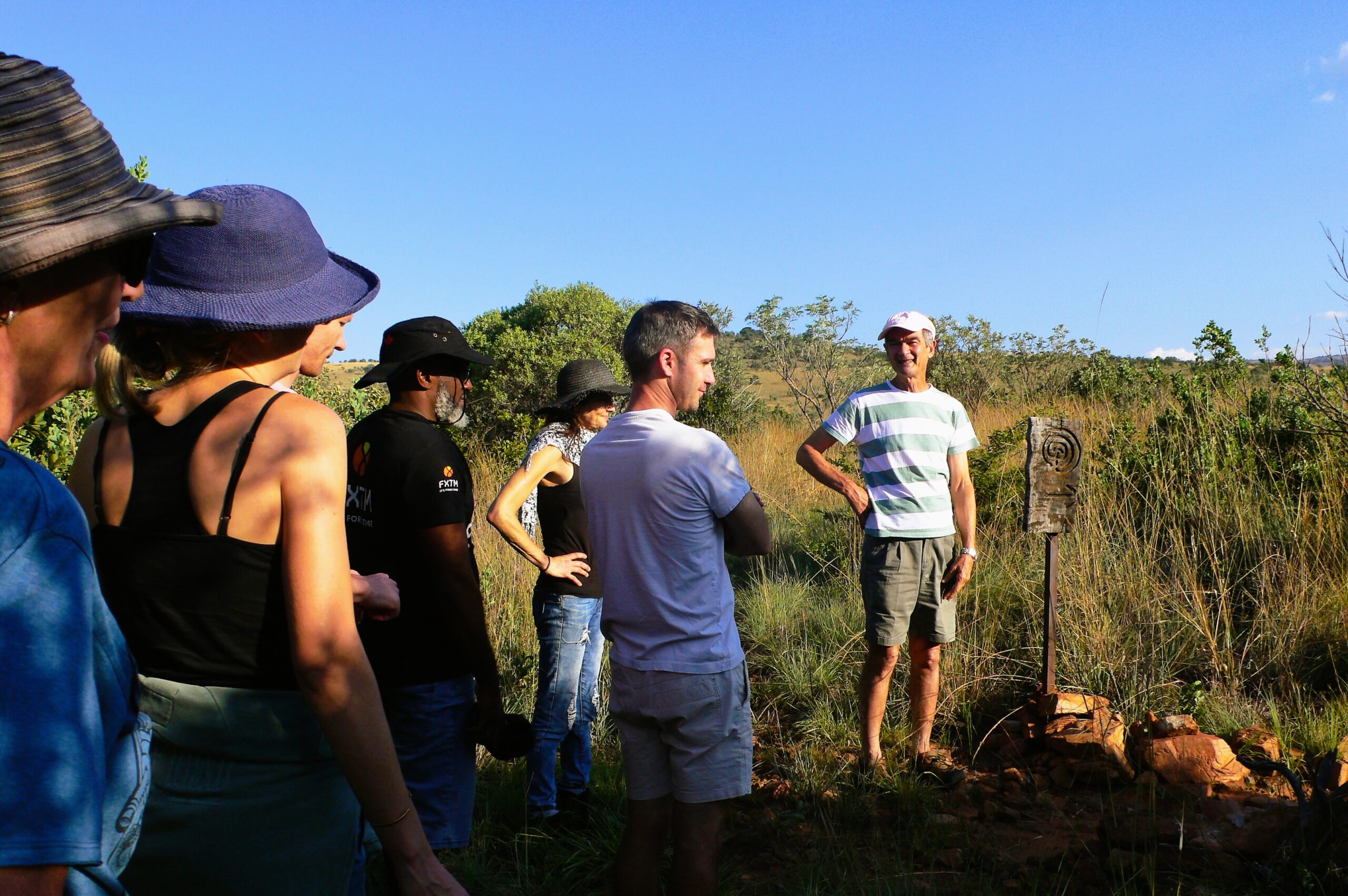
Mervyn Croft guiding us to the Labyrinth
Consciousness and “I”
Can Husserl’s ideal of “pure consciousness” ever be experienced? Is this the fantasy of enlightenment that Buddhists have entertained all along? Can we ever truly see things “as they are”? Is experience not always adrift in a murky sea of language? Is consciousness ever a state-free experience? Perhaps the best we can hope for is that a meditative attitude towards experience puts some insight generating distance between our experience and the meaning that we give to our experiences? In the end, the problem may not be that we are thinking animals, or the thoughts in themselves (the meanings we give), but the fact that we cling to these “things” (thoughts, meanings, assumptions, conclusions) so tightly. It seems possible that even the states we don’t seem to enjoy are sometimes clung to out of fear of unbecoming what we think we are.
Yet, for Sartre, consciousness in its purest state is spontaneous and autonomous; “nothing except consciousness can be the source of consciousness”. Likewise, a commonly purported verse from the Buddha being “there is no thinker only the thinking”. Sartre did, nevertheless, concede that in “I think” there is indeed an “I” that thinks. But, he proposes that it is an error to misinterpret this “I” for a “self that has been there all along”. It is only upon reflection in consciousness that an “I” is constituted. Therefore, we don’t discover a self through reflection, we create a self by reflecting on experience. If we take any guidance from Sartre, the notion of “introspection” is an unreliable process as reflection always “affirms more than it knows”. Therefore, his conclusion is that we should attempt to return to the reliability of “instantaneous consciousness”, or in Buddhist terms “sense-consciousness”.
We can therefore conclude that the unreliable process of “thinking” takes up an “I” position. We can also entertain that in meditative practice, it is not the self that relinquishes thoughts (as it is often instructed in meditation guidance material) but the thinking that momentarily suspends its “I” position. A therapeutic event could, therefore, be the process of finding the ongoing freedom to relinquishing the “I” position in consciousness. It is unlikely that this becomes a permanent state but rather that this makes room to giving rise to renewed self-constituting moments? A therapy based on these ideas appreciates how we reconstitute a self in every given moment, encouraging a more nimble mental process.
“Do you think I count the days? There is only one day left, always starting over: it is given to us at dawn and taken away from us at dusk” – Jean Paul Sartre
Not making objects of ourselves
Following on from phenomenology, Existential Psychoanalysis attempts to understand consciousness as an experience, from the inside out, rather than explain it as a thing from the outside in. Our “sense of self” is considered to be a part of this experience rather than an objective thing to be accurately known and from which we reliably experience the world. A primary aim of Existential Psychoanalysis is, therefore, not to treat people as mere things. Taken even further, time, space and consciousness are not the containers of who we are. Rather, we are manifestations of time, space, and consciousness. We are time, form and consciousness busy happening. Existential Psychoanalysis’s interest is not limited to intrapsychic processes (the things that go on in our heads) and does not take for granted that the models we have for how consciousness is structured tangibly exist because consciousness cannot be understood from some objective external viewpoint. Not only does an existential approach treat these models (for example, of consciousness and unconsciousness, or ego and superego) with caution, its interest extends beyond the notion of a mind to an interest in how the world is given to us in consciousness, and an understanding of the encounter between our being and the world from which it manifests. What happens, in a continuous flow of fragmented moments, when the surface of our being makes contact with a world? Taken a step further, from an Existential perspective, the beauty of consciousness is that it allows us some intervention in our own existence: we are not just amoebas floating in an indifferent universe and we are not purely at the mercy of our own drives and supposedly unconscious processes. It is with this in mind that we turn to Secular Buddhist methods of meditation as a means of discovering how the world is given to us in consciousness (explored further in Day 3).

Letting go of what?
When it comes to mediation, there seems to be a misconception that it is a means of “clearing your mind of all thoughts”. It seems possible that the attitude of an “I” that lets go of a thought will simply serve to solidify this “I” by keeping it vigilant to the threat of new “distracting” thoughts. This is a potential language trap that much of modern Buddhist teachings fall into. But if we return to some of the original teachings, as already mentioned there is no thought without a thinker and no thinker without thoughts. Both thinker and thought are simultaneously arising events. It is more likely that the meditation is about relinquishing the “I” position taken up in response to an event/experience/thought than relinquishing the thought itself. In Buddhist terms this requires an attitude of “equanimity” towards all of experience.
This brings us back to Husserl’s basic premise: that consciousness is always a consciousness of something, what became known as “intentionality”, highlighting that experience is always directed towards things in the world. Building on this, he pointed out how we develop a “natural attitude” towards experience whereby we readily accept the “givenness” of the world around us as we encounter it. We have a tendency to include our “self” and the selves of others as these actual objects (an idea elaborated on by Sartre and his notion of the “Gaze”).
The main concern here is that in order to deal with the inherent emptiness of consciousness we make objects of ourselves. We do this through clinging to our own thoughts and ideas. This tends to lead to an increasingly rigid, anxious and inflexible response to experience. The therapeutics of meditation is in relinquishing a fixed I position towards experience. Put simply, when I say “this is who I am” I take up a rigid position and become the sum of my responses to experience.
An exercise in not making an object of the “self”:
Think of an experience you are having or have recently had. Think of the response or reaction you have had to that experience. Now think of the “I” position (your beliefs about yourself, your wishes for yourself, the things you are avoiding for yourself) in relation to this response to the experience. Try and suspend any beliefs you have about yourself, relinquish the wishes you have for yourself or try and embrace the things you are avoiding in relation to this experience – how does this leave you feeling? Do any other options become available to you?
Can you think of when you most vividly experienced yourself as the object of someone else’s consciousness? When they decided for you who or how you should be? Perhaps a parent, a spouse or a friend deciding for you what is best. Can you think of the effect it had on you? Can you think of the categories you are in the habit of identifying with mother/father/lover/professional/son/daughter…this or that… kind of person? Can you think of the script these identities come with of who and how you should be? When are these categories experienced as helpful? When are these categories experienced as limiting?
Can you think of a time when you might have treated someone as an object within consciousness? In other words, when you lost sight of the fact that they are having an experience of their own. Perhaps you decided for them what they should or should not be thinking or doing? How often do we start a well-intended sentence with “don’t you think you should…” or “why don’t you….”? Or, when you simply presumed that you know best for them or better than them? Can you imagine how this might rob them of a sense of agency? Taken even further, can you think of a time when you might have treated someone as if they where there for nothing but your own utility? Think of how we so often tend to treat shop attendants. How often do we fully appreciate that there is another consciousness looking out at as (in all sentient beings) having an experience?
