PhD Philosophy & Psychoanalysis

Tag: therapy

The kink of therapy and the therapy of Kink: A critical reflection on methodology.

A brief essay presented at the South African Sexual Health Association 2026 Conference: Into the Fray.

Scroll through your Instagram feed and you will soon find something or someone telling you what is supposedly good for you. Just follow these 7 steps, those 10 exercises, and sprinkle them with some collagen, and you will find your way to everlasting health and happiness.
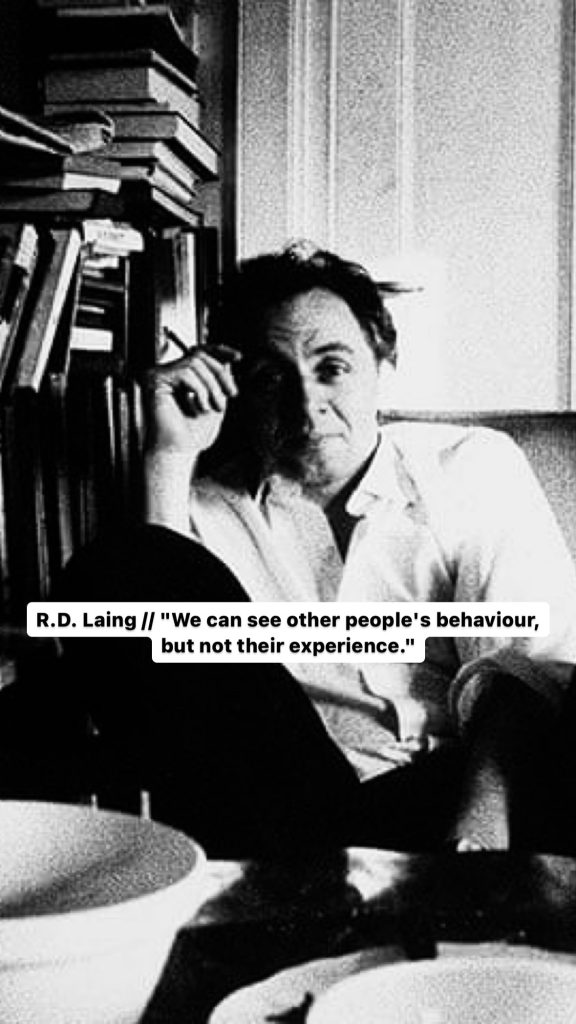
What if the goal in life was not happiness? What if life’s goal for you, despite all your efforts, is entropy? What if, as Freud and Breuer (1895/1955) proposed, the most we could hope to gain from any therapeutic experience was to transform hysterical misery into common unhappiness? Nevertheless, the psy-industry — psychology, psychiatry and psychoanalysis — has become the modern priesthood, preaching to us what it is to be supposedly normal, virtuous and healthy. Alternatively, analysts like R.D. Laing (1967) proposed that it is truly mad to be normal. That to be supposedly normal is to be alienated from what it means to be alive.

As you enter the gym, a sign catches you halfway up the staircase, advising you to hold the railing.


On your way back down, you get rewarded with a free protein smoothie for dutifully attending three times this week.

Your healthcare insurance’s way of reducing you as a liability. Somewhere between the handrail, intermittent glances at your phone, and the reward of the smoothie — a great deal has been proposed about how you should live, what your body is for, and what counts as taking care of it. Taking care of yourself has come to mean watching yourself in wall-to-wall mirrors as you raise kettlebells in an ode to Sisyphus.
Foucault (1988) would not have been surprised. He argued that modern power does not operate primarily through force and prohibition. It does not only say “no you cannot” — it says, “this is in your best interest”, “this is what it means to be normal.” Medicine, education, psychology, psychiatry and psychoanalysis are all, in his view, technologies of normalisation — disciplines that produce the very subjects they claim merely to describe, serve and treat. Foucault found it frankly absurd that one person would pay another to tell them how to live — not because the exchange was entirely meaningless but because it did not admit to the power relations it enacts.

What concerned Foucault most was not so much overt politics but something more insidious — the way power becomes most effective when it is most invisible, when we internalise its prescriptions as self-care. As you watch a genocide unfolding live on Instagram, fascism quietly and increasingly administrates your life through gym memberships, therapeutic frameworks, data collection and diagnostic categories — regulating your deviation from the norm, including how you experience your body and express your sexuality.

Image from VOX – Getty Images: GAZA

A couple of decades ago, I wrote a thesis on “How concerns about erections are treated and constructed through language on a Sexual Health Helpline.” This was the SASHA helpline. A handheld phone, on an empty desk at the back of an abortion clinic, attached to the home of the great late Elna McIntosh. Viagra was making its way into the South African market, and Pfizer needed an organisation to address the controversies that emerged from making millions by guaranteeing hard penises. It wasn’t long before new premises were needed to house a mini call centre. There were rumours that aged men were now dying from having sex — callers were advised not to take PDE5 inhibitors while taking nitrates — but the real controversy was that the introduction of Viagra had initiated public discussion about sex. Suddenly people could admit to not only wanting erections but to having all and any desires. It wasn’t only aged men calling in. It was the mistress trying to convince her lover to take the pill so she could get more mileage out of him. The wife complaining that her husband was taking the tablet and she wasn’t really interested anymore.

What the research indicated was that, under the influence of a pharmaceutical industry agenda, people’s concerns about sex became increasingly medicalised. Failure to maintain an erection was proposed as “the canary in the coal mine” for underlying health problems. This orientation eliminated all other possibilities about what a limp penis in a patriarchal society might mean. Both caller and helpline facilitator could quickly do away with the discomfort of exploring the mysteries of our passions by talking about a blue pill that might solve everything. The meaning of a hard penis went unaddressed.

An elderly man complains that the pill is no good. “Why?” asks the helpline facilitator. He took it and an hour later nothing had happened. “What were you doing after you took it?” “Mowing the lawn,” he replies. [image 9] Now, unless you have a particular fetish for the greasy back end of a grass cutter, it is unlikely that a PDE5 inhibitor is going to enhance your experience of cutting grass in any way. In this scene, the penis is treated like a mechanical device, a tool in need of repair, to be used on his poor unsuspecting post-menopausal wife. When he finishes his garden duty, she will have to finish hers. No talk of whether she even likes it or wants it. Consent was, unfortunately, not yet in vogue back then.

The gradual medicalisation and therapisation of everyday life contribute to the surreptitious rise of fascism. Everyday life is recategorised into too much of this or too little of that. Experiences rich with intrigue and mystery are professionalised: ayahuasca is stolen from the shaman; mindfulness is taken from the mountain; cold plunges become method rather than early morning madness; breath becomes work; and ketamine is reserved for clinical drips at exorbitant prices rather than complete immersion between lovers groping into the abyss of one another.

What, then, is the relationship between the world of kink and therapy? Are we not at risk of reducing the enigmatic, dark, and expressive world of kink into something purely for our own good? Take, for example, our current preoccupation with consent — not in its obvious and urgent attempt to prevent violation of any kind, but in the idea that we can pre-decide what an experience will be and mean to us. In an attempt to have safe experiences, there has been a growing fixation on the administration of experience. Everything must be agreed upon in advance. Limits must be declared. Surprises must be minimised. The encounter must be concluded before it begins.

The psychoanalyst Avgi Saketopoulou is suspicious of this fixation — not because consent is unimportant but because it rests on a fantasy: that we can know in advance what we are willing to experience, what we can bear, and where our limits lie. Genuine experience does not take this shape. We do not always know what we desire until we encounter it. We cannot predict what will emerge in contact between two or more people. Following Foucault (1988) and Bataille (1957/1986), Saketopoulou (2023) proposes that it is precisely at our limits — at the point where the ego’s capacity to manage and translate experience breaks down — that anything genuinely new becomes possible. To pre-negotiate the limit is to ensure you never reach it.

Avgi Saketopoulou

In Sexuality Beyond Consent, Saketopoulou (2023) proposes that there is an inherent bending of the client’s will through the process of therapy. For example, if you arrive in therapy declaring that you want to speak about your current sexual difficulty but that you don’t want to talk about how your own father molested you, the therapist is most likely to respect this — but in the hope that, over time, you will feel safe enough to go there. Even if both held strictly to that agreement, a sincere therapeutic encounter will take both parties somewhere neither anticipated. In both therapy and kink, there is value in taking the experience to a certain limit, where the usual moorings of the self are loosened — a dissolution of the ego rather than consolidation of it.

A man leans toward a woman and asks how she is feeling. A private conversation made deliberately public. She nods, smiling nervously. He turns to the audience and says he has an idea in mind but is not quite sure how it will play out. There is no checklist of hard limits — they have done this many times before. As he positions her, she notices herself in a mirror across the room. She whispers in his ear. He nods, smiling for the first time, and moves the mirror out of sight. [Image: Naka Akira at Toubaku, Tokyo, Japan]

He binds her, ceremoniously, into a Takate Kote. Raises her to her feet, forms a tight rope between two pillars that runs between her legs. A silk scarf covers her eyes. Then she hears it — the crash of Lego pieces forming a carpet at her feet. She giggles at the familiar sound. The room laughs with her. He tugs the rope. An invitation rather than a command. She inches forward across the Lego — each step a small confession, a surrender, an offering, a devotion.
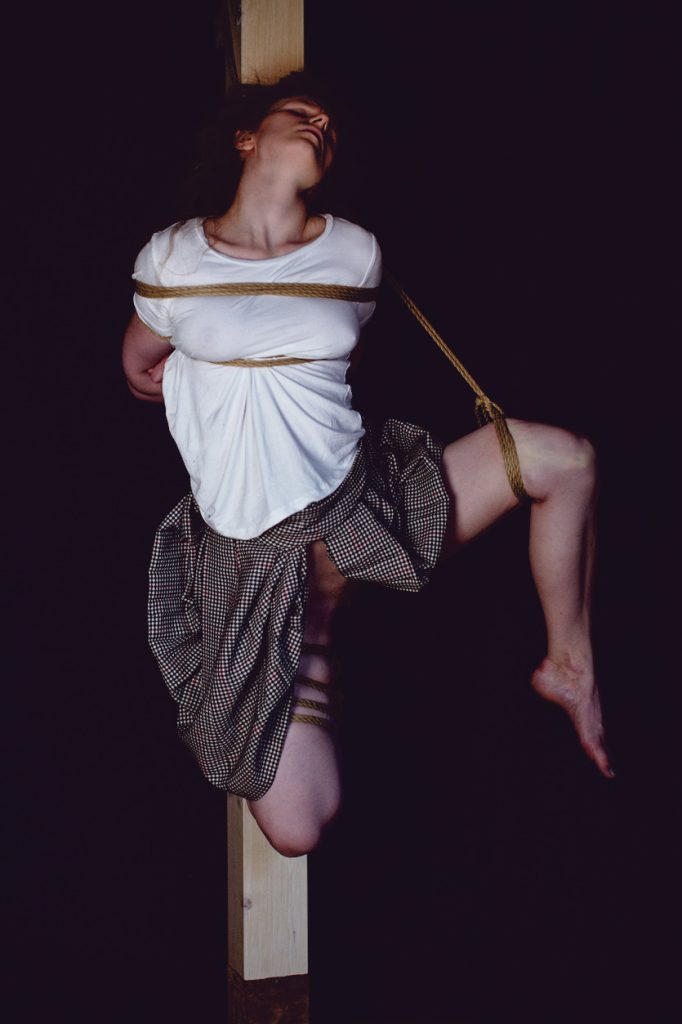
Eventually he pins her against the pillar, a Hashira — suspended, exposed, arms behind her back. He fetches the mirror. Places it directly opposite her. Removes the scarf. She blinks. Smiles. Laughs uncomfortably. Frowns. Looks away. He takes her jaw firmly in his hand and slowly returns her gaze to herself in the mirror. She now sees what we see. Her beautiful agony. She comes undone. The room laps her up as she seems to spill into it. [image by Andy Buru]

There is a lingering impact to this scene that resists easy explanation. As Alphonso Lingis puts it, “Observing an event, however unusual, is not having an experience” (Lingis, 2016, p. 7). Having an experience is to undergo a passion: wonder, rage, terror, jealousy, grief, lust, shame, guilt, awe, erotic pleasure — even love. What came over those present that they were no longer observers but having an experience? The self devoted to order and productivity, the prudent and calculating self that seeks to manage its feelings, the distinct self with its habitual identity — receded.
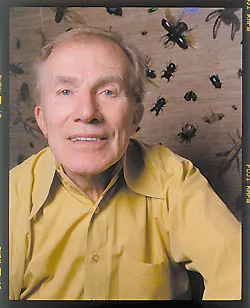
Alphonso Lingis

It is not easy or perhaps even necessary for the performers in this scene to put their experience into words. The compulsion to explain and translate is itself part of what the scene resists. We remain somewhat opaque to ourselves and to each other. No one can experience your experience, and you cannot experience theirs. We can only experience each other experiencing. The encounters that matter most — in kink, as in therapy — are the ones that do not attempt to resolve that opacity but venture towards it. Lingis (2016) warns against a psychology that encourages us to distance ourselves from the passions. Through the inevitable overwhelm of the everyday habitual self, something else emerges — something less fixed and more relational, even if just for a moment. Perhaps we could call it a kind of madness. Nevertheless, it gives way to a different kind of knowing — a collapse of conventional knowing and a relinquishment to the absurd.

The word therapy comes from the Greek — to be with, to attend to.

Not to cure.

Therapy, at its most honest, is simply this: to be with, in curious and courageous enough ways that allow something new to emerge in the space where the self, briefly, loosens its moorings on ideas of what, who, and how we ought to be.


References

Bataille, G. (1986). Erotism: Death and sensuality (M. Dalwood, Trans.). City Lights Books. (Original work published 1957)

Breuer, J., & Freud, S. (1955). Studies on hysteria. In J. Strachey (Ed. & Trans.), The standard edition of the complete psychological works of Sigmund Freud (Vol. 2). Hogarth Press. (Original work published 1895)

Foucault, M. (1988). Technologies of the self. In L. H. Martin, H. Gutman, & P. H. Hutton (Eds.), Technologies of the self: A seminar with Michel Foucault (pp. 16–49). University of Massachusetts Press.

Laing, R. D. (1967). The politics of experience and the bird of paradise. Penguin.

Lingis, A. (2016). Aconcagua. In R. Wheeler (Ed.), Passion in philosophy: Essays in honor of Alphonso Lingis (p. 7). Bloomsbury.

Saketopoulou, A. (2023). Sexuality beyond consent: Risk, race, traumatophilia. NYU Press.

Reclining into the emerging

The new home of existential analysis in Cape Town is finally taking shape. Even though I am far from a traditionally trained psychoanalyst, many of my clients have shared the fantasy of being able to just lie down and speak freely – to just be for a moment. This very fantasy of being able to say everything that could be said or needs to be said, is the very fantasy of psychoanalysis. This fantasy is perhaps most accurately represented by the psychoanalytic motif – the “chaise longue” (French for “long chair”) – an object with a fascinating story of its own.

We can imagine as far back as 7th Century B.C., an Assyrian King reclining on a sofa in what is now modern-day Iran, while feasting in celebration of a great victory. Reclining to eat or recount conquests was a marker of one’s elite status: you needed enough servants, enough space, and enough security to lie down like this in public. The Greeks and Romans adopted this reclining habit for their symposion – banquets that focused on drinking wine, conversation, and intellectual debate. Reclining became an increasing symbol of social status and masculinity.

The “Garden Party” relief from Nineveh, depicting the Neo-Assyrian queen Libbali-sharrat (left) dining with her husband, the king Ashurbanipal (right; r. 669–631 BC)

This trend went out of fashion in the Middle Ages but made its comeback in 18th century France. Reclining was, however, no longer a male endeavour but a feature saved for aristocratic women’s private chambers. The luxury and even performance of rest became an ideal that spread across upper class Europe. This is where the actual pieces of furnishing designed for such activity became popularised amongst those who could afford it.

The long chair got its most famous cultural boost in 1800, when the painter Jacques-Louis David depicted a 23-year-old socialite, Madame Récamier, seductively reclining on one, her feet bare. With her feet bare, the painting became a scandal and the gradual sensation of the work (bought by the Louvre) led the chaise longue to become something of an object of desire, femininity, and a certain transgressive sensuality.

Jacques-Louis David, Portrait of Madame Récamier, 1800, Louvre Museum, Paris. Public domain image

The Victorians moved the chaise longue out of the boudoir and into their over-furnished living rooms, where it served a new function – to catch women fainting from the physical restrictions of their corsetry. As a result, the Victorian “long chair” was now the fainting couch, with a particular design: featuring a single back with one high, curved arm – the perfect backdrop for a dainty arm as the lady in question wilted. You can therefore tell a Victorian chaise longue by this particular shape. Its design not only aestheticized collapse but became an object that supported the oppressive social norms imposed on women.

This is where its use in psychoanalysis became interesting. Freud was apparently gifted a chaise longue by his patient Madame Benvenisti. He covered it with a Qashqa’i rug – a carpet originating in southwestern Iran – and some pillows for comfort. The reclining position was first used for hypnosis but following a particularly stubborn patient, a wealthy woman named Fanny Moser, who preferred to talk rather than give into hypnosis, a new method was gradually discovered: Freud found that patients were more relaxed, open, and receptive when they lay down, facing away from him. This physical arrangement – the patient reclined, relaxed enough to be somewhere between sleep and wakefulness, and unable to see the analyst – seemed to allow things usually pushed away to surface. In this way, the chaise longue was no longer just a Victorian piece of furniture but an integral part of methodology and a particular mode of relating.

“There was always a feeling of sacred peace and quiet here. The rooms themselves must have been a surprise to any patient, for they in no way reminded one of a doctor’s office but rather of an archaeologist’s study… Everything here contributed to one’s feeling of leaving the haste of modern life behind, of being sheltered from one’s daily cares.”

–Sergei Pankejeff, known as the Wolfman

It potentially remains a significant symbol of the power of clinician over patient. But I like to think that it has other potential: a symbol of how methodology may be moving from oppression and suppression to freedom of expression. After all, it moved from an object to catch women as they fell prey to their oppressive corsetry to one that attempted to gradually free the symptoms of their sexual repressions. We have gladly moved beyond the idea that “hysteria” is a symptom of female failing, but I like to think that there may still be some therapeutic value in succumbing to a therapeutic “recline”, watchful of classism, racism, sexism and capitalism.

My own methodology, which I named in my thesis – contemplative existential analysis – looks at how Buddhist practices, existential philosophy and therapy intersect. What I invite here is something distinct from the classical psychoanalytic instruction to free associate: less a technique to be performed, and more an open, unguarded presence – a willingness to let what is true simply arrive. And so, with the introduction of this piece of Victorian history into the therapy space, I invite you to come and recline, relax, and speak whatever emerges.

Feel free to book an appointment using the menu below, regular sessions are encouraged and charged at a lower rate if booked in packages…

Self-Retreat Therapy

This past weekend, Fiona and I found ourselves entranced by a Leonard Cohen tribute show.  I wouldn’t usually be inspired by the idea of anyone attempting to emulate the grand master of melancholy, but a dear friend’s sister was performing, so I thought I would take a Sunday afternoon break from writing my thesis and venture off into the depths of Umbilo.  Coincidentally, I had been reading and writing about Cohen.

Dave Starke and Lizzie Gasford

In his later years, Cohen spent some time in a Zen monastery.  He served as assistant (or carer) to the aging Roshi.  Although he didn’t consider himself a monk, he shaved his head and adorned robes in order to get access to Roshi and his teachings.  This is where he wrote most of the poems from the “Book of Longing”.  Cohen had indulged in all the sex, drugs, money and fame one could have dreamed of and, yet, still seemed to be filled with longing.  It seems that he entered into the monastic life as a means of coming to terms with his own insatiable longings.  It seems possible that we all share this underlying feeling of lack or incompletion, not matter how much we try fill it with ideas of who we are and what we have achieved or think we should still achieve.  In a poem called “Titles”, he speaks about having had the title Poet and being “kindly accorded” the title singer “even though I could barely carry a tune”.  He renders the monastery as a place where these become irrelevant, in a challenging yet freeing way.

He still kept a bottle of Johnny Walker in his quarters and after 5 or 6 years returned to civilian life.  But I get the impression that his time there brought him more clarity.  In an ode to Leonard Cohen, the writer and Zen monk Shozan Jack Haubner, writes “But in Leonard’s world, the opposite of despair was not hope — it was clarity. From this clarity came the vision of a prophet.”  In his clarity lies a brutal honesty about life that he even poses a challenge to Zen beliefs.  Cohen writes:  “I know your burden’s heavy as you wheel it through the night. The guru says it’s empty. But that doesn’t mean it’s light.”

Modern Psychology has become the new priesthood, selling us a false promise of everlasting happiness – if you just follow these 10 steps, just work hard enough at your success, and take your medication regularly enough – you’ll get there.  I am yet to meet someone who is “there” and those that appear to be there, seem to be pretending. In our struggles to carry our “empty” burdens, I enjoy Cohen’s preference for clarity over hope and I have found that periods of retreat style living – that allow us to simply be with our struggles rather than escape them – are an ideal means of allowing such stark clarity.

From the 1st to 18th of March we will be opening up our retreat centre in La Mercy for self-retreat therapy.  You can book in for any length of days where we will follow retreat style living involving: 3 healthy meals a day, noble silence in the evenings, meditation and yoga in the mornings, somatic movement therapy and philosophical reflection.  If you are not already a client in therapy with me, you would need to have a preliminary session with me in order to make the most of your retreat.

To book a space or find out more, please email fiona@centreforpurposefulliving.co.za

If you happen to be close enough to the Magaliesburg, please join our retreat on “On Being-No-Thing-ness” from the 20th – 24th March at Emoyeni Retreat Centre.

Myself with Buddhist master and brilliant poet, Mervyn Croft, at Emoyeni.

Whether you decide to join us on retreat or not, please don’t miss this upcoming show with Dave Starke and Lizzie Gasford, it’s a melodic lesson on love, relationships and living, on the 6th of April at Northlands Bowling Club.

Who the hell do you think you are?

What is it that psychotherapy is meant to be doing?  This is a question that I am, by necessity, obsessed with.  Michael Foucault thought that paying someone to tell you how to live your life was a completely absurd idea.  I agree, this should not be the aim of psychotherapy.

When I was in training, there was a fellow intern that I found insanely irritating.  One afternoon, as she came out of her session with a client, she made a celebratory fist pump as if she had just scored a goal or something.  I asked her why she looked so happy with herself, “I just got my first client to cry” she said, celebrating.  Her attitude was indicative of an underlying misconception about therapy:  That you get it “right” when it is a difficult, painful, and exposing process.  It is often all of these things (hence the mandatory box of tissues on my table) but these things are not the goal.  Discomfort is often a part of the process that we need to endure, but not try and relish in.  Listening to Adam Phillips, a contemporary psychoanalyst, there is nothing wrong with the therapeutic conversation being a pleasurable experience for both client and therapist.  However, therapy to a great extent necessitates a confrontation with the “self”.  Such confrontations are unfortunately not always comfortable.  We are, therefore, likely to avoid them.

A client skips her therapy session to have botox.   There is an inherent symbolism to this:  Choosing to “save face” rather than “face our self”.  We can be particularly ugly to ourselves at times.  Therapy has no place rubbing our noses in this.  But there are unfortunately places in us botox can never reach.  “I can help you, if you just give me the chance” is how I ended our last therapy session.  That is about as much as I can do.  People cannot be forced or chastised into therapy.  They will never find any beauty in their own agony in this way.  Phillips heeds that “people can only develop in their own time and their own way.”

Therapy is not just about confronting ourselves.  We do come to therapy to discover who we are and how we became this person.  But we do so in order to go beyond who we think we are.  In this way, therapy is a place of self-invention.  It is, therefore, the work of therapy to help people find the freedom to live their lives.  Usually, the greatest obstacle to this freedom is the conception we have of ourselves.  “This is just who I am” is the greatest injustice anyone can do to themselves.

Therapy, therefore, asks us to answer an inevitable question: How do we get in our own way?  We stay in the bad relationship that keeps us unhappy.  We continue to drink despite our self-loathing for it.  We keep our anxiety alive by not making the changes we know we should make.  Simply pointing these things out is of little use to a client.  Rather the therapist offers the opportunity to describe yourself back to yourself in ways that will provide a view of what you do to yourself.  Psychotherapists are (and should be) awfully bad life coaches.  Telling people how to live their lives tends to be of short-lived benefit.  And, what is most challenging, is that people generally want you to do this (so that they can take their resent for their parents out on you later).

We were walking through the cane in the late afternoon.  “The earth is starting to travel back towards the sun” she says aloud.  I think to myself; the air does feel a little warmer, but the sun is still setting at its oblique angle to the horizon.  Fiona points out the full moon rising on the opposite end of the planet.  “Does the moon change its orbit too?”  she asks herself.  She is not asking me a question, she is talking aloud as a form of cultivating awareness. Phillips says “In order to articulate something, we have to have someone to listen.”  My role in that moment, was not necessarily to give her an answer.  But, nevertheless, it struck me that I didn’t actually know the answer in any case.  “I don’t really know what she is talking about?” I thought.  But, I didn’t say anything in case I sounded stupid.

So much of our lives is spent like this – with little awareness of what is actually going on.  There are aspects of our lives that are so familiar to us that we don’t bother to even consider them, let alone understand them.  We are busy hurtling through space and time without any need to give it much thought.  Most of the variables of our lives are just there, as they always have been.  This is also the case with the experience of our own selves.  We are so familiar to our selves that we become unfamiliar to who or what we actually are.   Therapy can be a means of thinking aloud about this in order to bring awareness to it.

In order to try and aid this process, I invite clients to write.  The other day a new client sent me pages of very loosely constructed sentences.  I usually welcome this but in her case I suggested that she write more comprehensively about herself.  When she told me that she had been deeply offended by this, I tried to explain that “If therapy is about making sense of yourself to yourself, then the more comprehensive we can be, the more useful this will be to you”.  She had had this fantasy that she could bring me the pieces of herself and I would hand her “self” back to her complete again.  I have an idea, in her case, why she needed this from me at the time but this builds on another dangerous misconception about therapy – that we arrive broken in order to leave fixed.  After all, “All the King’s horses and all the King’s men, couldn’t put Humpty together again.”  There are some things in life that can simply not be put back together.  What if therapy is about knowing, understanding and appreciating the broken bits of ourselves, rather than piecing them together again?  A sense of “wholeness” then, so to speak, may not come from being “fixed” but in making sense of why and how we came about feeling “broken” in the first place.

Ultimately, you bring who you are into therapy in order to discover who, in fact, that is.  As you make your discovery, you are likely to try and discard some aspects while cultivating others.  I think that successful therapy requires the ability to hold an essential contradiction in this regard: to take your “self” seriously enough to explore it but not so seriously that you become stuck in who you are.  When we either take ourselves too seriously or not seriously enough, we enter a kind of madness.  As Zizek puts it: the beggar who thinks he is a king is mad, but the king who believes he is in fact king is equally mad.  Therapy is about contemplating the forces that have shaped us and our behaviour.  The people, places and experiences that have given rise to the idea of “who I am”.

How did I come to be in the world in this way?  How would I rather be?  What gets in my way?

In order to be useful in the world, we have to hold onto who we are to some extent.  At the same time, we need to avoid becoming stuck in that identity.  Although psychotherapy appreciates that we are the product of our pasts, I don’t believe that it should support the idea that our lives, still to be lived, should be completely dictated by the life we have already lived.  Psychotherapy should come with a dose of permissiveness, in this regard, that looks towards a futures self.  Under the influence of Phillips, I would like to suggest that therapy should be weighted towards considering our unlived lives as much as it considers the lives we have already lived.

Imagine if life was a stage and, at any given moment, each of our particular lives was a performance on that stage.  There is both a freedom and an entrapment to this.  The freedom lies in how a “performance” is never fixed and there is always the possibility of invention.  The entrapment lies in the role we find ourselves playing in relationship to both the audience (for example, broader society) and those we share the stage with (for example, our family members).  It is as if our lives have handed us a script that we, before we even make it to adulthood, know far too well.  We run the risk of just playing out this script over and over again, even when “new actors” arrive on our stage.  It is in our families of origin that we have rehearsed this play until it is no longer “play” at all.  We cease to experiment, to some extent, with who or what we could be.  Therapy can be a way for us to “play” again with the idea of our selves.  The problem is, as Phillips puts it, that we’ve judged ourselves before we have found out who we really are.  Psychotherapy is permissive in that it, hopefully, suspends this judgment.  But it is in our struggles, as therapists, to suspend judgment that therapy risks impotency.  All too often we are too impartial in our attempts to intervene in the forces (internal or external) that cause trouble in people’s lives.  How many times should we sit back and watch Humpty Dumpty fall?  I told a client the other day that I can’t sit back and watch him continue to fuck up his life like this.  It squanders his money and my time.  In that moment, I felt that this was the most ethical thing to do.  Doing so, however, runs the risk of placing pressure on the client to be someone on behalf of the therapy.  There is no freedom in that.

Herein lies the delicateness of the therapeutic relationship:  If I am going to try and describe you back to yourself; especially the parts you either can’t see or don’t want to see; this requires a certain frankness on my behalf.  I think I owe it to you to try and help with embarking on the difficult process of integrating the things you have been denying without making too quick a presumption about what those things are.  Because these are usually the things that get in the way of a future version of yourself that you would most likely prefer to be.  It is a gradual, intensive, sometimes uncomfortable but never sardonic process.  It is, however, difficult not to come across like it is the work of therapy to tell you who or how to be.  Or to shame the parts of you that you are already trying to hide from view (consciously or unconsciously).  After all, who decides and how do we decide what is an acceptable way to live our lives?

To answer this question is to ask, “Who do you want to be?”  I believe that any relationship that is good for us (not just therapy) should be excited about the answer to this question.  Most of the time, people have an idea of the lives they want to be living but aspects of the lives they have already lived (and therefore aspects of who they believe they are) get in their way.  Therapy is, therefore, a process of getting you out of our own way.  And, to achieve this, we must first know who you think you actually are and how you came to think that.

Ultimately, a therapy room should have enough seats for the full stage performance of who you are: your sometimes broken self; your often more fixed self; the past versions of yourself; imagined future selves; and all the people that have had a significant role on the stage with you.  But, the actual process is much simpler than we might think.  You just have to have the courage to show up every week and face your own life.

Still(a)Life#31: On Writing and Listening

It has been interesting to write for 30 continuous days. I find myself writing on most days but this writing is usually a bit more focused on things outside of me. Mostly a reflection on a client’s circumstance. Sometimes a love letter. Now and again an erotic thought. I have tried not to write these lockdown diaries out of obligation. Doing anything out of sheer obligation is seldom a good idea. It has been freeing to write more openly. Even though it goes against the grain of a psychologist’s training. But, client and therapist are, after all, just two people in conversation. It’s been an ongoing project to try and find my own authenticity in that somewhat necessarily contrived relationship. The less contrived the better, I think. On the topics of authenticity and writing, I am reminded of the words of Charles Bukowski: “If it doesn’t come bursting out of you, in spite of everything, don’t do it. Unless it comes unasked out of your heart and your mind and your mouth and your gut, don’t do it.”

Some people, whose journeys are well known to me, have sent me endearing messages about what the writing has stirred in them and the choices they are finding the courage to make as a result. But, to continue writing tonight would be out of sheer obligation. There is nothing bursting out of me right now. I want to rather listen out for what the distant crash of waves has to tell me; the warmth of my lover can provide for me, as the hypnotics of sleep hopefully come and find me.

Still(a)Life #26: A Rebellion Deep Inside

Compliance is, mostly, a good thing. It allows for cohesion. Over-compliance, however, risks hiding things. My son was distressed the other day and couldn’t get hold of me. He apparently said “I never want to see Dad again”. My heart sank when I heard that. But, I am learning the value of the freedom to express ourselves, especially when we’re young. Rumi imagined a field “out beyond ideas of wrongdoing and rightdoing”, it’s an especially good place for us to meet in times of struggle. There are moments when there is no right feeling or wrong feeling to be had. When the expression of that feeling, rightly or wrongly, is the truest thing.

Under the lockdown compliance, our homes are the distilleries of these truths. Therapy is, to a great extent, the pursuit of truths. Not a forensic kind of truth. Not the kind a lie detector might reveal. In fact, whenever lie detectors are suggested in a couple’s therapy, I know it’s the beginning of the end. It’s an indication that the very foundations of trust have already been demolished. Therapeutic truths are different truths. They are an embodied sense that this feels right for me. This is what we need to feel authentically ourselves. And, when we get a sense of these truths, radical change usually follows. The truth, however, takes time to make itself known. First, we have to get over the anxiety this will cause us. Radical change can be traumatic.

We are encouraged from youth to comply with expectations of us. Often, we find ourselves having to choose and behave in ways that meet the needs of a parent. An overly vulnerable mother or a particularly angry father might have us playing out a role that helps “keep the peace”. Winnicott believed that this contributed to the development of a “false self”; a persona that we put out there into the world in order to comply with the demands of our environment.

We learn a capacity to behave according to the demands of the needs of others, first our parents and siblings and, later, society as a whole. However, this role we learn to play gradually overshadows a more spontaneous expressions of our authentic needs and feelings. Eventually we risk losing touch with them altogether. This loss can contribute to inevitable feelings of emptiness and isolation. We can spend a lifetime avoiding this chasm. Then comes lockdown. Spend enough time with yourself and your own authenticity will start a rebellion somewhere deep inside you. The things you didn’t want to say or feel, will slowly find expression. There is no wrong or right feeling but the inevitable expression will bring you closer to some people and further from others. Trust this, there is truth in it.

Still(a)Life#21: Hidden Layers Crack through the Surface

All of experience is a layered occasion. At any given moment, there is more to each experience than that which lies on the surface. Conscious and unconscious. Apparent and hidden. Suppressed versus expressed. For the most part, we present to the world an outer layer. A shell hardened by time, social norms and experience. It’s a shell designed to safely keep hidden the more vulnerable aspects of ourselves. The unborn parts we have not yet had the courage to enact and the missing parts we have not been able to find a place for. The thing is, we struggle to admit to ourselves what it is that we really want or to face the things we find too uncomfortable. We stick to the surface of things.

Lockdown slowly compresses these layers, they collapse in on each other and the things we have been hiding away or hiding from, crack through the surface. The husband chooses to sleep in his office. The wife struggles to hide her difficulty with food. The child refuses to go back to his mother’s house. The lover decides she is no longer settling for less.

My phone has started to vibrate in the night. The rumble of people’s layers stirring to the surface. Our initial tendency is to quickly find a place for these thoughts and feelings. Make sense of them. Move on. Put everything back together. This is not the time for getting “back to normal”. Not everything has a neat place.

The world outside our windows is changing as you read this. And, if you want to find out where you are in that world, it starts with a journey inward. Embracing the change does not start with holding on but with letting go.

“The only way to find out where I was was to get out of the way and let myself happen.”
― Mark Epstein, Going to Pieces Without Falling Apart: A Buddhist Perspective on Wholeness

Still Life #11: Apocalyptic Existentialism

This is Sam’s (12) Corona bird he scribbled out on a piece of paper for me. I framed it straight away. It encapsulates the balancing act we are all facing.

Some of us might be taking this time to savour a good meal or the bonds we share around the table while we simultaneously try to push away the contrasting anxiety of loss and the awareness of others less fortunate.

We juggle having to face the personal struggles we’ve had the luxury of ignoring while we wonder if a world crisis could make them suddenly irrelevant.

Unfortunately, I don’t think it will. Now is the time to face our demons or they will eat what’s left of us as the world goes hungry.

Although most of us are safe in the comfort of our homes. I wouldn’t recommend making a home of denial. Not of our own personal struggles nor of the state of things beyond our garden walls.

After reading my posts, a friend asked me today if I was okay. Therapists are not in the habit of being asked if they are okay. We don’t like to be asked. We like to take refuge in other people’s troubles to escape our own. I replied:

“Thank you. I think most people are in (perhaps necessary) denial. Focusing on zoom yoga and taking pictures of lockdown meals, while the world runs out of food and half of India dies. I’m trying not to jump on a soap box and I’m also trying to stay positive. People will die. And not just of Corona. South Africa will take years to recover and our politics, or lack thereof, will become more significant than ever. I think people want me to give them 7 steps to surviving lockdown with your kids, not apocalyptic existentialism. But it’s all I’ve got.”

© 2026 Jason Ross

Theme by Anders Noren — Up ↑