This past weekend, Fiona and I found ourselves entranced by a Leonard Cohen tribute show. I wouldn’t usually be inspired by the idea of anyone attempting to emulate the grand master of melancholy, but a dear friend’s sister was performing, so I thought I would take a Sunday afternoon break from writing my thesis and venture off into the depths of Umbilo. Coincidentally, I had been reading and writing about Cohen.

Dave Starke and Lizzie Gasford
In his later years, Cohen spent some time in a Zen monastery. He served as assistant (or carer) to the aging Roshi. Although he didn’t consider himself a monk, he shaved his head and adorned robes in order to get access to Roshi and his teachings. This is where he wrote most of the poems from the “Book of Longing”. Cohen had indulged in all the sex, drugs, money and fame one could have dreamed of and, yet, still seemed to be filled with longing. It seems that he entered into the monastic life as a means of coming to terms with his own insatiable longings. It seems possible that we all share this underlying feeling of lack or incompletion, not matter how much we try fill it with ideas of who we are and what we have achieved or think we should still achieve. In a poem called “Titles”, he speaks about having had the title Poet and being “kindly accorded” the title singer “even though I could barely carry a tune”. He renders the monastery as a place where these become irrelevant, in a challenging yet freeing way.

He still kept a bottle of Johnny Walker in his quarters and after 5 or 6 years returned to civilian life. But I get the impression that his time there brought him more clarity. In an ode to Leonard Cohen, the writer and Zen monk Shozan Jack Haubner, writes “But in Leonard’s world, the opposite of despair was not hope — it was clarity. From this clarity came the vision of a prophet.” In his clarity lies a brutal honesty about life that he even poses a challenge to Zen beliefs. Cohen writes: “I know your burden’s heavy as you wheel it through the night. The guru says it’s empty. But that doesn’t mean it’s light.”
Modern Psychology has become the new priesthood, selling us a false promise of everlasting happiness – if you just follow these 10 steps, just work hard enough at your success, and take your medication regularly enough – you’ll get there. I am yet to meet someone who is “there” and those that appear to be there, seem to be pretending. In our struggles to carry our “empty” burdens, I enjoy Cohen’s preference for clarity over hope and I have found that periods of retreat style living – that allow us to simply be with our struggles rather than escape them – are an ideal means of allowing such stark clarity.
From the 1st to 18th of March we will be opening up our retreat centre in La Mercy for self-retreat therapy. You can book in for any length of days where we will follow retreat style living involving: 3 healthy meals a day, noble silence in the evenings, meditation and yoga in the mornings, somatic movement therapy and philosophical reflection. If you are not already a client in therapy with me, you would need to have a preliminary session with me in order to make the most of your retreat.
To book a space or find out more, please email fiona@centreforpurposefulliving.co.za
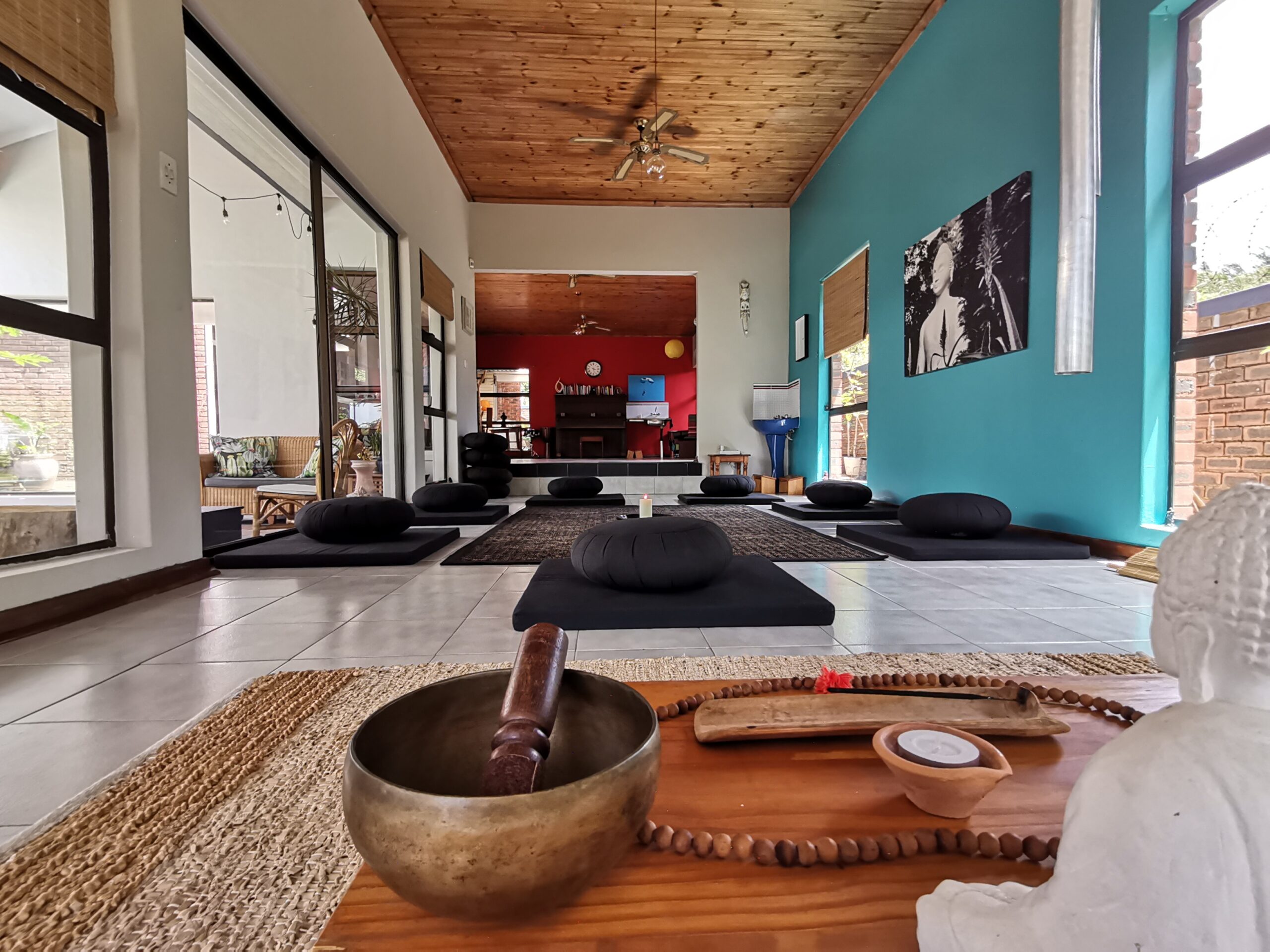
If you happen to be close enough to the Magaliesburg, please join our retreat on “On Being-No-Thing-ness” from the 20th – 24th March at Emoyeni Retreat Centre.

Myself with Buddhist master and brilliant poet, Mervyn Croft, at Emoyeni.
Whether you decide to join us on retreat or not, please don’t miss this upcoming show with Dave Starke and Lizzie Gasford, it’s a melodic lesson on love, relationships and living, on the 6th of April at Northlands Bowling Club.