PhD Philosophy & Psychoanalysis

Tag: Philosophy

The kink of therapy and the therapy of Kink: A critical reflection on methodology.

A brief essay presented at the South African Sexual Health Association 2026 Conference: Into the Fray.

Scroll through your Instagram feed and you will soon find something or someone telling you what is supposedly good for you. Just follow these 7 steps, those 10 exercises, and sprinkle them with some collagen, and you will find your way to everlasting health and happiness.
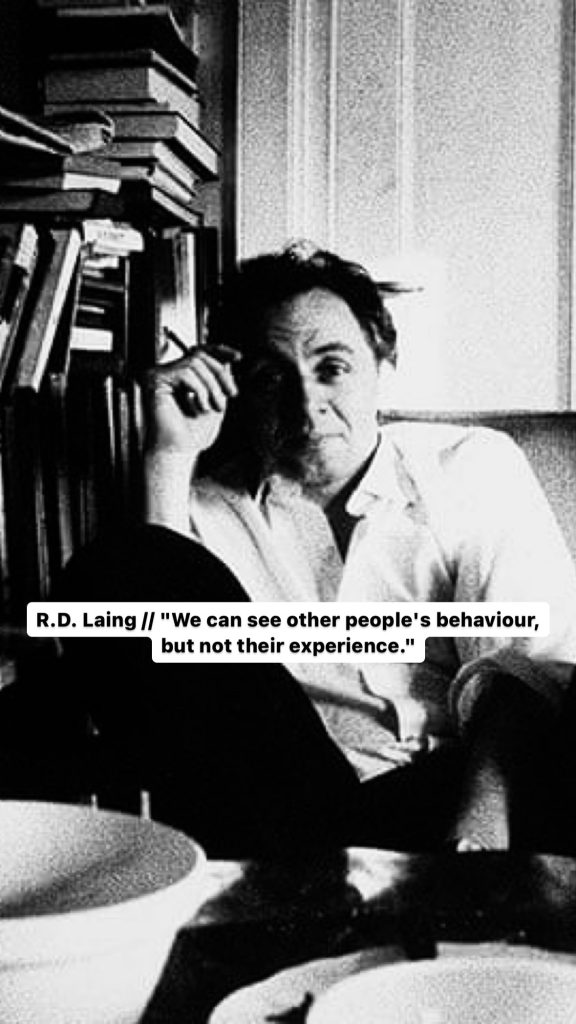
What if the goal in life was not happiness? What if life’s goal for you, despite all your efforts, is entropy? What if, as Freud and Breuer (1895/1955) proposed, the most we could hope to gain from any therapeutic experience was to transform hysterical misery into common unhappiness? Nevertheless, the psy-industry — psychology, psychiatry and psychoanalysis — has become the modern priesthood, preaching to us what it is to be supposedly normal, virtuous and healthy. Alternatively, analysts like R.D. Laing (1967) proposed that it is truly mad to be normal. That to be supposedly normal is to be alienated from what it means to be alive.

As you enter the gym, a sign catches you halfway up the staircase, advising you to hold the railing.


On your way back down, you get rewarded with a free protein smoothie for dutifully attending three times this week.

Your healthcare insurance’s way of reducing you as a liability. Somewhere between the handrail, intermittent glances at your phone, and the reward of the smoothie — a great deal has been proposed about how you should live, what your body is for, and what counts as taking care of it. Taking care of yourself has come to mean watching yourself in wall-to-wall mirrors as you raise kettlebells in an ode to Sisyphus.

Foucault (1988) would not have been surprised. He argued that modern power does not operate primarily through force and prohibition. It does not only say “no you cannot” — it says, “this is in your best interest”, “this is what it means to be normal.” Medicine, education, psychology, psychiatry and psychoanalysis are all, in his view, technologies of normalisation — disciplines that produce the very subjects they claim merely to describe, serve and treat. Foucault found it frankly absurd that one person would pay another to tell them how to live — not because the exchange was entirely meaningless but because it did not admit to the power relations it enacts.

What concerned Foucault most was not so much overt politics but something more insidious — the way power becomes most effective when it is most invisible, when we internalise its prescriptions as self-care. As you watch a genocide unfolding live on Instagram, fascism quietly and increasingly administrates your life through gym memberships, therapeutic frameworks, data collection and diagnostic categories — regulating your deviation from the norm, including how you experience your body and express your sexuality.

Image from VOX – Getty Images: GAZA

A couple of decades ago, I wrote a thesis on “How concerns about erections are treated and constructed through language on a Sexual Health Helpline.” This was the SASHA helpline. A handheld phone, on an empty desk at the back of an abortion clinic, attached to the home of the great late Elna McIntosh. Viagra was making its way into the South African market, and Pfizer needed an organisation to address the controversies that emerged from making millions by guaranteeing hard penises. It wasn’t long before new premises were needed to house a mini call centre. There were rumours that aged men were now dying from having sex — callers were advised not to take PDE5 inhibitors while taking nitrates — but the real controversy was that the introduction of Viagra had initiated public discussion about sex. Suddenly people could admit to not only wanting erections but to having all and any desires. It wasn’t only aged men calling in. It was the mistress trying to convince her lover to take the pill so she could get more mileage out of him. The wife complaining that her husband was taking the tablet and she wasn’t really interested anymore.

What the research indicated was that, under the influence of a pharmaceutical industry agenda, people’s concerns about sex became increasingly medicalised. Failure to maintain an erection was proposed as “the canary in the coal mine” for underlying health problems. This orientation eliminated all other possibilities about what a limp penis in a patriarchal society might mean. Both caller and helpline facilitator could quickly do away with the discomfort of exploring the mysteries of our passions by talking about a blue pill that might solve everything. The meaning of a hard penis went unaddressed.

An elderly man complains that the pill is no good. “Why?” asks the helpline facilitator. He took it and an hour later nothing had happened. “What were you doing after you took it?” “Mowing the lawn,” he replies. [image 9] Now, unless you have a particular fetish for the greasy back end of a grass cutter, it is unlikely that a PDE5 inhibitor is going to enhance your experience of cutting grass in any way. In this scene, the penis is treated like a mechanical device, a tool in need of repair, to be used on his poor unsuspecting post-menopausal wife. When he finishes his garden duty, she will have to finish hers. No talk of whether she even likes it or wants it. Consent was, unfortunately, not yet in vogue back then.

The gradual medicalisation and therapisation of everyday life contribute to the surreptitious rise of fascism. Everyday life is recategorised into too much of this or too little of that. Experiences rich with intrigue and mystery are professionalised: ayahuasca is stolen from the shaman; mindfulness is taken from the mountain; cold plunges become method rather than early morning madness; breath becomes work; and ketamine is reserved for clinical drips at exorbitant prices rather than complete immersion between lovers groping into the abyss of one another.

What, then, is the relationship between the world of kink and therapy? Are we not at risk of reducing the enigmatic, dark, and expressive world of kink into something purely for our own good? Take, for example, our current preoccupation with consent — not in its obvious and urgent attempt to prevent violation of any kind, but in the idea that we can pre-decide what an experience will be and mean to us. In an attempt to have safe experiences, there has been a growing fixation on the administration of experience. Everything must be agreed upon in advance. Limits must be declared. Surprises must be minimised. The encounter must be concluded before it begins.

The psychoanalyst Avgi Saketopoulou is suspicious of this fixation — not because consent is unimportant but because it rests on a fantasy: that we can know in advance what we are willing to experience, what we can bear, and where our limits lie. Genuine experience does not take this shape. We do not always know what we desire until we encounter it. We cannot predict what will emerge in contact between two or more people. Following Foucault (1988) and Bataille (1957/1986), Saketopoulou (2023) proposes that it is precisely at our limits — at the point where the ego’s capacity to manage and translate experience breaks down — that anything genuinely new becomes possible. To pre-negotiate the limit is to ensure you never reach it.

Avgi Saketopoulou

In Sexuality Beyond Consent, Saketopoulou (2023) proposes that there is an inherent bending of the client’s will through the process of therapy. For example, if you arrive in therapy declaring that you want to speak about your current sexual difficulty but that you don’t want to talk about how your own father molested you, the therapist is most likely to respect this — but in the hope that, over time, you will feel safe enough to go there. Even if both held strictly to that agreement, a sincere therapeutic encounter will take both parties somewhere neither anticipated. In both therapy and kink, there is value in taking the experience to a certain limit, where the usual moorings of the self are loosened — a dissolution of the ego rather than consolidation of it.

A man leans toward a woman and asks how she is feeling. A private conversation made deliberately public. She nods, smiling nervously. He turns to the audience and says he has an idea in mind but is not quite sure how it will play out. There is no checklist of hard limits — they have done this many times before. As he positions her, she notices herself in a mirror across the room. She whispers in his ear. He nods, smiling for the first time, and moves the mirror out of sight. [Image: Naka Akira at Toubaku, Tokyo, Japan]

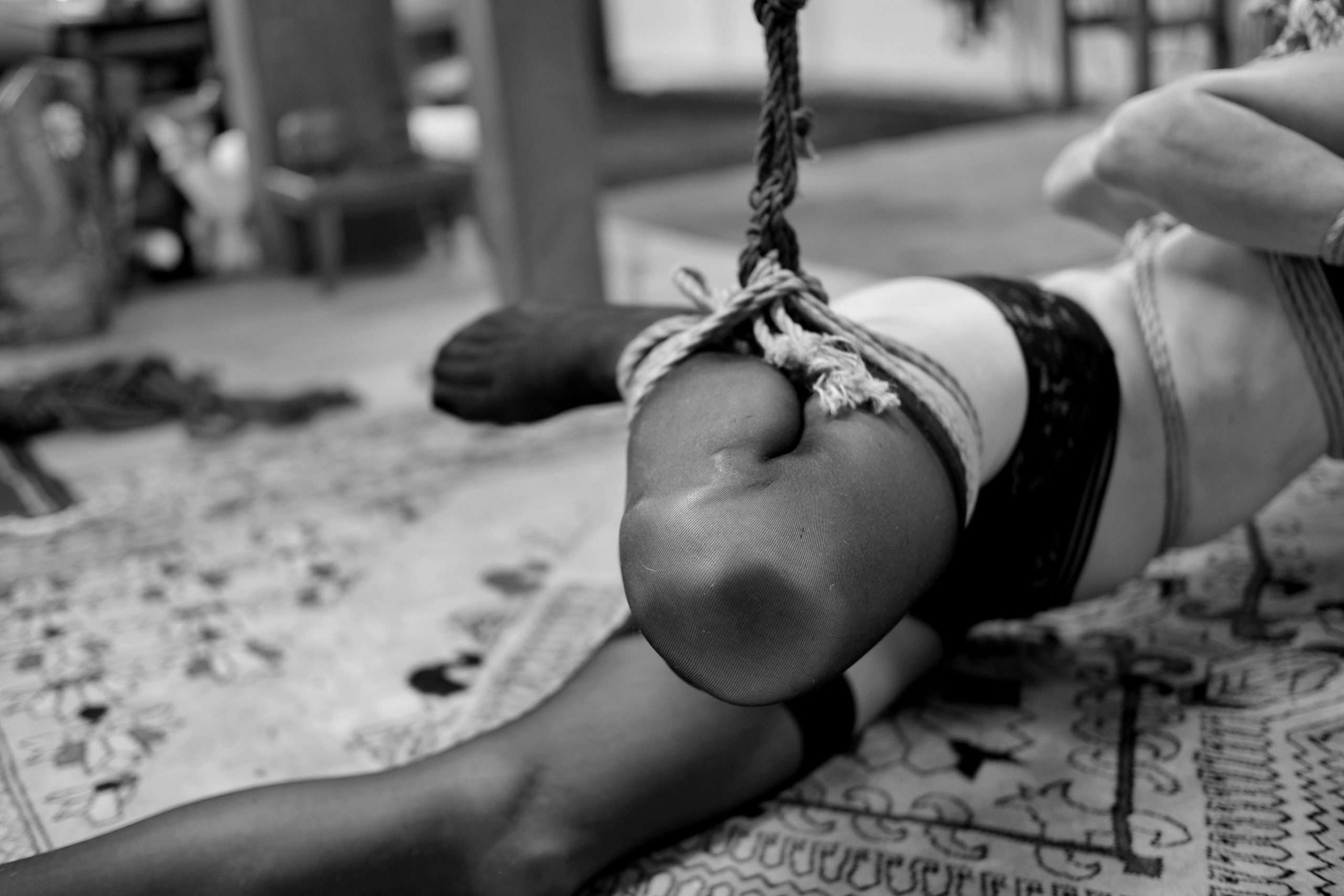
He binds her, ceremoniously, into a Takate Kote. Raises her to her feet, forms a tight rope between two pillars that runs between her legs. A silk scarf covers her eyes. Then she hears it — the crash of Lego pieces forming a carpet at her feet. She giggles at the familiar sound. The room laughs with her. He tugs the rope. An invitation rather than a command. She inches forward across the Lego — each step a small confession, a surrender, an offering, a devotion.

Eventually he pins her against the pillar, a Hashira — suspended, exposed, arms behind her back. He fetches the mirror. Places it directly opposite her. Removes the scarf. She blinks. Smiles. Laughs uncomfortably. Frowns. Looks away. He takes her jaw firmly in his hand and slowly returns her gaze to herself in the mirror. She now sees what we see. Her beautiful agony. She comes undone. The room laps her up as she seems to spill into it. [image by Andy Buru]

There is a lingering impact to this scene that resists easy explanation. As Alphonso Lingis puts it, “Observing an event, however unusual, is not having an experience” (Lingis, 2016, p. 7). Having an experience is to undergo a passion: wonder, rage, terror, jealousy, grief, lust, shame, guilt, awe, erotic pleasure — even love. What came over those present that they were no longer observers but having an experience? The self devoted to order and productivity, the prudent and calculating self that seeks to manage its feelings, the distinct self with its habitual identity — receded.
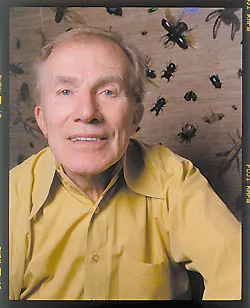
Alphonso Lingis

It is not easy or perhaps even necessary for the performers in this scene to put their experience into words. The compulsion to explain and translate is itself part of what the scene resists. We remain somewhat opaque to ourselves and to each other. No one can experience your experience, and you cannot experience theirs. We can only experience each other experiencing. The encounters that matter most — in kink, as in therapy — are the ones that do not attempt to resolve that opacity but venture towards it. Lingis (2016) warns against a psychology that encourages us to distance ourselves from the passions. Through the inevitable overwhelm of the everyday habitual self, something else emerges — something less fixed and more relational, even if just for a moment. Perhaps we could call it a kind of madness. Nevertheless, it gives way to a different kind of knowing — a collapse of conventional knowing and a relinquishment to the absurd.

The word therapy comes from the Greek — to be with, to attend to.

Not to cure.

Therapy, at its most honest, is simply this: to be with, in curious and courageous enough ways that allow something new to emerge in the space where the self, briefly, loosens its moorings on ideas of what, who, and how we ought to be.


References

Bataille, G. (1986). Erotism: Death and sensuality (M. Dalwood, Trans.). City Lights Books. (Original work published 1957)

Breuer, J., & Freud, S. (1955). Studies on hysteria. In J. Strachey (Ed. & Trans.), The standard edition of the complete psychological works of Sigmund Freud (Vol. 2). Hogarth Press. (Original work published 1895)

Foucault, M. (1988). Technologies of the self. In L. H. Martin, H. Gutman, & P. H. Hutton (Eds.), Technologies of the self: A seminar with Michel Foucault (pp. 16–49). University of Massachusetts Press.

Laing, R. D. (1967). The politics of experience and the bird of paradise. Penguin.

Lingis, A. (2016). Aconcagua. In R. Wheeler (Ed.), Passion in philosophy: Essays in honor of Alphonso Lingis (p. 7). Bloomsbury.

Saketopoulou, A. (2023). Sexuality beyond consent: Risk, race, traumatophilia. NYU Press.

On being “no-thing-ness” (Day 1/5)

An existential Buddhist analysis of the self as the “struggle to exist”

Day 1: A view on Self

(Day 1 of a retreat hosted at Emoyeni Retreat Centre, Mooi Nooi, South Africa)


This retreat considers an intersection between Existential Philosophy, Buddhism and Psychotherapy. It is based on the assumption that we all bring our own personal struggles with the “self” to a retreat setting in the hope that Buddhist practices may bring some transformation. The traditional Buddhist solution is that the self is an illusion. But, what does this mean for practical functioning in the everyday world. What I propose is that it is better to treat the self as a construction (an interdependent arising – to use Buddhist language) rather than a complete illusion. Ultimately, the “self” that we bring on retreat can be viewed as a “struggle to exist” that arises out of sensory contact with the world, giving rise to conscious experience that is then reflected upon (made sense of in consciousness). Conscious experience is opaque or transient and, therefore, uncertain, lacking or unsatisfactory. In response to this we either 1) enter into a struggle to make something solid and lasting out of experience (such as entering into a project of “having”), or 2) flee from the sensation of what it means to exist, taking refuge in alienating habits. The self can, therefore, be said to be a “struggle to exist”.

View from our comfortable stay at Emoyeni

What does it mean to have a “sense of self”? Is this a feeling? Is it an actual sensation? We all seem to have a felt sense of what it is like to exist. My sensation of self seems to be only accessible to me: I can never have direct access to yours, or you to mine. In the field of phenomenology this is probably best described as “hedonic tone”: a felt sense of what it means to exist on a sensory level that gives rise to the sensation of pleasure or pain. But, beyond this basic sensorial experience, what are we referring to when we talk about a “sense of self”? In a public address to the Spanish people, Leonard Cohen tells the story of how he found his voice:

It was only when he discovered the Spanish Poet, Lorca (even in translation) that he had a sense of permission to have a voice of his own: “It is not that I copied his voice, I would not dare, but he gave me permission to find a voice, to locate a voice. That is, to locate a self, a self that is not fixed, a self that struggles for its own existence”. This provides a succinct rendition of self: something that is “not fixed”, not a thing at all but a “voice” that “struggles for its own existence”. Similarly, for the Existential Psychoanalyst, the self is not a fixed thing brought into therapy to be successfully treated. The self is found at the place where consciousness and the world meet, in the struggle to comprehend what it means to exist. If psychotherapy is, therefore, an attempt to understand what it means to be human and the struggles that we face in response to our own existence, surely it should begin with an understanding of consciousness – our primary relation to the world? Therapy, much like poetry, serves as an attempt to give language to this juncture where consciousness meets a world. In this way, therapy finds a “self” that is not a fixed structure but a “voice” from which experience is articulated. The self is not a thing but an action, a relation and an articulation.

If Buddhism teaches a doctrine of “anatta”, or non-self, how is it even possible to function without a self? What are the therapeutic implications for having and not having a self? What role does the self play in functioning in the world? And, how would one function in the world without a self?

When we ask these kinds of questions, paying closer attention to the sense of self, we realise that it can be experienced in multiple ways. We have surely all had the sense of experiencing ourselves from the outside (in the third person) in a dream as if watching a scene of ourselves in a movie. Similarly, certain kinds of recall memory seem to involve this same third person perspective. Neurophenomenologist, Evan Thompson uses the phenomenon of dreaming as an illustration of how the sense of self takes on various forms in consciousness. In a conversation with Robert Wright in 2016, he equates mindfulness in waking with the lucidity of lucid dreaming while sleeping (and shows how neurologically these appear to be closer in brain states). Lucid dreaming being the kind of dreaming when you are aware that you are actually dreaming and, therefore, able to make conscious choices within the dream. When it comes to meditative practice, there is a certain quality to awareness that we are looking to cultivate that goes beyond just focused attention, a certain kind of quality of awareness of experience and relation to the self – much like the meta-awareness in lucid dreaming, it is the sense of experiencing yourself experiencing.


However, this poses some philosophical challenges, such as: when it comes to this kind of awareness, what is doing this observing? It is often conceived that this “observer”, or what cognitive science calls “meta-awareness”, is a separate self behind consciousness. In Western Philosophy this would be, for example, Husserl’s notion of the transcendent ego (a self that is behind consciousness) or in Upanishads (Hindu philosophy) the “true self” that can be discovered in pure consciousness. But, to what extent is this “meta-awareness” a construction (for example through memory) through which we piece together fragmented aspects of consciousness rather than a direct or immediate experience of consciousness itself? Or, is there a subtle and consistent level of awareness that is present in all states of consciousness (even deep dreamless sleep) and that maybe even survives death (as some Buddhist teachings would have us believe)? However, even though we cannot reduce the phenomenon of consciousness to firing of neurons (what has become known as the “hard problem” of consciousness) there is, as of yet, no scientific evidence that consciousness can exist independent of its neurological basis.


“For things to reveal themselves to us, we need to be ready to abandon our views about them.”
― Thich Nhat Hanh, Being Peace

My concern here is from a therapeutic perspective and is phenomenological. In other words, how can we to try and bracket our ideas about the world in order to go more directly into experience and discover what we find there. Therapy, much like Buddhism, is concerned with dealing with the illusions we are trapped within and freedom from the potential suffering they cause. From a phenomenological perspective, consciousness is all that we have. There is no Archimedean point from which we can stand outside of experience and witness the supposed Truth. Everything we know is given to us in consciousness, even our scientific conclusions are a creative outcome of conscious activity. Taken further, some might argue a panpsychist view – that the functioning and development of all living organisms within the cosmos involve some level of consciousness (awareness and response to existence). Nevertheless, consciousness, like the cosmos, is not easy to explore. Consciousness, like the cosmos, is a continuous and spontaneous eruption that appears to be self-organising and it does not appear that what we conceive of as a self is the actual origin of consciousness but rather the outcome of consciousness. As Sartre argued, the self is something that is constructed in consciousness within the act of reflecting upon experience. However, Evan Thompson argues that it is misleading to say that the self is a “illusion” (which is how it is commonly languaged in Buddhist teachings) but rather that it is a “construction”. It can also be argued that the construction of self within consciousness is essential to our functioning. In order to be effective in the world, to intervene in the events of our unfolding lives, we surely need to take up a position towards experience. This position towards experience, what we could call a “preference” (in its basic form as pleasure or pain, liking or disliking) are the grounds for such self-positioning (or perspective). It is, therefore, not so much this “I” position that we take towards experience that is the problem but the implications and ethics of this position. In other words, this “I” position (with ideas about what is “me” or “not me” and what is rightfully “mine”) takes on a certain understanding of the world, develops particular motivations based on this understanding of the world (and our place in it) and tends to cling on to this position. It is, therefore, not the tendency to take up this position that perhaps should be of central concern but the nature of the position that we take up and the ways in which we cling to it.

My courageous, yet small in stature, teenage son is playing club hockey against fully grown adults. He receives the ball and has at least two beastly men coming at him with sticks. His coach shouts “Back yourself, Sam!” It’s an interesting construction of self – that the self is something that can be self-backing. I probably spend a lot of time doing the same with clients in therapy – encouraging them to stand by their own needs and desires. This seems to be in direct contradiction with Buddhist teachings that encourage a relinquishment of desires. However, clients who have experienced deep enough shame in their lives can end up feeling apologetic for their own existence and live under a constant cloud of guilt-ridden anxiety, leaving them overly compelled to meet the needs of others in denial of their own. Such a tendency can leave them trapped in circumstances that perpetuate their trauma, tolerating circumstances that are harmful to them in the same ways that their original trauma was. Therapy is often, therefore, a process of constituting a solid enough sense of self (rather than dispelling it as an illusion) in order to gain a sense of agency that can lead to important changes. Severe trauma can also leave a person with an overly fragmented sense of self, making it difficult for them to function effectively in the world. Therapy in these circumstances is self-affirming rather than self-denying. I, therefore, ask the question of how therapy can provide some sense integration without supporting an overly rigid (and therefore fragile and defensive) sense of self? In terms of this the Buddhist psychiatrist, Mark Epstein, talks of an “unintegration” rather than a “disintegration”:

One of the most important tasks of adulthood is to discover, or rediscover, the ability to lose oneself. To do this we must understand the difference between unintegration and disintegration. The Chinese expression for orgasm, “having a high tide,” describes this difference quite effectively. In a high tide everything is floating, the self is submerged or dissolved, but it is not chaos. When we are afraid to relax the mind’s vigilance, however, we tend to equate this floating with drowning and we start to flounder. In this fear, we destroy our capacity to discover ourselves in a new way. We doom ourselves to a perpetual hardening of character, which we imagine is sanity but which comes to imprison us.

However, this does not account for the inevitable requirement for something to unify experiences within consciousness (otherwise all we would be left with are the fragments of “mind moments”). How, then, are we able to knit one moment to the next in a meaningful way? An example of the loss of this capacity being dementia. The real problem is not the unifying capacity of a sense of self but its egoic tendencies: the inclination to seek unity withing consciousness by seeking permanence, to have, and be in control. I believe that there is also value in being sympathetic to our self struggles without entering into a morbid romance with this self and its struggles. This is where Buddhism may have something to offer in terms of its concept of “metta” (compassion) and finds semblance with existentialists like Kierkegaard who saw “care” as the unifying factor in consciousness. To add to this, Heidegger claimed that “care” was the stamp of being human. Therefore, it is likely that a unifying aspect of consciousness can be shifted from “having” to “caring”. Such a shift, of care or compassion rather than having, moves us away from attempts to make something solid out of the self to a relationship with the self as an ongoing process of becoming.

“The self is a mystery. In our efforts to pin it down or make it safe, we dissociate ourselves from our complete experience of whatever it is or is not.”
― Mark Epstein, The Trauma of Everyday Life

My proposal is that it is not the self, in itself, that is the problem but how this self is conceived (the beliefs we develop around it, such as the world owes me something, or how Social Darwinism promotes “survival of the fittest”) and the relationship we have with this self, that is the trouble. In Buddhist language, it is the cravings and aversions that manifest out of our relationship with self (an egoic relationship) that are problematic. It’s the clinging to the self and not the self, in it’s self, that is the problem. The therapeutic model I am proposing is an entertainment of the possibility of continually relinquishing and re-establishing a self-position in relationship to experience as a malleable and unfolding process of continual becoming.

In summary, thus far, I am proposing a meditative approach to the self that takes on a Satrean flavour, viewing the self is a forever incomplete project of achieving some unity, something solid out of the fleeting, inherently empty, moments of consciousness. As the existential psychotherapist Spinelli conceives of what we are as “that process-like flow of being-always-becoming”, rather than a fixed objective self that supposedly can and needs to be accurately known.

The self is ultimately a perspective on experience and it can therefore take on many forms: We can talk of an autobiographical self; a sensory self (even a bodily sense of self is a construction – we put together fragmented sensory experiences that can be grossly distorted); an observer self; a habitual self; and an imagined self, to name a few. However, what seems fundamental to the sense of self is that it is a “sense”. Everyone has a felt sense of what it is like to exist. This is a feeling that we have on a sensory level. After all, it is only through my senses that I experience the fact that I exist. As Merleau-Ponty put it in Phenomenology of Perception, “The body is our general medium for having a world”. I’ve been thinking more and more about this hedonic tone and the role that it plays in our struggles. I have also been thinking about how there is something deeply habitual even to this more immediate sense: how the sensation of the past has a way of lingering in the present. Do we ever get a sense of what is occurring in the instantaneous moment? Is experience only ever somewhat retrospective, as we catch the tail end of a sense of something lingering? Are we ever fully in the present? Even the coolness of the wind on my skin as I type out these words has a way of lingering after the moment. It is through that lingering that I seem to trace the moment backwards. If this is true about the wind on my skin, how might this be particularly true for our “sense of self”? The sense of self is surely, in part, a lingering sense of what it is that we are and a potentially always outdated one. This is why trauma is so damaging, it leaves a particularly lasting unpleasant sensation of, for example shame, fearfulness, or discontent that not only impacts the present but what we anticipate for the future. Whatever vague sense one is left with from the past, it makes it ever more difficult to experience our “self” afresh in the present or imagine ourselves different in the future. The past seems to have a way of lingering in the present, much like the coolness of the wind on skin that lingers beyond the moment. It is this lingering sense that a person arrives in therapy with and that they usually would like to shake off. When this lingering sense is unpleasant enough, forever hindering the potential sense of something new, it tends to morph into a desperate despondence, often leaving one with fantasies of our own ending as the only way out.

This doesn’t have to be a passive process: We are not just sensory receptive organisms at the mercy of experience. We make choices and these choices are self-constituting. From a Satrean perspective, to neglect to choose is an unwelcome version of non-self. To exist we must choose. We, therefore, carry great responsibility in everything that we do. As Sartre is famous for saying, “Man is condemned to be free; because once thrown into the world, he is responsible for everything he does.” This is not dissimilar from certain Buddhist views, in Understanding Our Mind: 50 Verses on Buddhist Psychology , Thich Nhat Hanh proclaims that “My actions are my only true belongings.”

I am not studying Philosophy, it is studying me.

My thesis begins with the hope of no ending. In other words it follows Buddhist scholar, Stephen Batchelor’s encouragement “that we allow ourselves to be a mystery for ourselves rather than a set of more or less interesting facts.” (Batchelor & Batchelor, 2019, p.23) My intention is therefore antithetical in that I wish to fully explore this mystery while, at the same time, hoping that I never fall into the trap of believing that I have solved it. It is perhaps appropriate then that my point of departure is with Zizek and his critique of contemporary Buddhism – that it serves as the new opium of the masses.

There is something almost fetishistic about watching Zizek talk that is akin to “rubber necking” as one passes the scene of a gory road accident. I find myself particularly drawn to the vulgarity with which he finds dialectical opposition in everything, even his own utterances, interrupting himself as he builds his argument from multiple directions. At the same time, I am surprised by his generosity, as he goes about finding agreement in the most surprising places. I was particularly amused by his patience with Jordan Peterson in their public debate, politely suggesting that Peterson should perhaps read a bit more. I now realise that this remarkable ability to appreciate the contradiction in everything is a Hegelian stance.


Slavoj Zizek photographed at his home by David Levene in Lubljana, Slovenia. http:///www.eyevine.com

When I came across Slavoj Zizek’s critique of Buddhism, my initial reaction was that he too needed to read a bit more (about Buddhism). However, I have come to realise the gravity of his critique, not only due to its reservations about the development of a Western Buddhism, but for how it speaks to the manner in which we respond to our own existence in general, as we hurtle our way towards the inevitable end of the Holocene. As David Attenborough states in what he calls his recent witness statement, A Life On Our Planet (Netflix): “The true tragedy of our time is still unfolding”. How conscious are we of this? As Husserl insisted – consciousness is always a consciousness of something. What then should we be most conscious of at this time in our human history? It would surely be a tragic irony if Buddhist practices became the opiate through which we sedate ourselves from the consequences of ourselves. Going beyond Husserl, Zizek might argue, with reference to “parallax”, that my very consciousness of things changes the things themselves. This adds a whole new dimension to the concept of what it means to be “mindful”. Although mindfulness is originally a term used to refer to the practice of being present to the moment by moment unfolding of things, it has become a term that can be said to represent a burgeoning, somewhat contradictory, ideology in the west – a preoccupation with “self-awareness” as a necessary tool for surviving our attempts to stay afloat in the rising tides of neoliberal capitalism. Such an ideology narrows my phenomenological gaze to an awareness of self; a self-interested focus on what is going on within me, rather than a reflection on how I am being in the world.

Sir David Attenborough as seen on Netflix

According to Stephen Batchelor (2015) mindfulness is a term that has been loaned from Theology with no equivalent in Sanskrit or Pali.  The Pali phrase that more accurately represents the practice of mindfulness is “sati sampajanna”.  Batchelor roughly translates this as “remembering to be present” or “remembering the present”.  But what does it mean to “remember the present”?  Is there perhaps an accidental truth to the phrase: “remembering the present”?  Can the present be experienced in any other way than through it being remembered?  As Hegel might have argued “”the act of representing reality lags behind the process—it’s what remains residual” (Davis, 2017, p.385).  By my very act of engaging with “the present moment” it is already changed, not only by the passing of time but by the nature of my engagement with it.

Similarly, is being present a form of re-membering the fragments of reality as they are experienced? As Laing (1967, p.19) proposed: “Our task is both to experience and to conceive the concrete, that is to say, reality in its fullness and wholeness. But this is quite impossible, immediately. Experientially and conceptually, we have fragments.” Mindfulness should therefore aim to be much more than a technique for “finding calm within” in coping with modern reality; it can be seen as a consideration of our very relationship with reality.

In my attempt to go beyond the attitude of being a mere set of interesting facts to myself; I wish to capture the spirit of Philosophy as a practice. This spirit is summarised in a conversation that Davis (2017, p.386) recalls having with Zizek:

I remember driving from Chicago to Ann Arbor when Žižek and I got into a conversation about philosophy, about the very nature of thinking. And we thought about this employing his famous Hegelian procedure of the “dialectical 180” and we concluded that it is not so much that you study philosophy so much as the very opposite, that it studies you.

Reference:

Batchelor, S. (2015). After Buddhism: Rethinking the Dharma for a secular age. London, UK:

Yale.

Batchelor, M. & Batchelor, S. (2019).  What is this?  Ancient Questions for Modern Minds.  Wellington, New Zealand: Tuwhri.

Davis, C. (2017).  Today’s Psychotic Academy: Risking the Pedagogy of “Žižek’s 180”.  Philosophy Today, 61(2), 379–387. DOI: 10.5840/philtoday201769164

Laing, R.D. (1967). The Politics of Experience and The Bird of Paradise. Middlesex, England: Penguin.

Evening meditation at The Buddhist Retreat Centre, Ixopo, South Africa. May 2021

Buddhist Practice as Existential Therapy

Buddhism as an existential Practice

What if Buddhism could be seen as, essentially, an existential practice?  In other words, it asks questions like: “what is this thing that I am?”, “what is it that I am doing here?”, or, as Heidegger might have put it, “why am I even here at all?”.  From an existentialist perspective, the most interesting aspect of being human is the nature of consciousness: We experience the world in a way that we are able to be aware of the very fact that we are experiencing it.  This leads to complicated questions, such as: “What does it mean to be human?”; “Who or what in the end is doing the actual experiencing?”; and “What informs how we interpret the experiences we have?”  Our “way of being” in the world is particularly defined by our times.  As Heidegger suggests, we are thrown into a world not of our own making (especially the culture, language and traditions we are born into) but the world itself is not of our own design.  It is not easy to escape these, but it is certainly worth reflecting on how we have been shaped by the ideas about reality that we have grown up in.  Rather than let these ideas about reality be taken for granted and unexamined, the various Buddhist traditions serve as very deliberate methodologies for understanding how we exist in the world.  One of the most effective methodologies for this is Vipassana – the origin of what is now known as the Mindfulness Movement.

Imagination, Memory & Self

It is, perhaps, important for me to clarify here that I approach Buddhism as a secular practitioner and practicing psychologist.  This leads me to some cautionary notes about how Buddhism is often interpreted:  We often misinterpret the aim of meditation as a modality for freeing us from thought.  Psychologically speaking, this is both unwise and unlikely.  Thought is based on our inherent capacity for symbolic representation.  It is based on our ability to imagine.  We cannot live without imagination.  Without imagination, we have no means of conjuring up memories of the past or propelling versions of ourselves into the future.  Dementia is arguably not just a failure in memory, but underlying the loss of memory is a failure in the capacity for imagination.  Without imagination we cannot put together a version of ourselves that we present to the world as a means of getting on with the task of living.  It could be said that what we call a “self” is a felt sense of who we are, where we are and what it is that we are doing here – at any given moment in time.  It is this felt sense of self that is the needle with which we thread ourselves through time.  If the self is the needle, then our memory and imagination serve to thread this self through time.  Without these basic faculties – imagination, memory, and self – conscious experience loses coherence.  Individual moments only have meaning to us when we are able to thread them together.  However, over time the self becomes more than a feeling – it becomes an idea (or even a story) about who we are.   Our sense of self finds consistency along the patterns it weaves (habitual ways of being) as we thread our experiences into a story about our lives.  It is through this process that we start to have a sense of coherence about ourselves in relation to the world (and people) around us.  But it is also through this process that we inevitably build a fiction about this thing that we are.  We hold on to the idea of this thing that we are – an “I”, and a “me”, and all that is “mine” – as we anxiously try to preserve or defend it.  Without the faculties of imagination, memory and a feeling of self – we fear the loss of all sense of time and place.  We risk feeling fragmented. We become potentially incoherent to ourselves.

Buddhism heeds against holding on to the story we have for who we are, the “self”, too tightly.  From a Buddhist perspective, through becoming anxiously bound to the idea of who we are we become potentially ignorant to certain “truths”, chief of which being our own impermanence.

Self as Fiction

We are forever at risk of taking ourselves too seriously, of pulling the thread too tight around ideas of who we are and what we believe is really going on in our lives and, therefore, of restricting ourselves from the myriad of possibilities that life has to offer. We become entrenched in habitual emotional reactions through habitual ways of being in the world. We decide that “this is just who I am” when “who I am” is arguably a collection of patterned thoughts and behaviours that are loosely founded on an original temperament and largely shaped by the world that has been thrust upon us.

This thread (the storyline we develop in order to achieve a sense of coherence) of who we are and what we are doing here, can be easily disrupted by events in our lives, both good and bad. We could fall in love, we could lose a lover, or we could be diagnosed with cancer.  Such events can cut through this thread causing our lives to feel abruptly redefined. Covid19 has been no different to this.  For anyone paying attention, it has brought into question our environmental, social, political and economic ways of being in the world.

Buddhism teaches us that this “self”, that I achieve things with in the world, is a fiction. What I would like to emphasise is that it is somewhat of a necessary fiction. The artistry of Vipassana lies in taking this sense of self just seriously enough (through observation of it) and yet appreciating it as a fiction at the same time, through the ongoing process of “letting go”.  As Mark Epstein suggests, the problem is not that we think we are real but that we think we are “really real”.

If the self is a fiction, then what can we rely on? Buddhist practice encourages a reliance on “pregnant emptiness” of the present moment. It is here that refuge is to be found from our own inevitable neurosis. What makes it difficult for us to find refuge in the present is that our capacity for imagination means that we are forever losing ourselves to ruminations of the past or projections into the future. But I am not convinced that we are meant to do away with these faculties altogether – to give up on our imagination or to completely discard the self. To do so would mean to go deliberately mad. I believe that our task is to try and bring an ‘alertness’ to the process of how our imagination incessantly moves between past, present and future – reifying a sense of self.  Rob Nairn encourages an “impartiality” to this inevitable process as we bring awareness to it.  In this way, the practice of Vipassana helps bring us alive to the role that imagination plays in the formation of our reality. Over time, through the regular practice of Vipassana we are able to observe how thoughts and feelings shape our reality.

This is where the true therapy lies: Through ongoing practice, we come to realise just how much we are constantly rehashing the past or rehearsing the future. We seem to incessantly project a version of self into an imagined future. It is, arguably, a misinterpretation to treat these activities as a taboo or as getting it all wrong. The objective is compassionate awareness rather that critique and striving to “get better” at it. Thoughts, worries, memories, planning, rehearsing…are all tendencies essential to our cognitive functioning. It is more helpful to approach these tendencies with gentle caution rather than self-degradation:  To become an object to ourselves that we can observe with relative “equanimity” (a word Stephen Batchelor seems to prefer to Rob Nairn’s “impartiality”).

Losing ourselves to habitual thinking

This tendency, to lose ourselves in thoughts, is particularly problematic when it is the means through which we find escape from Dukkha – “the perpetual unsatisfactoriness of existence”.  When we talk about “the present moment”, we are not just talking about the sound of crickets, the wind in the trees, or the increasing ache in my back as I attempt to stay upright while meditating.  We are talking about thoughts and feelings that are presently flavouring my experience of reality.  In Buddhist psychology, thought itself is a sensory experience and it is out of our own reactions to these thoughts (grasping or aversion) that our true suffering is born.  Part of the therapeutic value of Buddhist practice lies in sifting through our own neurosis – getting a felt sense of what is “real” versus what we have “imagined” as real.  The therapeutic outcome lies in identifying how reactive and habitual thought patterns colour our reality (often in ways that perpetuate suffering).  In Buddhism, the present moment is simply the most reliable place to be.  It is where it is all really happening and, therefore, it is the place to go if we are to attempt understand anything about what it is that we are.

Thoughts can be very sticky; once they arrive, they set off habitual chains of further thoughts, feelings and behaviours.  This leads to patterns over time that form grooves in the mind.  Much like the flow of water erodes soil, these grooves are self-perpetuating.  We arrive at a place where these patterns seem to have the better of us, as if we are watching ourselves on automation.  It could be argued that habitual experiences like depression, anxiety and addiction are formed, or at the very least perpetuated, by these patterns.   For this reason, there can often be something very freeing to surrendering to the moment.  With enough practice it relinquishes us (even if momentarily) from the hold that these habitual patterns (of thought, feeling and behaviour) have on us.

The Existential Lesson of Covid19

Another way of talking about “Dukkha” is, as Mark Epstein would put it, that which is “hard to face”.  From an existential perspective, an inevitable conflict arises when we try to avoid certain “givens” to our existence.  Irvin Yalom, probably the most prolific author on Existential Therapy, summarises these “givens” as: death; freedom; isolation; and meaninglessness.  These are the anxieties that we tend to push aside in our everyday living. It is these same anxieties that Covid19 has very starkly brought into the foreground.  We are all geared, to some extent, towards ensuring our own survival.  We are inclined towards the preservation of self.  Even for those of us who are privileged enough to still be healthy, have work to keep us busy and food on our table; the idea of our own mortality lingers in the background of our everyday lives. Like the hum of the fridge in the kitchen at night – fear of our own death is there, even when we don’t pay too much attention to it. However, both Buddhism and Existentialism would argue that paying conscious attention to this anxiety opens us up to the possibility for new ways of being. It opens us up to questions like: What are the things we need to accept? What are the deeply ingrained habits we could possibly change? What does it mean to be alive in our time? What are the things that we have come to realise that we most value? What have we been taking for granted? What are the things that we are unnecessarily attached to?

The global pandemic has made degrees of isolation familiar to us all. Isolation, of any kind, serves as a confrontation with self. Buddhist practice can be described as a means of “going into oneself in order to get beyond oneself”. This is ideally what isolation facilitates. However, in a society that so highly values consumerism, we are particularly geared towards avoiding our own interiority (and the inevitable feeling of aloneness, even when we are with others); there is always something outside of ourselves that brings the hope that we will feel different or better about ourselves.   Stephen Batchelor has been exploring the existential basis of Buddhism since his earliest work, Alone with Others.  He emphasises the two basic dimensions of existence – “having” and “being”.  The central concern is that “as long as the notion of having predominates, our being remains empty and superficial”.  We are under the illusion that the accumulation of “things”, be they objects, relationships or knowledge, can provide us lasting satisfaction at the demise of learning how to be with things as they are.

Unfortunately, isolation alone can achieve very little. If anything, it can make the fear of our own thoughts and feelings all the more daunting.  As a therapist, I have witnessed people gradually come undone during the 2020 “lockdown”.  Despite alcohol bans in South Africa, most of my clients have self-medicated on alcohol more than ever.  In his most recent work, The Art of Solitude, Batchelor draws on the work of Montaigne, a French philosopher who had no contact with Buddhism but who chose a life of relative solitude. “Retreat into yourself, but first of all make yourself ready to receive yourself there. If you do not know how to govern yourself, it would be madness to entrust yourself to yourself. There are ways of failing in solitude as in society”.  How do we make ourselves ready to receive ourselves?

French chefs talk about “mise en place” – “everything in its place”. Before they produce a meal, they make sure that they prepare a place for everything. We need to do the same when it comes to solitude; when it comes to the act of “going into ourselves” there is a need to prepare a place for solitude. This is where the method of Vipassana (and the model it proposes for how the mind works) may be helpful. Vipassana prepares a place for us in the present moment.  Solitude, in the end, is not limited to the act of retreating into hermitage.  Even in the presence of others and especially when we truly go into ourselves, we can feel a particular isolation.  I can never truly access your experience and you can never truly access mine.  Therefore, to some extent, we are always experiencing somewhat of a solitude.  Being ready to receive ourselves requires a certain amount of courage to savour the underlying and perpetual feeling of solitude that we usually avoid through focusing on “things” outside of ourselves.  It requires a shift from a focus on “having” to an openness to “being”.

There is great value in going into isolation with a particular attitude:  Batchelor quotes Montaigne as saying “That is why it is not enough to remove oneself from people, not enough to go somewhere else. We have to remove ourselves from the habits of the populace that are within us.  We have to isolate our own self and return it to our possession. We carry our chains with us; we are not entirely free. We keep returning our gaze to the things we have left behind; we fantasize about them constantly.”  When we isolate ourselves, we do not necessarily completely free ourselves. The opposite seems true: worlds within us; the griefs from our pasts; the longings for our future; and ways of being that have grown to size within us come to meet us.  As the poet, Don Maclennan put it in, Grieving:

Why do we persist inhabiting old rooms
in houses where we grew to size,
enacting dramas in the attic or the music room
with its dusty bookcases and faulty piano?
You’d think our greatest gift was consciousness,
something to hold us cleanly in the here and now.
But you have grown to size inside me –
that’s why losing you hurts so much.

Don Maclennan

When we embrace solitude, we are not only confronted with the fear of loss of an outside world; we fear a loss of the worlds within us. Even when these are sometimes painful worlds – they are still familiar ones.  We hold onto their familiarity.  Albert Camus wrote that “In order to understand the world, one has to turn away from it on occasion.” But simply turning away from it is not sufficient.  We need to recognise how the world we have grown to size in has actually grown to size within us.  When we go into ourselves, we find the voices of our parents, past lovers, the media, patriarchy, capitalism and many more – some of these voices we no longer even recognise.  We risk mistaking them for our own thoughts.

This is where the practice of meditation serves a similar function to therapy.  It helps us discover answers to questions like “What are these thoughts and feelings based on?” However, in meditation, we do not attempt to answer these questions with the thinking part of our minds. We answer them by simply observing our own thoughts while holding the question in mind. While therapy might be focused on change, meditation is preferenced towards “embracing things as they are” as Batchelor would put it, and then bringing awareness to how we react to things as they are.  The practice is to have a questioning stance without ever really settling on a fixed answer.

Perhaps we could say that Covid19 has been the equivalent of Siddhartha leaving the palace:  A moment of existential anxiety when our eyes are opened to the true nature of things, particularly how our lives are connected through our shared potential suffering. There are many responses to this; one being to run back into the seclusion of our palaces (or our gated communities) and find solace in our usual pleasures; the other is to continue to venture into what it means to be alive in our times and not to turn away from the existential “givens”. The difficulty with this is that when we attend to the experience of “being in the world” it brings into sharp focus that there are somewhat incomprehensible aspects to our existence – it doesn’t ever fully make sense. Why are we here in the first place and does the universe even care?

Even if, on closer contemplation, our own existence might seem rather strange to us; it is important to carve out some sort of purpose without taking ourselves too seriously. Covid19 is a stark reminder of what David Hume wrote: “The life of man is of no greater importance to the universe than that of an oyster.”  Perhaps the Covid19 crisis poses the inevitable question: Now that we realise how precarious our existence is, what do we choose to do with it?

Since birth, we are thrust into a world not of our own choosing. We need to understand our own response to this aspect of our existence and how our responses continue to shape who we are. As we struggle to let go of a world that has grown to size within us, what freedoms can we find in our reactions to the world around us? Vipassana is a method of letting go of the things that have become deeply habitual to the mind.  It is the courage to explore our existential freedom.  Existential freedom is perhaps best captured by Sartre’s proclamation that “Existence precedes essence”.  We are thrust into a world not of our own choosing; become aware of ourselves; and are compelled to make choices.  Every choice we make represents the possibilities of (wo)man – what we think a human should be.  There is no essential blueprint for who we should be.  Rather we hang on to arbitrary identities and man-made ideas. Therefore, once we let go of these stories for who and how we should be, there is some anguish to this freedom because “In fashioning myself, I fashion humanity.”

A brief note on Secular Buddhism as Psychotherapy

Although it can be therapeutic, Vipassana is not so much a therapeutic tool but a means of practicing a philosophical approach to life.  It is a means for us to practice coming to terms with how things actually are, rather than how we might fear, crave or imagine them to be.  Stephen Batchelor stresses that this is not necessarily a complacency or a resignation to how things actually are.  Once we have come to terms with what is actually going on (within us or in the world around us) we make room for new possibilities; new ways of being and thinking in the world that are less dictated by habitual reactivity –  we prepare a place for existential freedom.

Vipassana is an attempt at deepening our inherent capacity for conscious experience.  Although consciousness remains somewhat of a mystery there is perhaps nothing that mystical about it. I can recall first hearing Rob Nairn (retired professor in criminology) lecture on the topic more than 20 years ago.  He conveyed Vipassana as a succinct and pragmatic philosophy of mind.  This brief lecture served as a foundational reference point for understanding the mind and was often a means to refuting some of the theories I was exposed to while studying psychology.  Buddhist ideas were a particularly helpful vantage point in my tendency to refute diagnostic thinking:  We all suffer from the same thing, the human condition.  As Samuel Beckett claimed, “You’re on earth, there is no cure for that.”

Vipassana practice is also somewhat of a departure from western psychology in that it relies more on direct experience of the mind than theoretical ideas of mind.  Vipassana attempts to know the mind experientially rather than theoretically.  In this way it provides the foundation for any mindfulness practice – “direct experience”.  As Rob would emphasise, mindfulness is “knowing what is happening, while it is happening”.  Leaving us with a task that is alarmingly complex in a simplicity that starkly contrasts to how we go about most of our everyday lives.

“Existence is a flame which constantly melts and recasts our theories”, R.D Laing.

These ideas will be more thoroughly explored on an intensive retreat at The Buddhist Retreat Centre, Ixopo, from the 13th – 15th November with an additional exploration in Buddhist Psychotherapy from 15th – 18th November. To book, click here.

© 2026 Jason Ross

Theme by Anders Noren — Up ↑