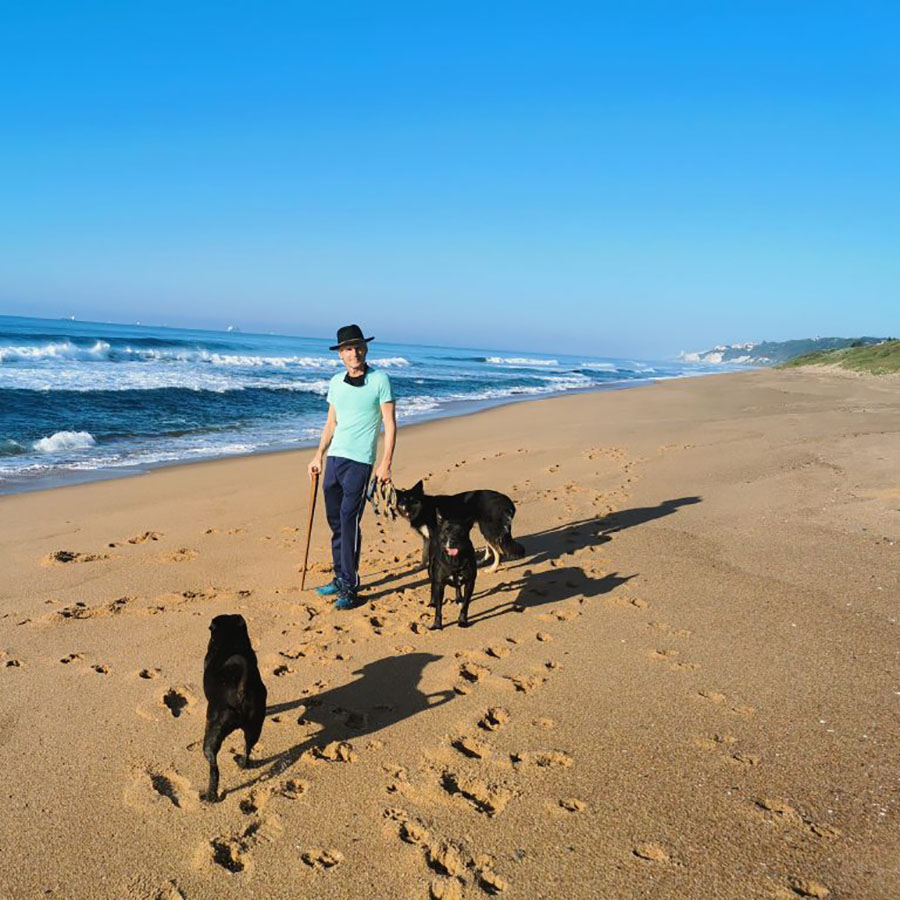
It has always concerned me how my children felt fearful at the presence of someone in police uniform. I am not sure how that came about. Perhaps the legacy of our country’s history made its way to them through overhearing adult dinner time conversations. Sadly, they are more fearful now than ever. When we see a blue and white car approaching on our morning walks, it more fear than protection that is felt.
From 6 to 9, it’s difficult to shake the feeling that I am not really free. Despite the sense of openness that comes with sunshine, empty roads and clear blue water, I sit with this pending feeling that I could do something wrong at any point in time. It’s not an entirely unfamiliar feeling. I think I had it often as a child. Waiting for my father’s unpredictable outburst or my mother’s feelings of injury. It was easy to feel like you were getting something wrong. Contemporary Psychanalyst, Adam Phillips, claims that “no one ever recovers from the sado-masochism of childhood”. There is an inevitable power indifference to being a child and the only way to survive it is to find some pleasure in having power over you or, at times, some joy in finding ways of finding your own power. I tell Josh this week, “If you don’t stop fighting with your brother you won’t get your violin”. “I don’t want it anyway,” he replies, insincerely.
Good parenting, if there is such a thing, lies in making room for a child’s attempts at empowerment without giving into their every need. At worst and unfortunately more commonly, parenting is done through a diminishing of the child. We have a tendency to make the already small feel even smaller. Luckily children are forever forgiving. They are compelled to keep a fantasy alive that we will be what they need us to be. Until, one day, they realise their parents are just mere mortal humans. If this happens either too early or too late in life, it can be devastating. In fact, throughout our lives we are likely to constantly try and resurrect our parents from the reality of their inadequacies. We want them to be everything we need them to be. It is perhaps then the job of parents to gradually introduce their real selves to us, when the time is right?
Adam Phillips believes that a good parent is able to tolerate a child’s inevitable anger towards them. They will inevitably resist the power we have over them. They will inevitably feel somewhat betrayed when they realise we are, in the end, only flawed humans. As we walk past some officers and the boys creep closer to us out of fear, Fiona reassures them, “they are just people under those uniforms, like you and I, just as scared and unsure as we are.”
As the president made his first speech, most of the people I know cheered him on with much faith and fantasy in a reunited South Africa. I hadn’t seen that since Madiba shimmied his way across the World Cup Rugby field. We hoped for another Tata (isiXhosa for “Father”). But, as we all know, you get different types of parents. The biggest problem with a more punitive parent is that they give rise to shame. Freud believed that “shame” was a useless emotion. It is, but that doesn’t stop it from the havoc it causes. A good parent allows you to ask them questions; is genuinely open to criticism; leaves less room for doubt; and allows you to gradually become responsible for your own choices. An inadequate parent simply repeats what was done to them, normally by keeping cycles of oppression alive. A good-enough parent allows for freedom within reasonable boundaries. A good parent can be trusted to enforce those boundaries only when needed. A good parent makes room for personal integrity and self-efficacy.
Shame is the feeling that there is something unacceptable about me and it is going to be revealed at any moment. The most effective way to engender shame is to leave someone feeling that no matter what they do they will be in the wrong. In psychology this is known as a “double bind”. Here we sit, the whole of society caught up in a “double bind”. It feels too dangerous to go back to everyday life and, yet, it is becoming too costly to stay at home. There are people starving but it’s illegal to feed them. There are some who even feel that we shouldn’t even be at home in the first place. There are some who will perhaps sit tight until a vaccine arrives. But, our shared struggle with what to do and when to do it highlights an underlying condition of our very existence – the very contradictory nature of life itself. Life is full of these “double binds”.
It is through our strife with life’s contradictory nature that the feeling of being disjointed and alienated (even from ourselves) can arise. In fact, it was proposed by Bateson (a founder of Family Therapy) that the development of schizophrenia could be attributed to the extent to which we are exposed to “double binds” during our development. We may not all show signs of schizophrenia, but contradictions are more common to our everyday lives than is ideal. If pervasive enough, these kinds of tensions can give rise to underlying feelings of fragmentation or un-realness within us. The benchmark of an event being traumatic is the overwhelming question it may leave you with – “Is this really happening?”
This often manifests in the experience of our own bodies. Shame is a very visceral experience. It leaves us with a crawling skin. This is often the flavour of our conversations in sex therapy. Our sexuality is far too often shaped by the simultaneous occasioning of both pleasure and shame. So many people have experienced how being in their bodies can feel both good and bad at the same time. Abuse of any kind, especially from someone you trust or love, is the most obvious (yet least acknowledged) ingredient for this. There is a distinct kind of trauma that evolves from the coupling of pleasure and shame – it renders us apologetic for our own needs. In severe enough cases, apologetic for our own existence. I spend a lot of my day campaigning on behalf of people’s needs, encouraging them to treat their own needs as legitimate enough. To allow their needs to be seen.
I wonder how many people’s needs are going unseen right now. Those going hungry in their homes; those feeling alone in their marriages; those working harder than they ever have before; others wishing if only they could be working at all. Collectively, what is it that we “really” need? Is it more ICU beds? Is it a chance to ride those glossy winter waves? Is it the reliability of the next plate of food? I had this fantasy that covid-19 would be the greatest leveler our society has ever seen: A re-calibration towards a shared value system. I fear that it may have more deeply embedded the existing inequalities in our society.