PhD Philosophy & Psychoanalysis

Tag: existentialism (Page 2 of 2)

Still(a)Life#28: The Plague

When I first started my practice in Johannesburg, I used to make sure that I was always wearing a good pair of shoes. I was young and needed to be taken seriously. Clients spend an inordinate amount of time staring at your feet. Especially when you ask the more difficult questions. The other day I asked a client a difficult question, she simply turned the lid of her laptop up to the ceiling as she tried to answer it. There are some interesting advantages to online therapy.

Today I didn’t wear any shoes. I felt at first as I imagine a Muslim woman might feel without her hijab. But one or two sessions in and it felt comfortable: honest. There’s a book at my feet. I don’t get much chance to read it but I keep it close for a sense of security; that someone might just know a way forward for us. In 1941, the French Algerian, Albert Camus, started writing a book about a virus transmitted from animals to humans. He portrays how the society in the book doesn’t really question what it means to be alive until their lives come into a clear and present danger. For Camus, the real plague is not the virus but the fact that we are perpetually vulnerable to the absurdity of life. There is no hidden meaning or purpose to the plague, human suffering has no underlying “purpose” and death is a reminder of how our lives can be rendered suddenly meaningless. This is the human condition.

Camus’ real concern is for how humanity engages with this condition. For instance, our tendency to create an “us” and a “them” – to think of ourselves as uniquely immune to human struggles. Throughout History, pandemics, have proven that we are ultimately all vulnerable to the same fate. Camus, however, seems to find little value in panic. For him, panic is a response to a transient condition that we could potentially solve. Rather, if the condition we need to treat is the very circumstance of being human, then we need to find ways of “living”. Camus proposes that the only way to fight the plague would be through “decency” to one another. And the only way to deal with the human condition would be to live as fully and sensuously as possible. To live life to the fullest is to make life worth enduring.

And so, today, I enjoyed the feeling under my feet, the sun casting shadows on the wall, Josh laughing outside as he played with the dogs. I wondered what he meant by living with decency…Perhaps it’s simply to love?

“They knew now that if there is one thing one can always yearn for, and sometimes attain, it is human love.”
― Albert Camus, The Plague
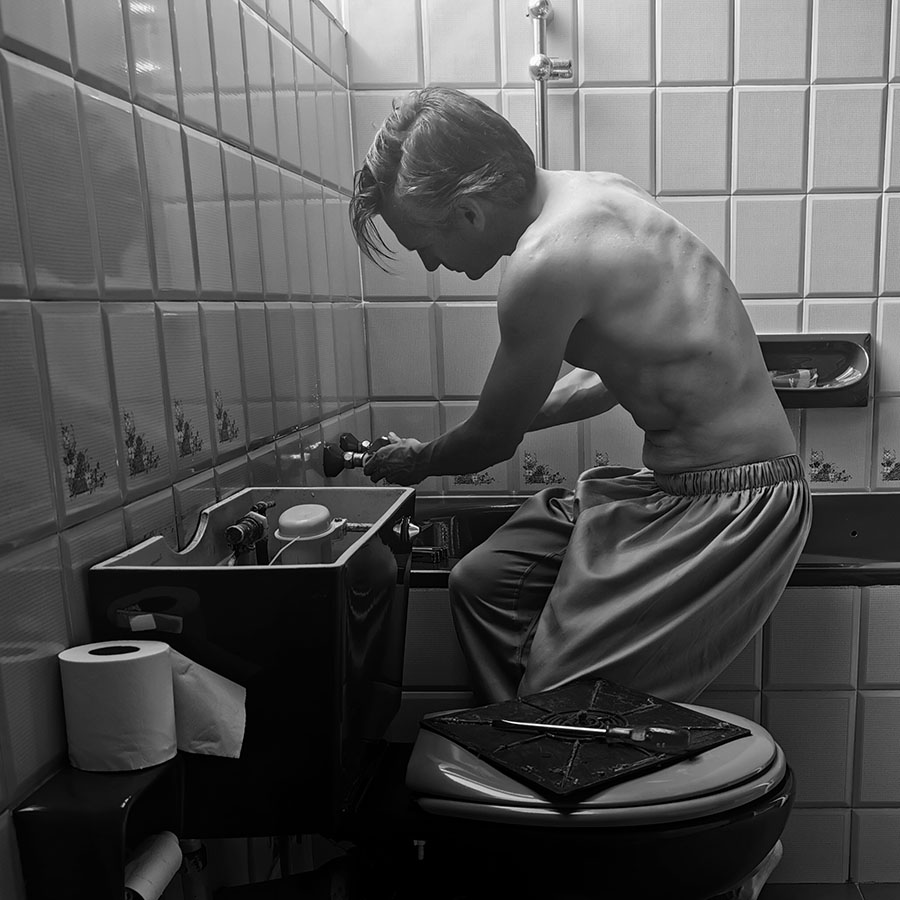
Still Life #16: Exposing an Imagined and Unreal World

I think we have forgotten what it means to be human: Industrialization, accelerating technological advances, and the increasing specialization of what we do with our time have caused us to live in a relatively automated fashion. Although seemingly efficient, it leaves us further and further removed from what we are. Our children are brought up to conceive of chicken as a nugget in a take-away box, not a winged creature bred for food rather than flight.

Today I tried my best to fix a broken tap. That is not a part of “who” I see myself to be; DIY is not my thing. But, without the luxury of just calling someone or popping to the hardware, I was forced to make an unsuccessful day of it. The water mains are still off. Lock-down gets a bit more real with no water. “How can this be happening, now” I thought to myself. As if the world owes me something. I wanted to blame somebody. I probably wasn’t very nice to be around.

We have conceptualized a world where we get what we want, where the basics are taken for granted and where things should always make sense. Especially bad things, they should not happen at all and if they do, they must have some sort of reason, some greater design. We have conceptualized a world where we have assumed that our human needs are central

*Enter Covid19

“We perceive the world in a particular way and confidently expect it to conform to its appearance. But we fail to recognize that certain aspects of the ‘reality’ that appear to us are nothing but figments of our own imagination. In this confusion a conflict ensues between the world as it is and the world as we believe it to be. And the more we insist on our infallibility, the more frustrated we become as the actual world again and again stubbornly refuses to live up to our expectations.”
― Stephen Batchelor, Alone with Others

Still Life #14: Keeping a Purpose

“It is starting to feel like a sentence” a client told me today. A stark contrast from the relative excitement he felt the week before. The problem with “confinement” is that the hours and days start to merge. The usual impetus, no matter how trivial, to get up in the morning and put on an identity can be easily lost. And, with it, we can start to lose our purpose.

After the initial forced respite from the business of life is over, we might start to crave a need to feel useful. If you are not a medic, a grocer or an officer – this might prove trying. One of the greatest needs we have is to “achieve” something. Our definitions of achievement are very caught up in things we may not have access to at the moment, especially capital gains.

The existentialist in me would like to urge that we all learn to come undone a little bit. Given the absence of our usual distractions, it will teach us something about ourselves.

Even though I’m reluctant to sound like a life coach, if you are fearing for your sanity, I would encourage you to forge some sort of daily routine. We all need to anchor ourselves into something.

Still Life #11: Apocalyptic Existentialism

This is Sam’s (12) Corona bird he scribbled out on a piece of paper for me. I framed it straight away. It encapsulates the balancing act we are all facing.

Some of us might be taking this time to savour a good meal or the bonds we share around the table while we simultaneously try to push away the contrasting anxiety of loss and the awareness of others less fortunate.

We juggle having to face the personal struggles we’ve had the luxury of ignoring while we wonder if a world crisis could make them suddenly irrelevant.

Unfortunately, I don’t think it will. Now is the time to face our demons or they will eat what’s left of us as the world goes hungry.

Although most of us are safe in the comfort of our homes. I wouldn’t recommend making a home of denial. Not of our own personal struggles nor of the state of things beyond our garden walls.

After reading my posts, a friend asked me today if I was okay. Therapists are not in the habit of being asked if they are okay. We don’t like to be asked. We like to take refuge in other people’s troubles to escape our own. I replied:

“Thank you. I think most people are in (perhaps necessary) denial. Focusing on zoom yoga and taking pictures of lockdown meals, while the world runs out of food and half of India dies. I’m trying not to jump on a soap box and I’m also trying to stay positive. People will die. And not just of Corona. South Africa will take years to recover and our politics, or lack thereof, will become more significant than ever. I think people want me to give them 7 steps to surviving lockdown with your kids, not apocalyptic existentialism. But it’s all I’ve got.”

Newer posts »

© 2026 Jason Ross

Theme by Anders Noren — Up ↑