PhD Philosophy & Psychoanalysis

Tag: coronavirus

Still(a)Life#33: Ships in the Night

Ships that pass in the night, and speak each other in passing,
Only a signal shown and a distant voice in the darkness;
So on the ocean of life we pass and speak one another,
Only a look and a voice, then darkness again and a silence.

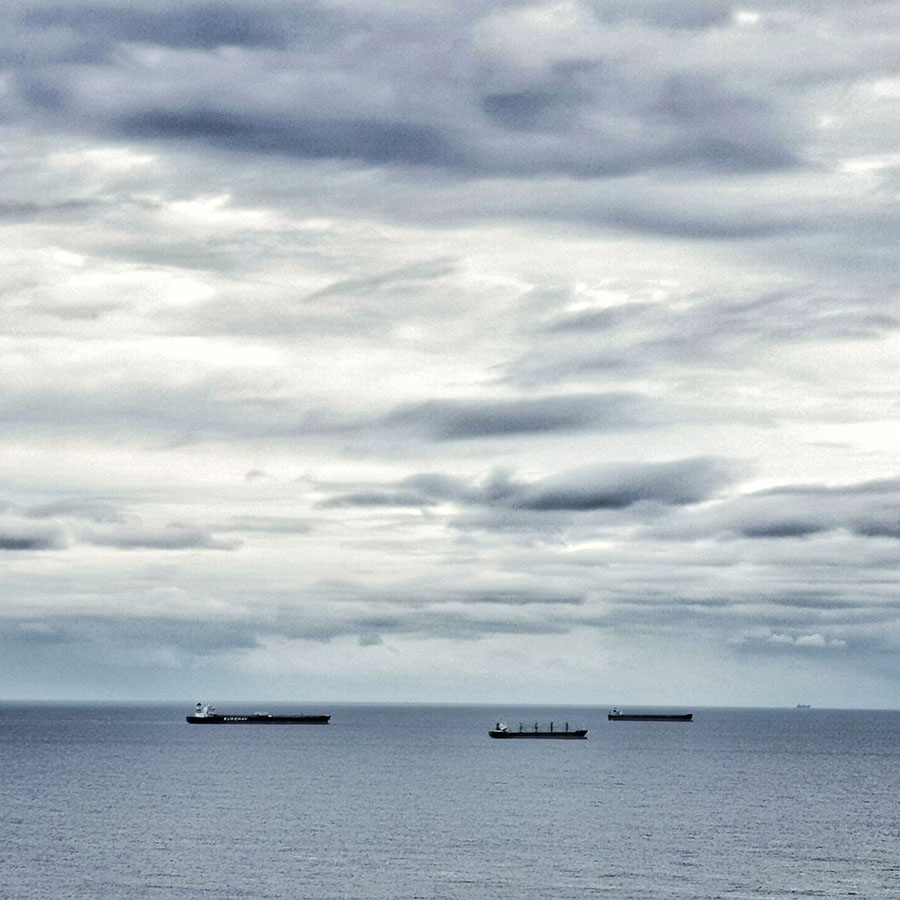
This is an extract from a 1874 poem that left us with the figure of speech “like ships that pass in the night”. On any normal day, when you look out of our bedroom window, you’ll find an average of four ships within our line of sight. Tonight there are 18. They sit there like ghosts of a struggling economy, already long gone. In the stillness of the morning, you can hear the drone of some of their engines as they leave a streak of polluted air across the horizon. At night their lights blink at us – beacons from a world beyond our lockdown.

But there are entire worlds unfolding inside our private lockdowns. This week I have read a letter from a person wanting to leave their spouse; a letter from a spouse that has already had the courage to leave; a letter confronting an abuser in the past; a letter to celebrate a new found comfort in sexuality and excitement for the future; a letter about unrequited love and the fear of loneliness; a letter about despondence with a partner’s lockdown drinking; a letter from a past client, savouring life, despite lockdown…to name just a few.

If there is something you have been neglecting: a feeling; a conversation; a bad habit; a chapter in your past; a role you reluctantly play in the lives of those you love; or a hope for your future – it is likely to make itself known during this period. There is only so much alcohol left in your cupboard or laps you can do around the garden. My concern is for how shutting these things down inevitably shuts us out from those around us. This gives rise to a whole different kind of isolation. We so easily become those “ships in the night” to one another. Individual vessels that give nothing but a “look and a voice” towards one another.
It’s become common place to talk a bit about the reality of covid19 at the start of every session. Fifteen minutes into a very valuable discussion on the state of things, a client apologises for wanting to turn to matters “on my doorstep”. I reassured her that it is these matters “on our doorsteps” that are more important than ever. I think we had the fantasy that as the world went into crisis, these “doorstep” issues would easily be swept under a mat of comparative irrelevance. It seems quite the opposite – they have become more relevant than ever.

Still(a)Life #23: Learning through Curiosity

If we listen closely enough, there are perhaps voices arising out of the uncharacteristically silent lockdown days, telling us things. This morning it was Josh playing chopsticks on an out of tune piano. When I stopped to listen, I realised he was starting to improvise. His usual busy self bursting into spontaneous melody. I found myself relieved that he has not had too much formal musical training yet. Something in him is developing through this free play. As Vygotsky wrote “In play, a child is always above his average age, above his daily behaviour; in play, it is as though he were a head taller than himself.” I found myself angry with how my child’s education has so often left him feeling smaller than himself, diminished, behind.

The silence is confirming for me that we need to rethink education, more so now than ever. I was trying to force Joshua to do his schoolwork and Fiona interjected, “let’s not call it that anymore, let’s call it learning”. We’ve made a new rule: if we can’t call it “learning” it has no place in our home. Learning is not about grades; worksheets; completing tasks; the successful regurgitation of facts. Learning is a process of making something part of who you are; the chance to enact something; demonstrate it upon the world. Learning is development that is born out of relationships with others and not an acquisition of knowledge through repetition. Learning is something you become not something you simply have to do. Think of how we learn a language or a musical skill. True learning doesn’t necessarily happen in a classroom or a place, it happens through play, enactment, often through struggle but not in the absence of passion and imagination.

Personally, I’m done with education. And if you have been trying to help your children learn from home, I bet that by now you are too? There is no child who is not, at first, curious about the world they are born into. We have an ownership to them to open every window we can to that world. A brand new world awaits them.

Still(a)Life#21: Hidden Layers Crack through the Surface

All of experience is a layered occasion. At any given moment, there is more to each experience than that which lies on the surface. Conscious and unconscious. Apparent and hidden. Suppressed versus expressed. For the most part, we present to the world an outer layer. A shell hardened by time, social norms and experience. It’s a shell designed to safely keep hidden the more vulnerable aspects of ourselves. The unborn parts we have not yet had the courage to enact and the missing parts we have not been able to find a place for. The thing is, we struggle to admit to ourselves what it is that we really want or to face the things we find too uncomfortable. We stick to the surface of things.

Lockdown slowly compresses these layers, they collapse in on each other and the things we have been hiding away or hiding from, crack through the surface. The husband chooses to sleep in his office. The wife struggles to hide her difficulty with food. The child refuses to go back to his mother’s house. The lover decides she is no longer settling for less.

My phone has started to vibrate in the night. The rumble of people’s layers stirring to the surface. Our initial tendency is to quickly find a place for these thoughts and feelings. Make sense of them. Move on. Put everything back together. This is not the time for getting “back to normal”. Not everything has a neat place.

The world outside our windows is changing as you read this. And, if you want to find out where you are in that world, it starts with a journey inward. Embracing the change does not start with holding on but with letting go.

“The only way to find out where I was was to get out of the way and let myself happen.”
― Mark Epstein, Going to Pieces Without Falling Apart: A Buddhist Perspective on Wholeness

Still(a)Life#20: In This Together

When Veronica saw the bags of food piled at the kitchen door she shrieked “Thank you, thank you” at Fiona, “if it wasn’t for Corona, I would hug you”.

“We can hug” Fiona replied, “we’re all in this together”.

Veronica squeezed her as tight and long as she could. The food was for the community down the road but, despite being a Zimbabwean with her own family struggling far off out of her own reach, it was as if we were feeding her own children.

There are many forms of isolation but surely hunger is the worst? It’s so ghastly, we tend to look the other way. Today I am struggling to find words. I think I’ve used up my daily quota. So I’m lending some from Arundhati Roy:

“The only dream worth having is to dream that you will live while you are alive, and die only when you are dead. To love, to be loved. To never forget your own insignificance. To never get used to the unspeakable violence and vulgar disparity of the life around you. To seek joy in the saddest places. To pursue beauty to its lair. To never simplify what is complicated or complicate what is simple. To respect strength, never power. Above all to watch. To try and understand. To never look away. And never, never to forget.”

Still(a)Life #19: Effort to Contain Anxiety

This is what the fear of Corona has done to our morning coffee; cluttered it with vitamin C and other potentially placebo prophylactics. The difference between fear and anxiety is that fear is for something that tangibly exists in the world. Fear is designed to help us avoid the object of our fear. Fear is rooted in something real and is designed for our own survival through encouraging us to do something about it, even if this “something” is simple avoidance. Anxiety, on the other hand, is for something less tangible. Anxiety is fear dislodged from any specific object, “free floating” (as psychology puts it) in the background of our minds. It is not so easy to do “something” about anxiety. We are born into the world with an inkling of it. As it increasingly frees itself from its original moorings, it slips away from our efforts to contain it.

It is a good time to try and recognise the difference between fear and anxiety. It’s a good idea to fear #covid19 and behave accordingly. The anxiety that it feeds, however, is not going to be all that helpful. Anxiety will leave us in denial, restlessness, panic or disorganisation. The most we can do with anxiety is to just let it be. Treat it with somewhat indifference. Or bring it back to its original object – fear of death, loss and loneliness. Or, the very incomprehensibility of the fact that we exist at all and why.

This is especially important for us at this stage of our efforts here in South Africa. We are only at the onset of our battle with the corona virus. For those of us who are privileged enough to have a fridge full of food and a roof over our heads; lockdown is a temporary breather before the real change comes and our real efforts begin. So, I have been encouraging my clients to pace themselves. To save their energy for what is to come. Anxiety is wasteful of our resources. “Worrying is carrying tomorrow’s load with today’s strength- carrying two days at once. It is moving into tomorrow ahead of time. Worrying doesn’t empty tomorrow of its sorrow; it empties today of its strength.”
― Corrie Ten Boomanxiety

Still Life #15: Shared Experience

Online consults are not new to me. 7 years ago I moved my practice to Durban and many of my Johannesburg clients have stayed in contact in this way. But there’s something different about these consultations at the moment. Usually there is a level of removal between your client’s experience and your own. Suddenly, there’s a sense of a more deeply shared experience.

My anxieties are their anxieties. And yet, it’s remarkable how, at the same time, our idiosyncratic struggles are more relevant than ever. Problematic relationships with food or alcohol are suddenly more apparent than ever. Frustrations in a marriage won’t go unheard by the second week. Or, our usual anxieties seem to have suddenly taken up all the room in our heads or our beds.

I find myself wondering how doctors feel – treating something that they are equally at risk of contracting. I wonder what they do with that vulnerability. Does a hazmat help? Despite all the room we are privileged enough to have, I’ve been camping out on our bedroom balcony. My own hazmat hut, out from which I peer into people’s living realities through a screen.

When I’m not talking, I’m reading, obsessively. Trying to forge some sort of safety out of epidemiological predictions. “Modelling” is what they call it – using science to make guesses.

But I’m not taking my own advice. I’m not embracing what it means to be alive, in this moment. I’m trading the here and now for an imagined future.

I’ve promised not to read anything this weekend. Cold turkey!

Still Life #12: The Naked Truth

Brene Brown proposes that “Vulnerability is the birthplace of innovation, creativity and change”. I would add to this that the courage to “be with what is”, is a necessary precursor to vulnerability. In order to be vulnerable, we need to strip ourselves down to the bare truth of things.

This is difficult at the moment, given the layers of anxiety we might be trying to avoid. We are likely to sooth ourselves on a count down. 9 more days. But, even if we come out of lockdown (for economic reasons) it would be unwise to go back to business as usual.

To be vulnerable means to appreciate that our lives will be different for the next 18months (at least). To be vulnerable means to be willing to change our lives forever. If to be vulnerable means innovation, creativity and change; then to be vulnerable requires us to reflect on how we live. The tighter we hold on to how things have been, the more anxious we will continue to be. The less innovative we will become.

To be vulnerable requires an openness to re-evaluating how we school our children; earn our money; grow our food; treat our elderly; care for the sick.

To be vulnerable means I no longer see the homeless, the poor, the old, the foreign as living in a separate world to me.

To be vulnerable is to have the courage to see things as they are.

Still Life #8: United in Fear

Corona virus has become the great revealer of what we are, merely human. It is the great leveller. It knows no boundaries. Borders, class, religions, education’s or any other means will not keep it at bay. It unites us through our shared fears.

I didn’t join Fi on the apocalyptic shopping spree. I didn’t want to face the hauntingly empty streets. Buddhists talk about Dukkha “that which is hard to face”. I spend my days focusing on other people’s fears so I don’t have to deal with my own. But, this time, it’s hard to hide my own fallibility. It’s impossible to deny that we’re all in this together. There are no experts. I only have a few guesses. We will lockdown longer than we would like. But, we will rely on one another for the answers. Death teaches us things about ourselves. We’re looking at it in the face.

Still Life #7: Between Care and Incarceration

As the crow flies, our house is not far from the international airport. You could often hear the reverse thrusts of the Boeing’s as they landed in the distance. The sounds of the day don’t carry the same familiarity.

A chopper is in the habit of crossing the blank canvas above the house. The beat of its blades feels more like a panic than a reassurance. More people have been arrested than the number of confirmed covid19 cases. The virus isn’t only a threat to vulnerable lungs, it will reopen the wounds of a vulnerable society. The line between care and incarceration is far too thin.

Where have all the sex workers gone? How many women have been beaten in their homes?

Why does the guard in our street not know about washing his hands?

I close my eyes as I hear the chopper blade its way through the sky. I take a few breaths; I listen to my hurried heartbeat. It tells me it’s time to be concerned.

© 2026 Jason Ross

Theme by Anders NorenUp ↑