
PhD Philosophy & Psychoanalysis

Tag: Avgi Saketopoulou

The kink of therapy and the therapy of Kink: A critical reflection on methodology.

A brief essay presented at the South African Sexual Health Association 2026 Conference: Into the Fray.

Scroll through your Instagram feed and you will soon find something or someone telling you what is supposedly good for you. Just follow these 7 steps, those 10 exercises, and sprinkle them with some collagen, and you will find your way to everlasting health and happiness.
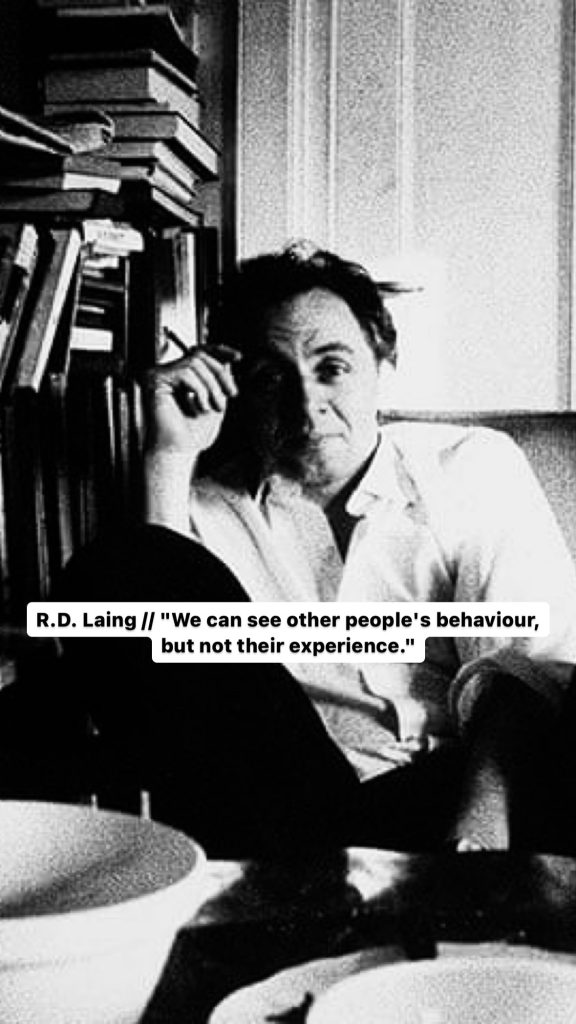
What if the goal in life was not happiness? What if life’s goal for you, despite all your efforts, is entropy? What if, as Freud and Breuer (1895/1955) proposed, the most we could hope to gain from any therapeutic experience was to transform hysterical misery into common unhappiness? Nevertheless, the psy-industry — psychology, psychiatry and psychoanalysis — has become the modern priesthood, preaching to us what it is to be supposedly normal, virtuous and healthy. Alternatively, analysts like R.D. Laing (1967) proposed that it is truly mad to be normal. That to be supposedly normal is to be alienated from what it means to be alive.

As you enter the gym, a sign catches you halfway up the staircase, advising you to hold the railing.


On your way back down, you get rewarded with a free protein smoothie for dutifully attending three times this week.

Your healthcare insurance’s way of reducing you as a liability. Somewhere between the handrail, intermittent glances at your phone, and the reward of the smoothie — a great deal has been proposed about how you should live, what your body is for, and what counts as taking care of it. Taking care of yourself has come to mean watching yourself in wall-to-wall mirrors as you raise kettlebells in an ode to Sisyphus.

Foucault (1988) would not have been surprised. He argued that modern power does not operate primarily through force and prohibition. It does not only say “no you cannot” — it says, “this is in your best interest”, “this is what it means to be normal.” Medicine, education, psychology, psychiatry and psychoanalysis are all, in his view, technologies of normalisation — disciplines that produce the very subjects they claim merely to describe, serve and treat. Foucault found it frankly absurd that one person would pay another to tell them how to live — not because the exchange was entirely meaningless but because it did not admit to the power relations it enacts.

What concerned Foucault most was not so much overt politics but something more insidious — the way power becomes most effective when it is most invisible, when we internalise its prescriptions as self-care. As you watch a genocide unfolding live on Instagram, fascism quietly and increasingly administrates your life through gym memberships, therapeutic frameworks, data collection and diagnostic categories — regulating your deviation from the norm, including how you experience your body and express your sexuality.

Image from VOX – Getty Images: GAZA

A couple of decades ago, I wrote a thesis on “How concerns about erections are treated and constructed through language on a Sexual Health Helpline.” This was the SASHA helpline. A handheld phone, on an empty desk at the back of an abortion clinic, attached to the home of the great late Elna McIntosh. Viagra was making its way into the South African market, and Pfizer needed an organisation to address the controversies that emerged from making millions by guaranteeing hard penises. It wasn’t long before new premises were needed to house a mini call centre. There were rumours that aged men were now dying from having sex — callers were advised not to take PDE5 inhibitors while taking nitrates — but the real controversy was that the introduction of Viagra had initiated public discussion about sex. Suddenly people could admit to not only wanting erections but to having all and any desires. It wasn’t only aged men calling in. It was the mistress trying to convince her lover to take the pill so she could get more mileage out of him. The wife complaining that her husband was taking the tablet and she wasn’t really interested anymore.

What the research indicated was that, under the influence of a pharmaceutical industry agenda, people’s concerns about sex became increasingly medicalised. Failure to maintain an erection was proposed as “the canary in the coal mine” for underlying health problems. This orientation eliminated all other possibilities about what a limp penis in a patriarchal society might mean. Both caller and helpline facilitator could quickly do away with the discomfort of exploring the mysteries of our passions by talking about a blue pill that might solve everything. The meaning of a hard penis went unaddressed.

An elderly man complains that the pill is no good. “Why?” asks the helpline facilitator. He took it and an hour later nothing had happened. “What were you doing after you took it?” “Mowing the lawn,” he replies. [image 9] Now, unless you have a particular fetish for the greasy back end of a grass cutter, it is unlikely that a PDE5 inhibitor is going to enhance your experience of cutting grass in any way. In this scene, the penis is treated like a mechanical device, a tool in need of repair, to be used on his poor unsuspecting post-menopausal wife. When he finishes his garden duty, she will have to finish hers. No talk of whether she even likes it or wants it. Consent was, unfortunately, not yet in vogue back then.

The gradual medicalisation and therapisation of everyday life contribute to the surreptitious rise of fascism. Everyday life is recategorised into too much of this or too little of that. Experiences rich with intrigue and mystery are professionalised: ayahuasca is stolen from the shaman; mindfulness is taken from the mountain; cold plunges become method rather than early morning madness; breath becomes work; and ketamine is reserved for clinical drips at exorbitant prices rather than complete immersion between lovers groping into the abyss of one another.

What, then, is the relationship between the world of kink and therapy? Are we not at risk of reducing the enigmatic, dark, and expressive world of kink into something purely for our own good? Take, for example, our current preoccupation with consent — not in its obvious and urgent attempt to prevent violation of any kind, but in the idea that we can pre-decide what an experience will be and mean to us. In an attempt to have safe experiences, there has been a growing fixation on the administration of experience. Everything must be agreed upon in advance. Limits must be declared. Surprises must be minimised. The encounter must be concluded before it begins.

The psychoanalyst Avgi Saketopoulou is suspicious of this fixation — not because consent is unimportant but because it rests on a fantasy: that we can know in advance what we are willing to experience, what we can bear, and where our limits lie. Genuine experience does not take this shape. We do not always know what we desire until we encounter it. We cannot predict what will emerge in contact between two or more people. Following Foucault (1988) and Bataille (1957/1986), Saketopoulou (2023) proposes that it is precisely at our limits — at the point where the ego’s capacity to manage and translate experience breaks down — that anything genuinely new becomes possible. To pre-negotiate the limit is to ensure you never reach it.

Avgi Saketopoulou

In Sexuality Beyond Consent, Saketopoulou (2023) proposes that there is an inherent bending of the client’s will through the process of therapy. For example, if you arrive in therapy declaring that you want to speak about your current sexual difficulty but that you don’t want to talk about how your own father molested you, the therapist is most likely to respect this — but in the hope that, over time, you will feel safe enough to go there. Even if both held strictly to that agreement, a sincere therapeutic encounter will take both parties somewhere neither anticipated. In both therapy and kink, there is value in taking the experience to a certain limit, where the usual moorings of the self are loosened — a dissolution of the ego rather than consolidation of it.

A man leans toward a woman and asks how she is feeling. A private conversation made deliberately public. She nods, smiling nervously. He turns to the audience and says he has an idea in mind but is not quite sure how it will play out. There is no checklist of hard limits — they have done this many times before. As he positions her, she notices herself in a mirror across the room. She whispers in his ear. He nods, smiling for the first time, and moves the mirror out of sight. [Image: Naka Akira at Toubaku, Tokyo, Japan]

He binds her, ceremoniously, into a Takate Kote. Raises her to her feet, forms a tight rope between two pillars that runs between her legs. A silk scarf covers her eyes. Then she hears it — the crash of Lego pieces forming a carpet at her feet. She giggles at the familiar sound. The room laughs with her. He tugs the rope. An invitation rather than a command. She inches forward across the Lego — each step a small confession, a surrender, an offering, a devotion.

Eventually he pins her against the pillar, a Hashira — suspended, exposed, arms behind her back. He fetches the mirror. Places it directly opposite her. Removes the scarf. She blinks. Smiles. Laughs uncomfortably. Frowns. Looks away. He takes her jaw firmly in his hand and slowly returns her gaze to herself in the mirror. She now sees what we see. Her beautiful agony. She comes undone. The room laps her up as she seems to spill into it. [image by Andy Buru]

There is a lingering impact to this scene that resists easy explanation. As Alphonso Lingis puts it, “Observing an event, however unusual, is not having an experience” (Lingis, 2016, p. 7). Having an experience is to undergo a passion: wonder, rage, terror, jealousy, grief, lust, shame, guilt, awe, erotic pleasure — even love. What came over those present that they were no longer observers but having an experience? The self devoted to order and productivity, the prudent and calculating self that seeks to manage its feelings, the distinct self with its habitual identity — receded.

Alphonso Lingis

It is not easy or perhaps even necessary for the performers in this scene to put their experience into words. The compulsion to explain and translate is itself part of what the scene resists. We remain somewhat opaque to ourselves and to each other. No one can experience your experience, and you cannot experience theirs. We can only experience each other experiencing. The encounters that matter most — in kink, as in therapy — are the ones that do not attempt to resolve that opacity but venture towards it. Lingis (2016) warns against a psychology that encourages us to distance ourselves from the passions. Through the inevitable overwhelm of the everyday habitual self, something else emerges — something less fixed and more relational, even if just for a moment. Perhaps we could call it a kind of madness. Nevertheless, it gives way to a different kind of knowing — a collapse of conventional knowing and a relinquishment to the absurd.

The word therapy comes from the Greek — to be with, to attend to.

Not to cure.

Therapy, at its most honest, is simply this: to be with, in curious and courageous enough ways that allow something new to emerge in the space where the self, briefly, loosens its moorings on ideas of what, who, and how we ought to be.


References

Bataille, G. (1986). Erotism: Death and sensuality (M. Dalwood, Trans.). City Lights Books. (Original work published 1957)

Breuer, J., & Freud, S. (1955). Studies on hysteria. In J. Strachey (Ed. & Trans.), The standard edition of the complete psychological works of Sigmund Freud (Vol. 2). Hogarth Press. (Original work published 1895)

Foucault, M. (1988). Technologies of the self. In L. H. Martin, H. Gutman, & P. H. Hutton (Eds.), Technologies of the self: A seminar with Michel Foucault (pp. 16–49). University of Massachusetts Press.

Laing, R. D. (1967). The politics of experience and the bird of paradise. Penguin.

Lingis, A. (2016). Aconcagua. In R. Wheeler (Ed.), Passion in philosophy: Essays in honor of Alphonso Lingis (p. 7). Bloomsbury.

Saketopoulou, A. (2023). Sexuality beyond consent: Risk, race, traumatophilia. NYU Press.

Beyond Consent

Therapy as kink and kink as therapy

I don’t feel that it is necessary to know exactly what I am. The main interest in life and work is to become someone else that you were not in the beginning. If you knew when you began a book what you would say at the end, do you think that you would have the courage to write it? What is true for writing and for a love relationship is true also for life. The game is worthwhile insofar as we don’t know what will be the end.

Foucault (1988, p. 9), “Truth, Power, Self,” interview with Rux Martin, in Martin et al. (Eds.), Technologies of the Self

NOBUYOSHI ARAKI, SEKF PORTRIT, 1994

Introduction

Despite having worked within psychiatric institutions and trained in psychology, Michel Foucault thought it was entirely absurd that one person would pay another person to tell them how to live their lives.  For Foucault (1988), the self was not something to be excavated through confessions (to a priest, analyst or doctor) but to be crafted and exercised in resisting the ways we are made subjects through various forms of power.  Medicine, education, psychology, psychiatry and even psychoanalysis were included in such forms of power.  All play a role in shaping how we define and experience ourselves, especially when it comes to prescriptions for what it means to be supposedly normal.   When it comes to psychiatry, for example, certain experiences are defined as illness conditions such as “bi-polar”.  This is not treated as a metaphor for the patient’s experience, but a claim regarding an inherent truth about them that supposedly defines them as the problem.  A person’s pattern of emotional upheaval is defined as a condition that they suffer from rather than a response to particular life conditions they are struggling against.     He or she does X or Y because they are “bi-polar”.  The critical stance towards the psy-industry that began to emerge out of philosophy lead some practitioners, such as the psychiatrist R.D. Laing, to break away from the conventional ways of treating people in severe forms of distress.  R.D. Laing made the conclusion that we were entitled to the benefit of our own symptoms, leading to much more radical definitions of what was “therapeutic”. 

Although Foucault helped pave the way for a critical stance towards these disciplines, he did not offer much of an alternative methodology for avoiding this play of power.  He did not really foresee us ever escaping power relations.  We can, however, utilise Foucault’s ideas of “self-crafting” in ways that might resist these powers.  Foucault would likely have approved of “kink” practices as a form of constituting and transforming a self in ways that resist the pressure to develop fixed and normative identities.  After all, Foucault was known to frequent bathhouses and leather bars in San Francisco’s Folsom Street district and acquaintances from that period described him as enthusiastic about sadomasochistic practices. James Miller’s biography The Passion of Michel Foucault (1993) deals with this at length, arguing that Foucault saw “limit-experiences”, including intense erotic ones, as philosophically significant.  His idea of “limit-experiences”, drawn partly from Bataille and Blanchot, are experiences that push the self to its edges – allowing it to be potentially dissolved or transformed by these experiences. 

The contemporary psychoanalyst Avgi Saketopoulou (2023) – drawing on Bataille, Sade, and the psychoanalytic theory of Laplanche – develops Foucault’s idea of limit-experience through her concept of “limit consent”: a willingness to enter into an experience that risks the self rather than preserves the self.  Although there are many differences between Saketopoulou’s psychoanalysis and Foucault’s notion of how a self is produced, both thinkers resist the idea that we should preserve the self.  Such preservation is to give into the prohibitive forces of power rather than harness the productive use of power and desire. 

My work with negative psychoanalyst, Julie Reshe (2023), encourages me to further radicalise Saketopoulou’s work.  Where Saketopoulou asks what becomes possible when the ego is overwhelmed, Reshe resists the implicit promise of transformation. There is no cure, only the quality of presence we bring to inevitable suffering. To enter an experience that risks the self is not a path toward a better self but a felt acknowledgement that the self was never as solid in the first place.  For Reshe, the limit experience is “love” – not claiming to know another but a willingness to die into them — relinquishing the boundary between self and other as the only authentic form of accompaniment.

My argument is that there is a necessary “kink” to what we deem as “therapeutic”. But, what exactly does it mean to have a “kink”?  To be bent? To go beyond the norm?  The truly therapeutic event resists the norm.  As R.D. Laing argues in The Politics of Experience and the Bird of Paradise (1967), to be supposedly normal is to be “alienated”, to be asleep, to shy away from consciousness and the nature of one’s own mind.  Kink is not always just some unusual sexual practice but a particular ethic – an openness to how we relate to ourselves, our bodies, our sexualities and each other.  A truly kinky practice is, ideally, an honest and ethical space:  A space for one to more openly explore and perform a self.  It appears that, when it’s permissible to be sexually explicit, other aspects of our personhood are brought into focus.  The practice of kink is ultimately a space where the usually denied aspects of relationships, such as our inherent sadomasochist tendencies, can be more outwardly performed.  In this way, it is the ideal stage for something more honest to happen between two or more people.  Kink invites the courage for more honest discovery of our “true” desires.  It is a practice of ethics because ethics, in the end, is simply the willingness to keep each other in mind and to act accordingly.  Through a preoccupation with consent, however, the new liberal kink community has increasingly come to mistake ethics for an affinity for rules.  In an understandable attempt to create safety, there has been a fixation on how everything about sex can be pre-decided and pre-negotiated.  But rules make perfect hiding places for the lies we tell ourselves about ourselves, alienating us further and further from what we are.    

Rules as hiding places for our true desires

Beverly:  	After I came home last week, he sent me a message to check in if I was okay with him breaking the rules the other evening.  
Therapist: What rules?
Beverly: Given that I probably don’t want children and that his parents will no doubt want him to marry a devout Hindu girl, we decided to put some rules in place that would help make it safe for us to continue with our arrangement.
Therapist: Can you share an example?
Beverly: No communication unless to arrange our hookups. No displays of affection. No shared meals together. No sleeping over. You know…nothing relationship-like.
Therapist: And which rules did he break?
Beverly: All of them?
Therapist: Where does this leave you?
Beverly: I think I was okay…
[long pause]
Beverly: Until he sent the message.
Therapist: What did the message say?
Beverly: That he wanted to know if I was okay after the lines got blurry again. He said he really enjoys his time with me but that he wanted to make sure that he is not hurting me….
[long pause]
Beverly: The night we were together, he said, “I miss you”. We made a meal together. He stayed over.
Therapist: Does that hurt you? Are you hurt by it?
Beverly: No, I don’t think so. I am sad about what could have been, but I don’t want to give up what we have.
[Another pause. She laughs as if I am trying to squeeze something from her through the silence.]
Beverly: It’s not just the sex, it’s the person. I enjoy being around him.
Therapist: So if it wasn’t for the issue of children and marriage, there would be no need for the rules?
Beverly: I don’t think so. Don’t get me wrong, sex in a dungeon is great, but I could really enjoy time with him in the everyday world.
Therapist: Can I be honest with you?
Beverly: Yes, of course.
Therapist: I think it is surprisingly patriarchal of him to propose that his chief concern is for you getting hurt. Surely that is for you to decide? It seems to me, rather than a demonstration of responsibility for breaking the rules, it is a way for him to absolve himself of when you do possibly get hurt. His guilt is not your responsibility, nor is a display of his guilt to be mistaken with taking responsibility.
[Beverly laughs nervously]
Therapist: Forgive me, it is against my training to give such strong personal opinions. But perhaps we have known each other for long enough by now for me to give an opinion?
Beverly: No, no, please go ahead. This is much more fun.
Therapist: Rules are hiding places for the lies we tell ourselves and others.
[Beverly repeats therapist’s sentence slowly back to herself].
Therapist: It is perhaps rather a question of how you hold each
other in mind rather than whether you are sticking to the rules. When he says, “I miss you”, what does he mean by it? Who is the “I” and who is the “you” he is referring to? What did he hope, in that moment, of uttering “I miss you” to convey?

There are many dangers to this kind of conversation with a client.  Psychoanalysis cautions the analyst from offering too much of themselves in the interaction.  The client may, for example, start to feel that they need to please the therapist or, on the other hand, may feel oppressed by the therapist’s views.  The therapist can easily become just another parental figure that the client fears disappointing.  In short, the therapist above risks entering into a theatre of projection and counter-projection.  On the other hand, when the therapist gives nothing of themselves, the relationship becomes overly contrived.  What is most important is that the conversation remains mostly about the client without losing its honesty.   Kink can teach us something about how to say what we mean and mean what we say.  As a place where you intend to take things beyond their usual limit, it is important to be clear about your intentions.  However, when everything is pre-negotiated and pre-decided, it can lose an essential edge.  In Sexuality Beyond Consent, Avgi Saketopoulou (2023) proposes that it is only at this edge, where the ego is overwhelmed, that any true shift can happen in a person. 
 

Beyond Consent

He leans towards her and asks how she is feeling.  A private conversation made deliberately public.  She just nods at first, smiling back at him, genuinely nervous.  The room laughs with her as she grins at the dimly lit audience. Kneeling even closer beside her, he turns to the room and describes how he has an idea in mind, but that he is not quite sure how it will play out.  He explains, demonstrating with hands softly resting on each of her shoulders, how he tries to get a feel for how she is doing and what she is needing.  He looks over at her and she gives that same nervous smile.  There is no usual check in regarding “hard limits” and particular likes or dislikes – they have done this many times before.  As he sets her up in Seiza, she notices that she can see herself in a free-standing mirror across the room.  She leans over and whispers in his ear.  He nods, smiling for the first time.  Rising, he moves the mirror to the back of the room, out of sight.  His movements are slow and deliberate.    
Kneeling behind her, he begins a ceremonious Takate Kote, binding her forearms together behind her back, causing her shoulders to pin backwards, exposing her chest for it to receive sensual attention as the strands of jute rope slowly slide against her skin and weave a munenawa around her already half-exposed breasts. Entrapped in this way, it is easy for him to raise her slender frame to its feet. He forms a tight rope between two Hashiras, a couple of metres apart. The rope runs between her legs, bringing her to her toes as the slight weight of her torso tightens the pressure of the rope against her still hidden crotch. A silk scarf masks her sight, but she can hear the crash of Lego pieces forming a carpet at her feet. She giggles at the familiar sound. The room laughs with her. Her toes twitch nervously, keeping her balanced between the pleasure and the tension. He steps away as a sculptor would, momentarily examining his work.
He tugs at the rope that crosses between her breasts. More of an invitation than a command. Her toes find the edges of the first few pieces. She inches forward, slowly, precariously. Low light reveals smooth muscles twitching and tensing as she makes the painstaking traverse. He has made neat knots along the rope, ostinati that offer a brief note of pleasure against the pain. Her cheeks flushed, she sucks on her breath as if through a straw. His own movements are comparatively subtle; the room hardly notices his heavier feet gliding over the white Lego pieces effortlessly. His face unreadable, his body offering no testimony to discomfort nor desire. He seems entranced in her and her every move. The audience has disappeared for him. She takes increasingly deep breaths; her body does not lie. Each step a small confession, a surrender, an offering, a devotion. The room holds its breath with her. By the time she nears the far pillar, she lets out a gasp. The rope between her legs is now at its tightest.
This signals him to finally release her from this tight rope as he lays her on the floor upon the scattered Lego. He begins to tie around a single limb. Any voyeur in the room familiar with Shibari might safely anticipate that he is about to relieve her current discomfort by suspending her into a new predicament. He works the ties slowly, each rope a remapping of her form. Surprisingly, she is not so much going up but going against the pillar, a Hashira tie. Eyes still covered in a silk scarf, the rest of her in a state of increasing undress. Suspended off the floor, back pinned to the pillar, arms behind her back, feet curled behind her flanking the pillar: she has become particularly exposed to his forgotten audience. She seems to be able to relax somewhat into this kind of familiar yet extreme discomfort.
Looking up at the audience for the first time in a while, he smiles as if colluding with the audience, he leaves her there for a moment to return with the mirror. This time, he places it against the opposing pillar, even closer to her than before. For the first time his body gives way to his own anticipation. He moves hastily to remove the silk scarf. She blinks at the sudden unveiling. She smiles, laughs, then frowns at herself - suddenly looks away. He grabs her firmly by the jaw, distorting her cheeks and with slow and deliberate force returns her gaze back to herself in the mirror. She now sees what we see. Her beautiful agony. Breasts contorted by rope. One nipple exposed. Lines of rope pork her lean belly. Her inner thighs spatchcocked to the room. Rope slits her mons pubis. She is breathing heavily. Suspended somewhere between arousal and discomfort. A murmur moves through the room as we all share the same gaze. Then everything goes still. She perhaps gives in to being seen for the first time that evening. She perhaps allows herself to see herself in this state. Eyes dare to look up into the room, watching us, watching her, watching herself. The room has received her as she is.

No one should ever condone the intent to violate.  But what if there are breaches of initial fear and reticence that are not violations?  This is why both a night of kink or a moment of therapy are better off not left as a once-off event, but a gradual process of mutual trust and discovery.  More significantly, what if we only find freedom at our limits – at our unintegration – rather than the ego’s constant need for consolidation and consolation.  Deciding what is going to happen prior to the event, prior to contact with another, limits how something new can potentially emerge out of the encounter.  We do not know if we have an appetite for something until we have tasted it, and we may even find ourselves at initial odds with the things our appetite reveals.  Therapy, by necessity, goes beyond consent – if only it could admit to this.  When a client arrives in therapy and states that they want to speak about their failed relationship but not about their sexual abuse, the therapist may not pressure them to talk about the abuse at first, but it is likely that the therapist intends to go there at some point.  This introduces the question of the relationship between trust and violation.  On the boundary between the two lies a subtle art, a particular form of attention, an appetite for loving discovery.  For R.D. Laing, to love is a willingness to know (as cited in Feldmár, 2023).

The Therapeutic Event

A therapeutic event is one that undermines the ego rather than upholds it.  A therapeutic event is about holding a particular form of attention, one that is interested in what emerges with care but also with curiosity in what lies on the other side of being overwhelmed.  It is about going to pieces without entirely falling apart and then seeing what can be made of the pieces.   This requires that the therapist avoid sitting outside of experience, that the therapist allow themselves to be affected by the encounter.  Overly careful boundaries, rigid theoretical orientations, and detailed process notes are just places for therapists to hide themselves.  For an encounter to have value, we must relinquish ourselves to it.  We must be prepared to die into the encounter – as Julie Reshe might say. The therapist who remains entirely intact at the end of a session has not yet entered the room.  They have not been fully present to the exchange.  There is no cure to offer, only presence to inevitable struggle, and the quality of this presence depends on each party’s willingness to go to a place together. 

However, this is not an “anything goes” methodology but a subtle art of coming alongside another in their experience and nudging one another along.  If for R.D. Laing, to love is to know then my work with negative psychoanalyst, Julie Reshe, has helped me radicalise this into love as the willingness to die into the other.  What I make of this is that “the therapeutic moment” lies in our capacity to come undone.  Love, knowing, accepting and undoing are perhaps, after all, not that dissimilar.  Such undoing is only bearable in company, in communion, and this company is only authentic when it has the courage not to look away from our shared abyss.  From a Negative Psychoanalytic perspective, what is deemed therapeutic is not “cure” (as this is deemed implausible) but communion around our own inevitable sense of emptiness. 

Conclusion

Despite the inevitable pessimism of this approach, there is something to be gained in the freedom from one’s own defences. When we commune around our own inevitable sense of emptiness; when we acknowledge the absurdity of this life and the indifference of the universe; when we open ourselves up to inevitable suffering; and when we loosen our grip on who is me and what is mine — there is a momentary relinquishing to what it means to be alive, and a gap opens for something new to happen. This does not necessarily imply resolve, cure, or even improvement. No longer refusing to be what we are allows us to break with habitual and defensive ways of existing. We become less alienated. Less prey to the fiction of the supposedly normal.

What Foucault, Laing, Saketopoulou and Reshe share is a refusal — to treat the human subject as a problem to be solved, a self to be corrected, a wound to be closed. For Foucault, there is no true self to be excavated through confession, only a self to be crafted in resistance. Laing insisted we are entitled to the benefit of our own symptoms and that the norms of society are themselves complicit in our suffering. Saketopoulou shows us that it is only at our limit — at the edge of what the ego can manage and translate — that genuine shift becomes possible. Reshe refuses even that promise. There is no cure. There is only the quality of presence we bring to inevitable struggle, and the willingness to die into the encounter rather than supervise it from a safe distance.

The kink of therapy, then, is not a technique. It cannot be taught the way a theoretical orientation is taught, certified, and supervised into compliance. It is closer to an ethic — the same ethic that governs the honest kink space — of keeping each other in mind, of saying what we mean and meaning what we say, of not hiding behind the rules we write to protect ourselves from what we actually desire and what we actually fear. There is no difference in vulnerability between the rigger and the rope bottom, or the therapist and the client. Both take the risk of venturing into the unknown. Communion around shared emptiness is not a failure of therapy. It is its most honest form.

She is suspended between the two pillars, taken far enough to eventually encounter herself in the mirror, at her limit. He holds her gaze there, firmly. The room receives her as she is. This is not cure. It is not resolution. It is something rarer and more necessary — the experience of being fully seen, in one’s beautiful agony, without the other looking away.

This is the kink of therapy and the therapy of kink.

References:

Feldmár, A. (2023). Credo: R. D. Laing and radical psychotherapy. Karnac Books.

Foucault, M. (1988). Technologies of the self. In L. H. Martin, H. Gutman, & P. H. Hutton (Eds.), Technologies of the self: A seminar with Michel Foucault (pp. 16–49). University of Massachusetts Press.

Laing, R. D. (1967). The politics of experience and the bird of paradise. Penguin.

Miller, J. (1993). The passion of Michel Foucault. Simon & Schuster.

Reshe, J. (2023). Negative psychoanalysis for the living dead: Philosophical pessimism and the death drive. Palgrave Macmillan.

Saketopoulou, A. (2023). Sexuality beyond consent: Risk, race, traumatophilia. NYU Press.

© 2026 Jason Ross

Theme by Anders Noren — Up ↑