
A brief essay presented at the South African Sexual Health Association 2026 Conference: Into the Fray.
Scroll through your Instagram feed and you will soon find something or someone telling you what is supposedly good for you. Just follow these 7 steps, those 10 exercises, and sprinkle them with some collagen, and you will find your way to everlasting health and happiness.
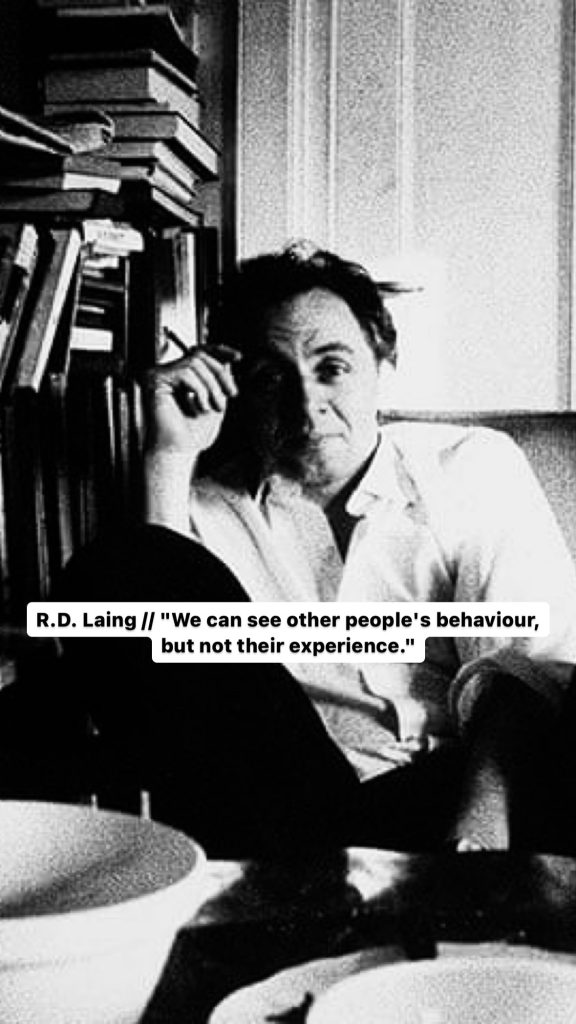
What if the goal in life was not happiness? What if life’s goal for you, despite all your efforts, is entropy? What if, as Freud and Breuer (1895/1955) proposed, the most we could hope to gain from any therapeutic experience was to transform hysterical misery into common unhappiness? Nevertheless, the psy-industry — psychology, psychiatry and psychoanalysis — has become the modern priesthood, preaching to us what it is to be supposedly normal, virtuous and healthy. Alternatively, analysts like R.D. Laing (1967) proposed that it is truly mad to be normal. That to be supposedly normal is to be alienated from what it means to be alive.
As you enter the gym, a sign catches you halfway up the staircase, advising you to hold the railing.


On your way back down, you get rewarded with a free protein smoothie for dutifully attending three times this week.
Your healthcare insurance’s way of reducing you as a liability. Somewhere between the handrail, intermittent glances at your phone, and the reward of the smoothie — a great deal has been proposed about how you should live, what your body is for, and what counts as taking care of it. Taking care of yourself has come to mean watching yourself in wall-to-wall mirrors as you raise kettlebells in an ode to Sisyphus.
Foucault (1988) would not have been surprised. He argued that modern power does not operate primarily through force and prohibition. It does not only say “no you cannot” — it says, “this is in your best interest”, “this is what it means to be normal.” Medicine, education, psychology, psychiatry and psychoanalysis are all, in his view, technologies of normalisation — disciplines that produce the very subjects they claim merely to describe, serve and treat. Foucault found it frankly absurd that one person would pay another to tell them how to live — not because the exchange was entirely meaningless but because it did not admit to the power relations it enacts.
What concerned Foucault most was not so much overt politics but something more insidious — the way power becomes most effective when it is most invisible, when we internalise its prescriptions as self-care. As you watch a genocide unfolding live on Instagram, fascism quietly and increasingly administrates your life through gym memberships, therapeutic frameworks, data collection and diagnostic categories — regulating your deviation from the norm, including how you experience your body and express your sexuality.

A couple of decades ago, I wrote a thesis on “How concerns about erections are treated and constructed through language on a Sexual Health Helpline.” This was the SASHA helpline. A handheld phone, on an empty desk at the back of an abortion clinic, attached to the home of the great late Elna McIntosh. Viagra was making its way into the South African market, and Pfizer needed an organisation to address the controversies that emerged from making millions by guaranteeing hard penises. It wasn’t long before new premises were needed to house a mini call centre. There were rumours that aged men were now dying from having sex — callers were advised not to take PDE5 inhibitors while taking nitrates — but the real controversy was that the introduction of Viagra had initiated public discussion about sex. Suddenly people could admit to not only wanting erections but to having all and any desires. It wasn’t only aged men calling in. It was the mistress trying to convince her lover to take the pill so she could get more mileage out of him. The wife complaining that her husband was taking the tablet and she wasn’t really interested anymore.
What the research indicated was that, under the influence of a pharmaceutical industry agenda, people’s concerns about sex became increasingly medicalised. Failure to maintain an erection was proposed as “the canary in the coal mine” for underlying health problems. This orientation eliminated all other possibilities about what a limp penis in a patriarchal society might mean. Both caller and helpline facilitator could quickly do away with the discomfort of exploring the mysteries of our passions by talking about a blue pill that might solve everything. The meaning of a hard penis went unaddressed.
An elderly man complains that the pill is no good. “Why?” asks the helpline facilitator. He took it and an hour later nothing had happened. “What were you doing after you took it?” “Mowing the lawn,” he replies. [image 9] Now, unless you have a particular fetish for the greasy back end of a grass cutter, it is unlikely that a PDE5 inhibitor is going to enhance your experience of cutting grass in any way. In this scene, the penis is treated like a mechanical device, a tool in need of repair, to be used on his poor unsuspecting post-menopausal wife. When he finishes his garden duty, she will have to finish hers. No talk of whether she even likes it or wants it. Consent was, unfortunately, not yet in vogue back then.
The gradual medicalisation and therapisation of everyday life contribute to the surreptitious rise of fascism. Everyday life is recategorised into too much of this or too little of that. Experiences rich with intrigue and mystery are professionalised: ayahuasca is stolen from the shaman; mindfulness is taken from the mountain; cold plunges become method rather than early morning madness; breath becomes work; and ketamine is reserved for clinical drips at exorbitant prices rather than complete immersion between lovers groping into the abyss of one another.
What, then, is the relationship between the world of kink and therapy? Are we not at risk of reducing the enigmatic, dark, and expressive world of kink into something purely for our own good? Take, for example, our current preoccupation with consent — not in its obvious and urgent attempt to prevent violation of any kind, but in the idea that we can pre-decide what an experience will be and mean to us. In an attempt to have safe experiences, there has been a growing fixation on the administration of experience. Everything must be agreed upon in advance. Limits must be declared. Surprises must be minimised. The encounter must be concluded before it begins.
The psychoanalyst Avgi Saketopoulou is suspicious of this fixation — not because consent is unimportant but because it rests on a fantasy: that we can know in advance what we are willing to experience, what we can bear, and where our limits lie. Genuine experience does not take this shape. We do not always know what we desire until we encounter it. We cannot predict what will emerge in contact between two or more people. Following Foucault (1988) and Bataille (1957/1986), Saketopoulou (2023) proposes that it is precisely at our limits — at the point where the ego’s capacity to manage and translate experience breaks down — that anything genuinely new becomes possible. To pre-negotiate the limit is to ensure you never reach it.

In Sexuality Beyond Consent, Saketopoulou (2023) proposes that there is an inherent bending of the client’s will through the process of therapy. For example, if you arrive in therapy declaring that you want to speak about your current sexual difficulty but that you don’t want to talk about how your own father molested you, the therapist is most likely to respect this — but in the hope that, over time, you will feel safe enough to go there. Even if both held strictly to that agreement, a sincere therapeutic encounter will take both parties somewhere neither anticipated. In both therapy and kink, there is value in taking the experience to a certain limit, where the usual moorings of the self are loosened — a dissolution of the ego rather than consolidation of it.
A man leans toward a woman and asks how she is feeling. A private conversation made deliberately public. She nods, smiling nervously. He turns to the audience and says he has an idea in mind but is not quite sure how it will play out. There is no checklist of hard limits — they have done this many times before. As he positions her, she notices herself in a mirror across the room. She whispers in his ear. He nods, smiling for the first time, and moves the mirror out of sight. [Image: Naka Akira at Toubaku, Tokyo, Japan]

He binds her, ceremoniously, into a Takate Kote. Raises her to her feet, forms a tight rope between two pillars that runs between her legs. A silk scarf covers her eyes. Then she hears it — the crash of Lego pieces forming a carpet at her feet. She giggles at the familiar sound. The room laughs with her. He tugs the rope. An invitation rather than a command. She inches forward across the Lego — each step a small confession, a surrender, an offering, a devotion.

Eventually he pins her against the pillar, a Hashira — suspended, exposed, arms behind her back. He fetches the mirror. Places it directly opposite her. Removes the scarf. She blinks. Smiles. Laughs uncomfortably. Frowns. Looks away. He takes her jaw firmly in his hand and slowly returns her gaze to herself in the mirror. She now sees what we see. Her beautiful agony. She comes undone. The room laps her up as she seems to spill into it. [image by Andy Buru]
There is a lingering impact to this scene that resists easy explanation. As Alphonso Lingis puts it, “Observing an event, however unusual, is not having an experience” (Lingis, 2016, p. 7). Having an experience is to undergo a passion: wonder, rage, terror, jealousy, grief, lust, shame, guilt, awe, erotic pleasure — even love. What came over those present that they were no longer observers but having an experience? The self devoted to order and productivity, the prudent and calculating self that seeks to manage its feelings, the distinct self with its habitual identity — receded.

It is not easy or perhaps even necessary for the performers in this scene to put their experience into words. The compulsion to explain and translate is itself part of what the scene resists. We remain somewhat opaque to ourselves and to each other. No one can experience your experience, and you cannot experience theirs. We can only experience each other experiencing. The encounters that matter most — in kink, as in therapy — are the ones that do not attempt to resolve that opacity but venture towards it. Lingis (2016) warns against a psychology that encourages us to distance ourselves from the passions. Through the inevitable overwhelm of the everyday habitual self, something else emerges — something less fixed and more relational, even if just for a moment. Perhaps we could call it a kind of madness. Nevertheless, it gives way to a different kind of knowing — a collapse of conventional knowing and a relinquishment to the absurd.
The word therapy comes from the Greek — to be with, to attend to.
Not to cure.
Therapy, at its most honest, is simply this: to be with, in curious and courageous enough ways that allow something new to emerge in the space where the self, briefly, loosens its moorings on ideas of what, who, and how we ought to be.
References
Bataille, G. (1986). Erotism: Death and sensuality (M. Dalwood, Trans.). City Lights Books. (Original work published 1957)
Breuer, J., & Freud, S. (1955). Studies on hysteria. In J. Strachey (Ed. & Trans.), The standard edition of the complete psychological works of Sigmund Freud (Vol. 2). Hogarth Press. (Original work published 1895)
Foucault, M. (1988). Technologies of the self. In L. H. Martin, H. Gutman, & P. H. Hutton (Eds.), Technologies of the self: A seminar with Michel Foucault (pp. 16–49). University of Massachusetts Press.
Laing, R. D. (1967). The politics of experience and the bird of paradise. Penguin.
Lingis, A. (2016). Aconcagua. In R. Wheeler (Ed.), Passion in philosophy: Essays in honor of Alphonso Lingis (p. 7). Bloomsbury.
Saketopoulou, A. (2023). Sexuality beyond consent: Risk, race, traumatophilia. NYU Press.


